
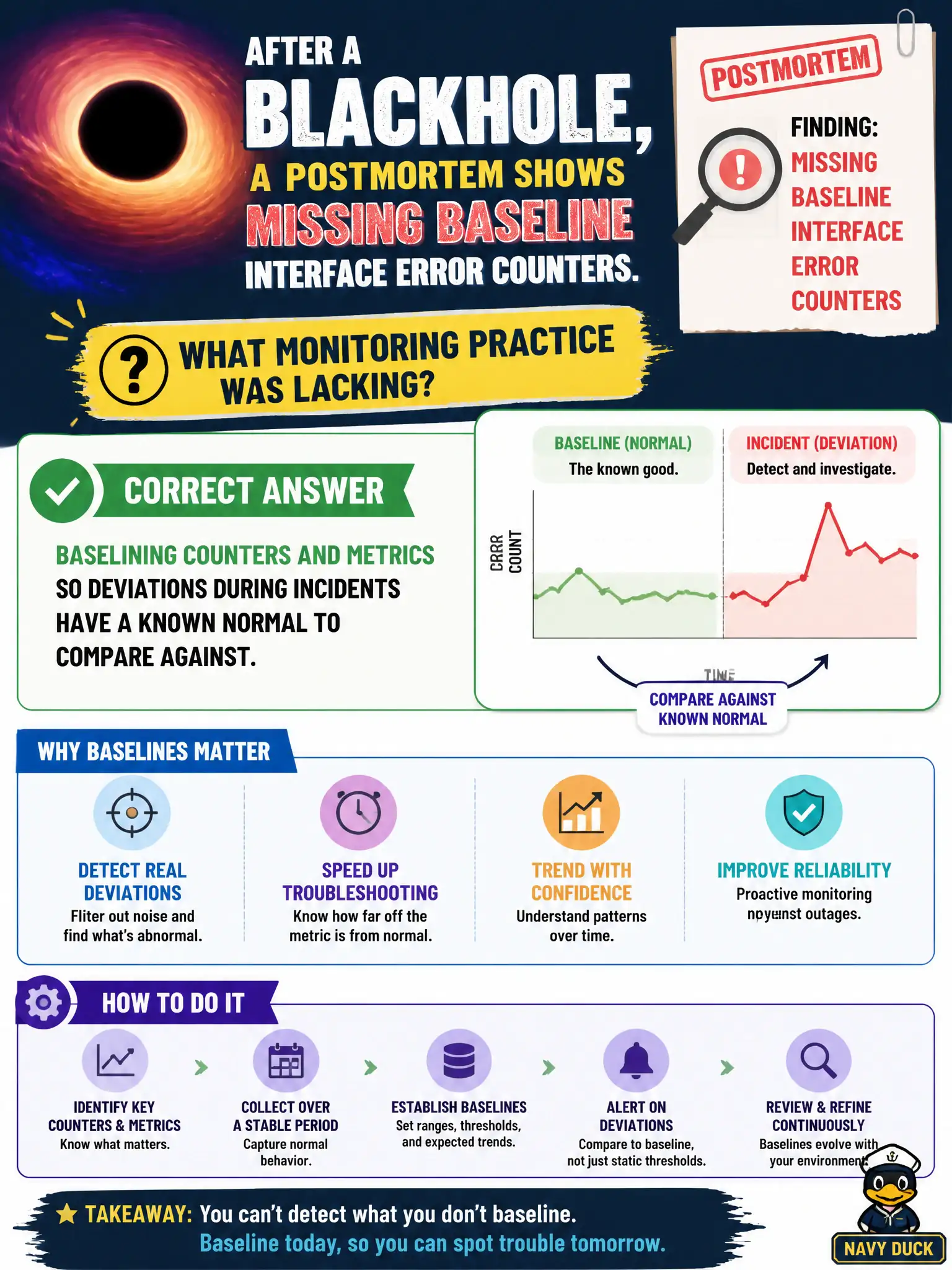
After a blackhole, a postmortem shows missing baseline interface error counters. What monitoring practice was lacking?
Select an answer to reveal the explanation.
Short Explanation
Without a baseline, error counters are just lonely numbers—like a fever reading with no idea what 'normal' temperature was yesterday. Good DC monitoring keeps a known-good snapshot so a blackhole investigation has contrast. Wiping history or trusting 'it seemed fine' is how postmortems shrug.
Full Explanation
Baselining interface error counters and related metrics gives blackhole postmortems a known normal to compare against—essential municipal monitoring practice. Deleting historical counters every hour prevents trend formation. Verbal memory is not a quantitative baseline. Refusing to collect interface errors undermines blackhole analysis. Exam caveat: Baselines must be retained across change windows or deviations are invisible. Operational check: Export a known-good error-counter baseline and compare it to post-incident values for the blackholed path. In civic data-center operations, record the expected CLI or collector evidence for this concept so the next on-call engineer can validate fabric behavior without re-deriving the design under incident pressure. In civic data-center operations, record the expected CLI or collector evidence for this concept so the next on-call engineer can validate fabric behavior without re-deriving the design under incident pressure. In civic data-center operations, record the expected CLI or collector evidence for this concept so the next on-call engineer can validate fabric behavior without re-deriving the design under incident pressure. In civic data-center operations, record the expected CLI or collector evidence for this concept so the next on-call engineer can validate fabric behavior without re-deriving the design under incident pressure.