
A smart-city fabric wants streaming interface counters instead of five-minute SNMP polls for RoCE storage racks. What purpose does that telemetry choice serve?
Select an answer to reveal the explanation.
Short Explanation
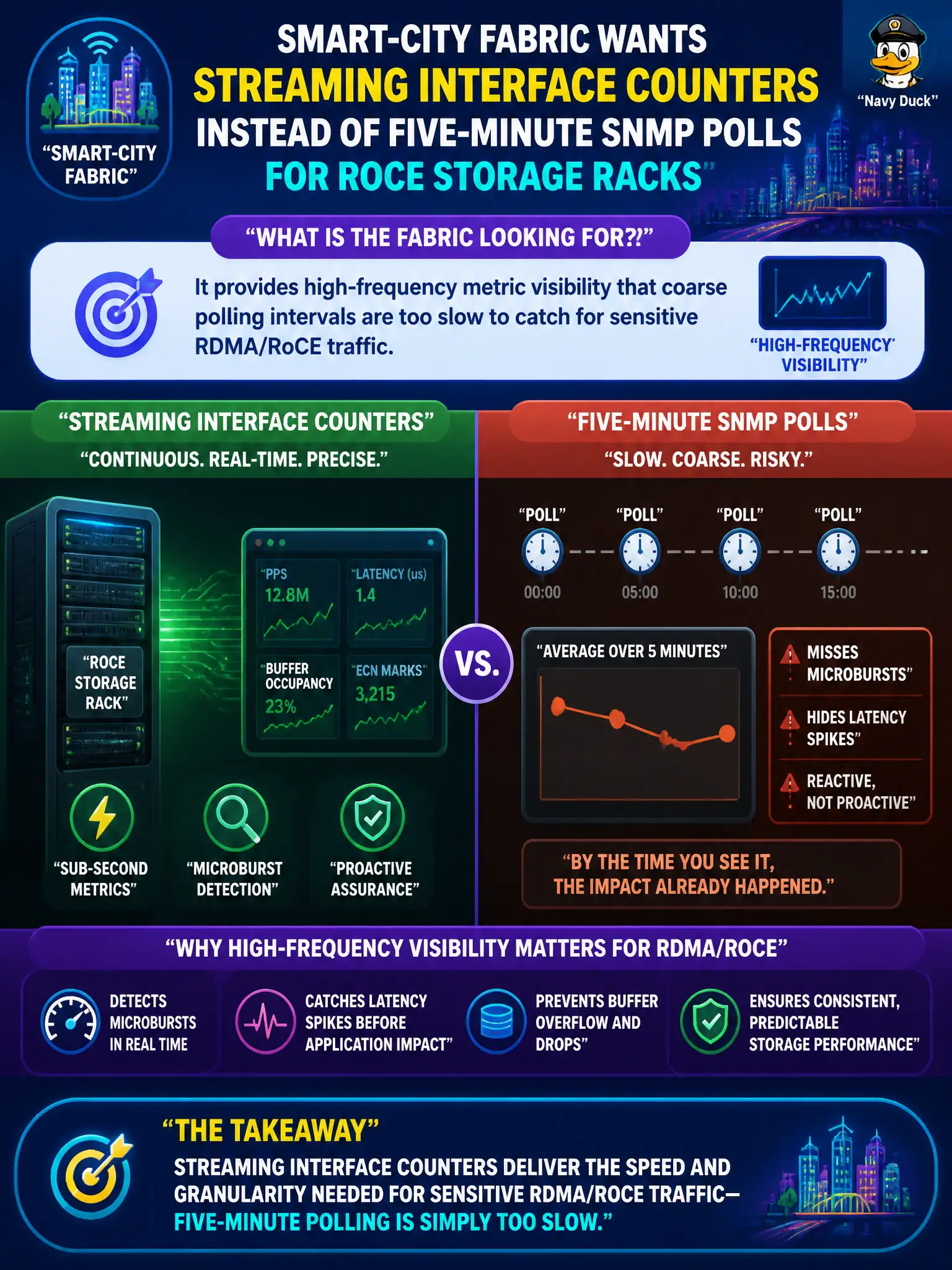
RoCE storage hates surprises that live between five-minute SNMP naps—microbursts and drops come and go before the pollster knocks. Streaming counters are the continuous heart-rate monitor. Pretty dashboards without the faster feed still miss the spike.
Full Explanation
Streaming interface counters provides high-frequency visibility that coarse five-minute SNMP polls are too slow to catch for sensitive RoCE/RDMA storage racks in a smart-city fabric. The goal is not to slow visibility to hide storage drops. Telemetry choice does not replace optical cables with copper. It is not merely decorative Grafana theming. Exam caveat: Match sampling cadence to workload sensitivity; RoCE microbursts die between slow polls. Operational check: Compare drops seen in streaming telemetry versus SNMP during a lab microburst on a storage uplink. In civic data-center operations, record the expected CLI or collector evidence for this concept so the next on-call engineer can validate fabric behavior without re-deriving the design under incident pressure. In civic data-center operations, record the expected CLI or collector evidence for this concept so the next on-call engineer can validate fabric behavior without re-deriving the design under incident pressure. In civic data-center operations, record the expected CLI or collector evidence for this concept so the next on-call engineer can validate fabric behavior without re-deriving the design under incident pressure. In civic data-center operations, record the expected CLI or collector evidence for this concept so the next on-call engineer can validate fabric behavior without re-deriving the design under incident pressure.