
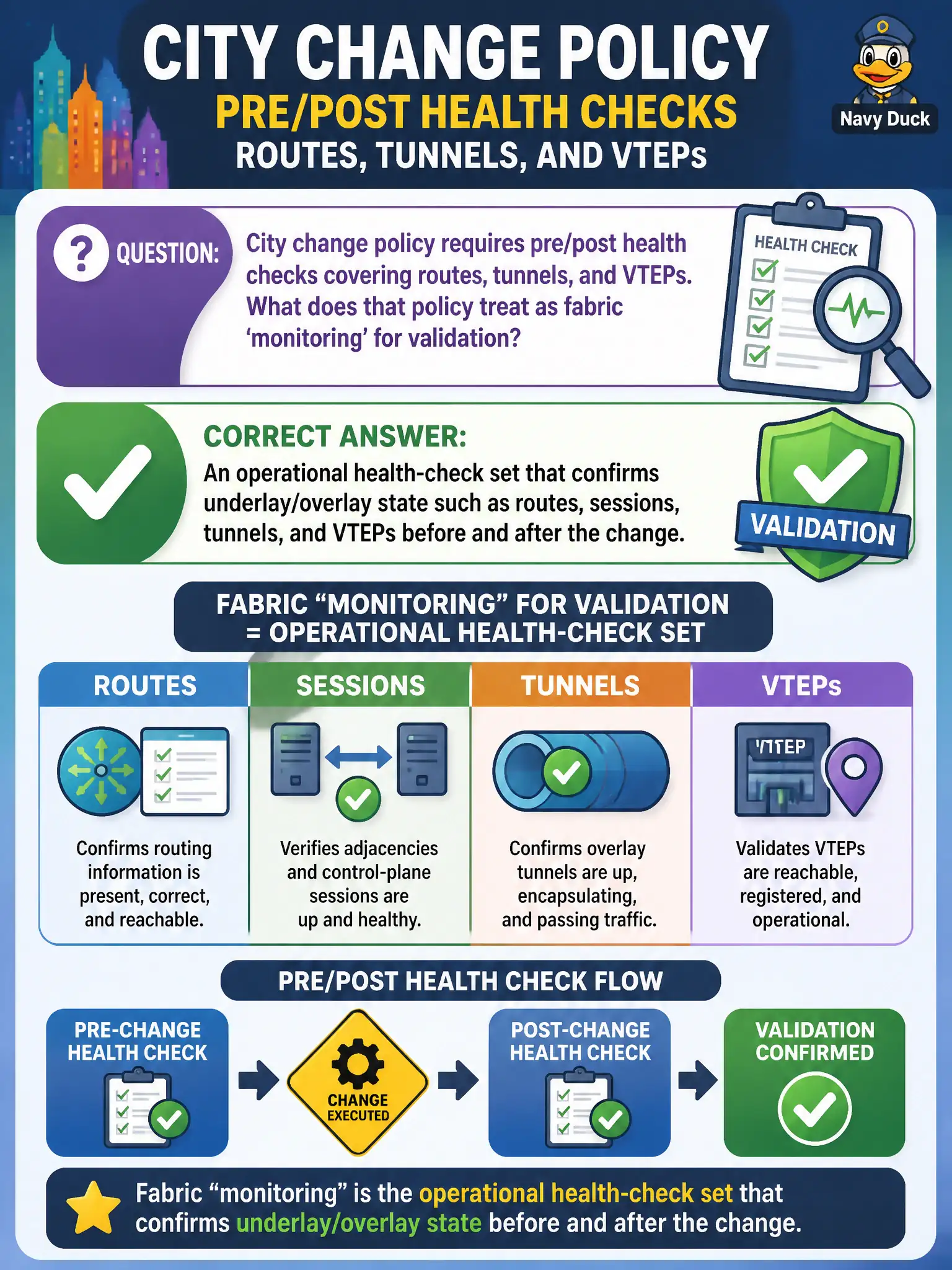
City change policy requires pre/post health checks covering routes, tunnels, and VTEPs. What does that policy treat as fabric 'monitoring' for validation?
Select an answer to reveal the explanation.
Short Explanation
Pre/post checks are the before-and-after photos of the fabric's vital signs—routes, tunnels, VTEPs—not selfies of the chassis logo. If those vitals match the expected baseline after the window, the change landed; if not, you roll back with evidence. Coffee machines do not count as VTEP health.
Full Explanation
City change policy treats fabric monitoring for validation as an operational health-check set confirming underlay/overlay state—routes, sessions, tunnels, and VTEPs—before and after the window. Photographing chassis logos is cosmetic, not validation. Coffee machine power is not a VTEP check. Even ticket numbers are not technical health evidence. Exam caveat: Store the health-check outputs with the change record for rollback decisions. Operational check: Run the documented pre-check, make a lab change, run post-check, and diff the route/session/VTEP outputs. In civic data-center operations, record the expected CLI or collector evidence for this concept so the next on-call engineer can validate fabric behavior without re-deriving the design under incident pressure. In civic data-center operations, record the expected CLI or collector evidence for this concept so the next on-call engineer can validate fabric behavior without re-deriving the design under incident pressure. In civic data-center operations, record the expected CLI or collector evidence for this concept so the next on-call engineer can validate fabric behavior without re-deriving the design under incident pressure. In civic data-center operations, record the expected CLI or collector evidence for this concept so the next on-call engineer can validate fabric behavior without re-deriving the design under incident pressure.