
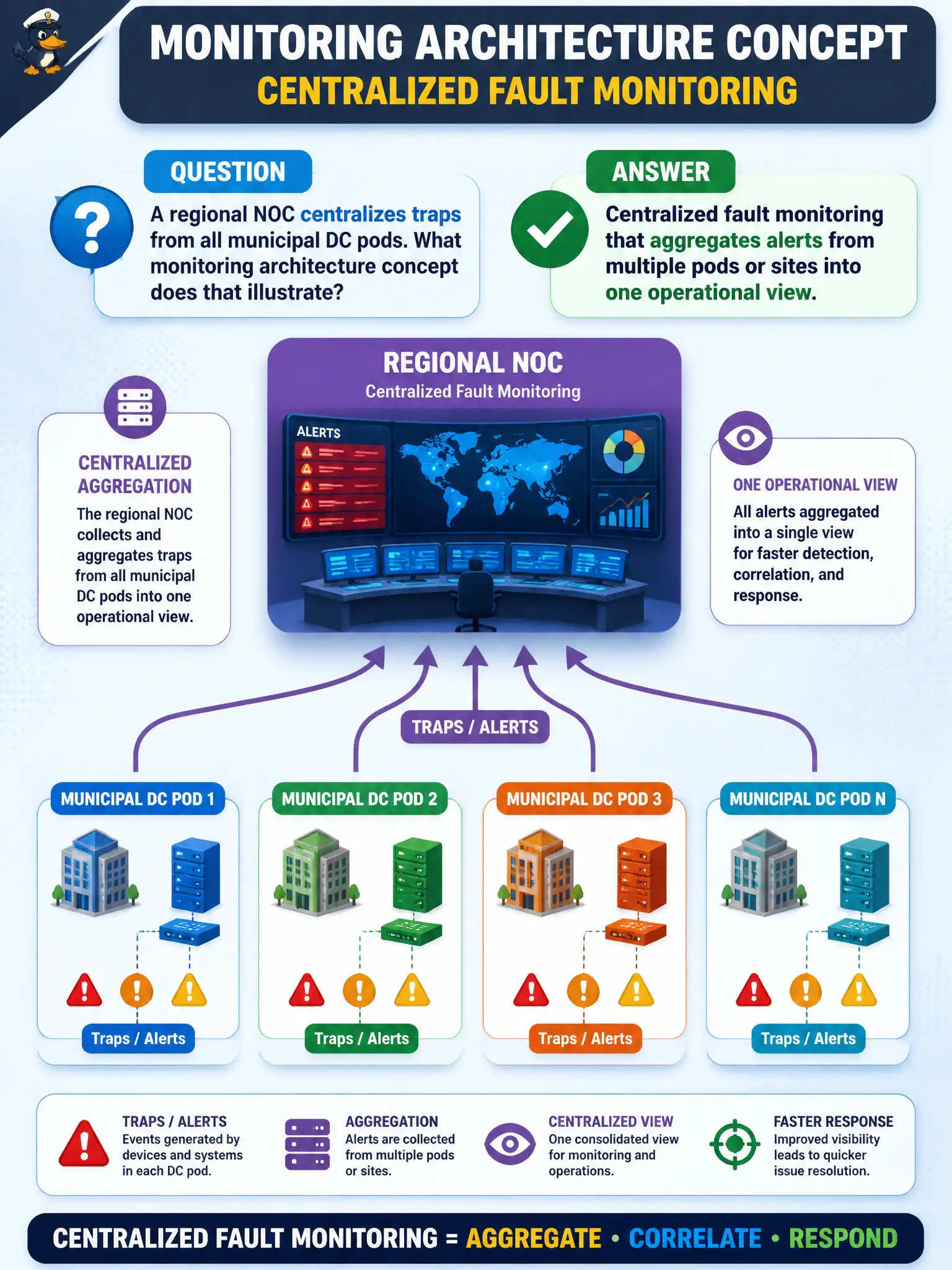
A regional NOC centralizes traps from all municipal DC pods. What monitoring architecture concept does that illustrate?
Select an answer to reveal the explanation.
Short Explanation
Centralizing traps is like every fire station calling one dispatch desk instead of hoping someone walks the halls with a flashlight. Multi-pod city fabrics need that single pane so a spine fault in Pod B is not someone's weekend surprise. Sticky notes and console tourism do not scale.
Full Explanation
Centralizing traps from all municipal DC pods illustrates centralized fault monitoring that aggregates alerts into one regional NOC operational view. Sticky-note local retention does not scale multi-pod ops. Console tourism per leaf is not an architecture for regional visibility. Disabling traps blinds the regional NOC. Exam caveat: Centralization improves MTTD only if routing, community, and dedup of trap sources are designed. Operational check: Generate a test trap from each pod and confirm it appears once, correctly sourced, on the regional console. In civic data-center operations, record the expected CLI or collector evidence for this concept so the next on-call engineer can validate fabric behavior without re-deriving the design under incident pressure. In civic data-center operations, record the expected CLI or collector evidence for this concept so the next on-call engineer can validate fabric behavior without re-deriving the design under incident pressure. In civic data-center operations, record the expected CLI or collector evidence for this concept so the next on-call engineer can validate fabric behavior without re-deriving the design under incident pressure. In civic data-center operations, record the expected CLI or collector evidence for this concept so the next on-call engineer can validate fabric behavior without re-deriving the design under incident pressure.