
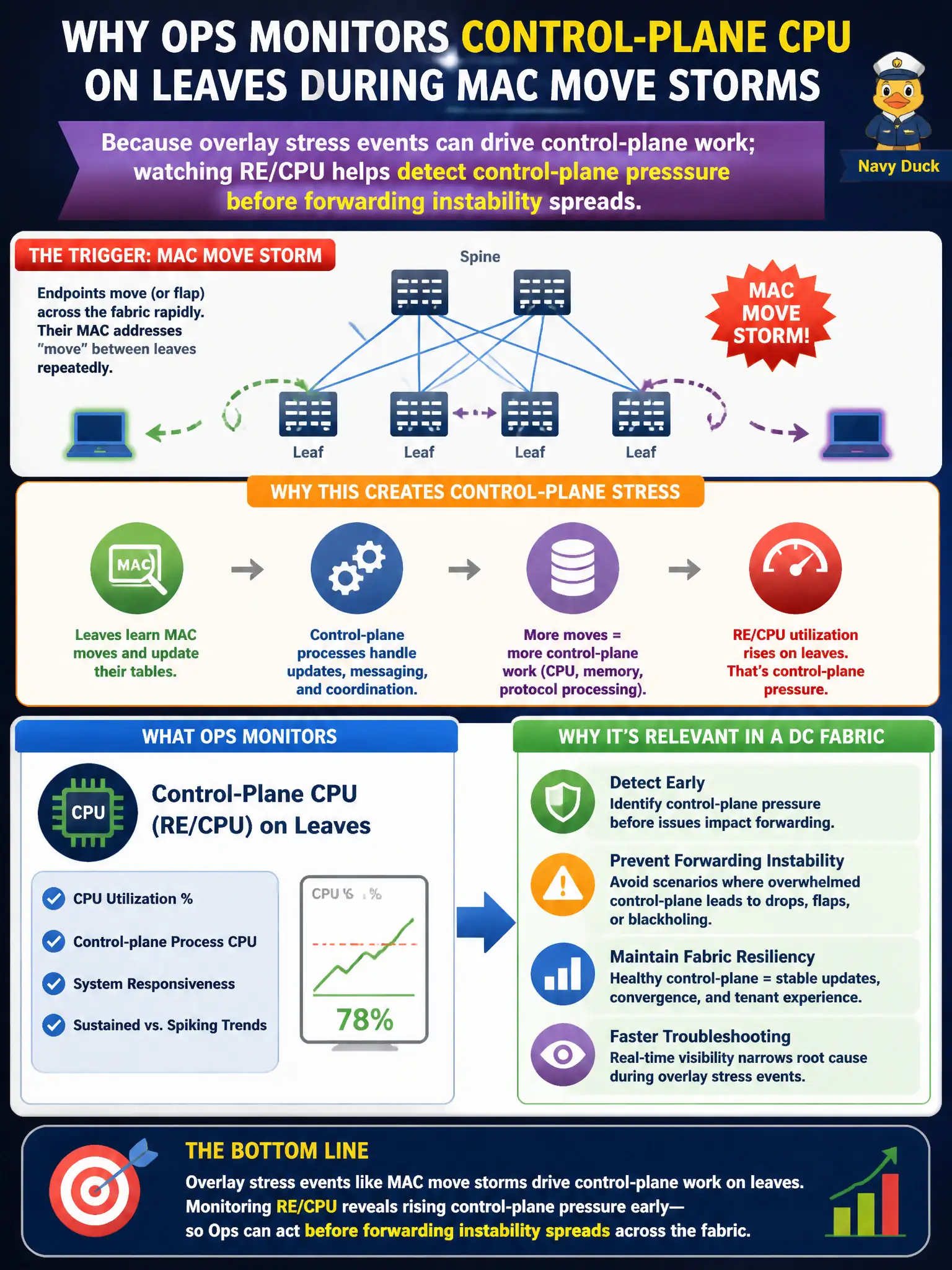
Ops wants to monitor control-plane CPU on leaves during MAC move storms. Why is that resource monitoring relevant in a DC fabric?
Select an answer to reveal the explanation.
Short Explanation
A MAC move storm is like a frantic roll call that keeps interrupting the principal—the leaf's control plane gets hammered while it relearns who sits where. Watching CPU/RE load tells you the office is overwhelmed before classrooms lose order. USB baud rates are not the story here.
Full Explanation
Overlay stress such as MAC move storms drives control-plane work; watching leaf RE/CPU detects pressure before forwarding instability spreads across the township fabric. Leaf CPU is not unrelated to overlay learning events. MAC move storms are not about USB console baud rates. Spines and leaves share fate through fabric control and forwarding coupling; leaf CPU still matters. Exam caveat: Pair CPU monitoring with MAC-move or EVPN learning rate signals during incidents. Operational check: Induce learning churn in lab and confirm CPU/RE graphs rise alongside move counters. In civic data-center operations, record the expected CLI or collector evidence for this concept so the next on-call engineer can validate fabric behavior without re-deriving the design under incident pressure. In civic data-center operations, record the expected CLI or collector evidence for this concept so the next on-call engineer can validate fabric behavior without re-deriving the design under incident pressure. In civic data-center operations, record the expected CLI or collector evidence for this concept so the next on-call engineer can validate fabric behavior without re-deriving the design under incident pressure.