
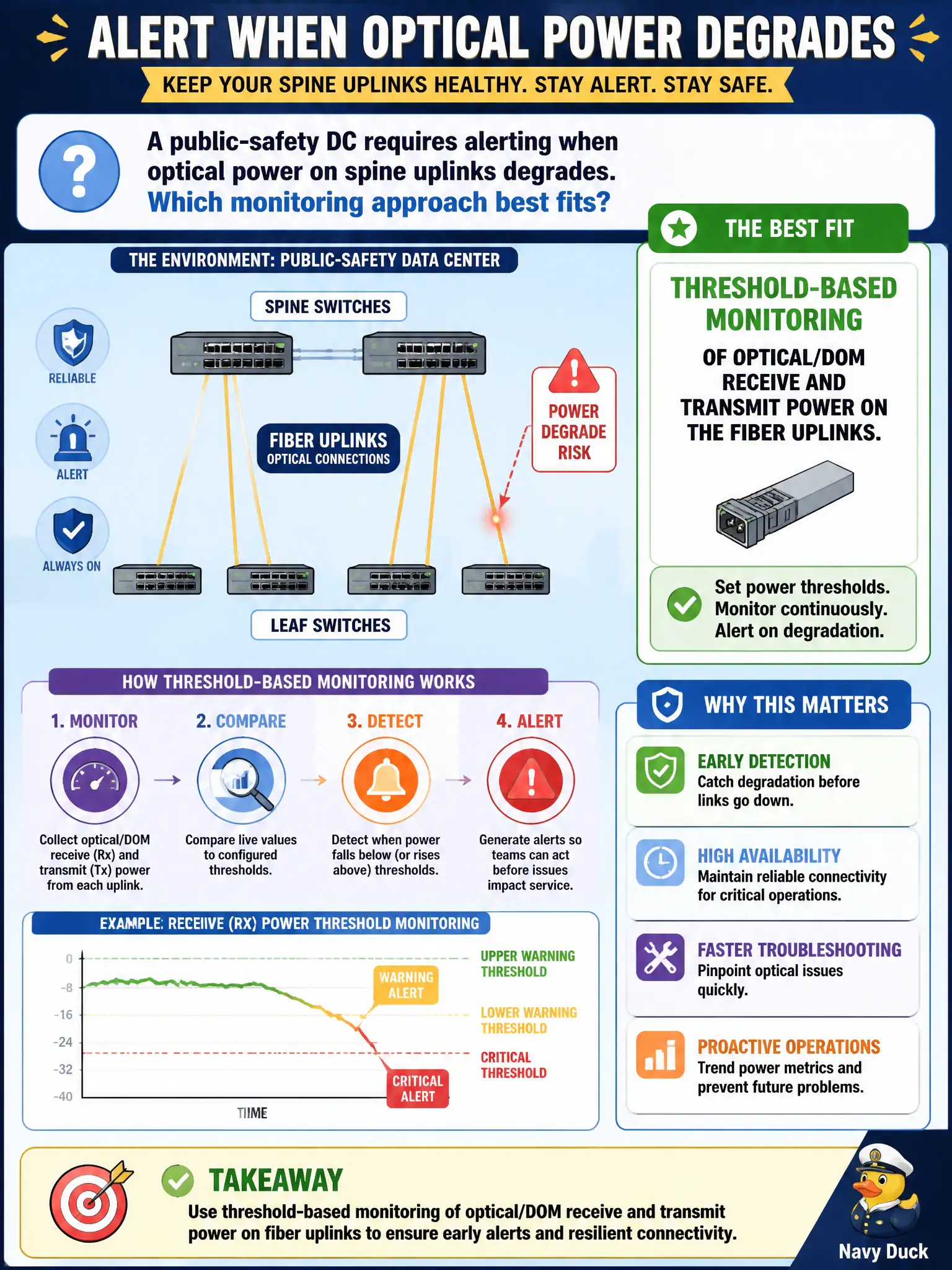
A public-safety DC requires alerting when optical power on spine uplinks degrades. Which monitoring approach best fits?
Select an answer to reveal the explanation.
Short Explanation
Fiber uplinks whisper trouble through optical power long before the whole link dies. Set DOM thresholds so the NOC hears the whisper—like a smoke detector, not a sticky-note count. Turning alarms off so nobody is 'interrupted' is how public-safety fabrics go dark quietly.
Full Explanation
Threshold-based monitoring of optical/DOM receive and transmit power on fiber spine uplinks gives public-safety fabrics early warning of degrading optics before hard failures. KVM keyboard LED brightness is unrelated. Sticky-note counts on the change board are not optical health. Disabling optics alarms removes the early-warning system. Exam caveat: Set thresholds with headroom above vendor Rx/Tx floors so warnings arrive before citizen-impacting hard downs. Operational check: Lower Rx power on a lab optic (attenuator) and confirm threshold alerts identify the exact spine uplink. In civic data-center operations, record the expected CLI or collector evidence for this concept so the next on-call engineer can validate fabric behavior without re-deriving the design under incident pressure. In civic data-center operations, record the expected CLI or collector evidence for this concept so the next on-call engineer can validate fabric behavior without re-deriving the design under incident pressure. In civic data-center operations, record the expected CLI or collector evidence for this concept so the next on-call engineer can validate fabric behavior without re-deriving the design under incident pressure.