
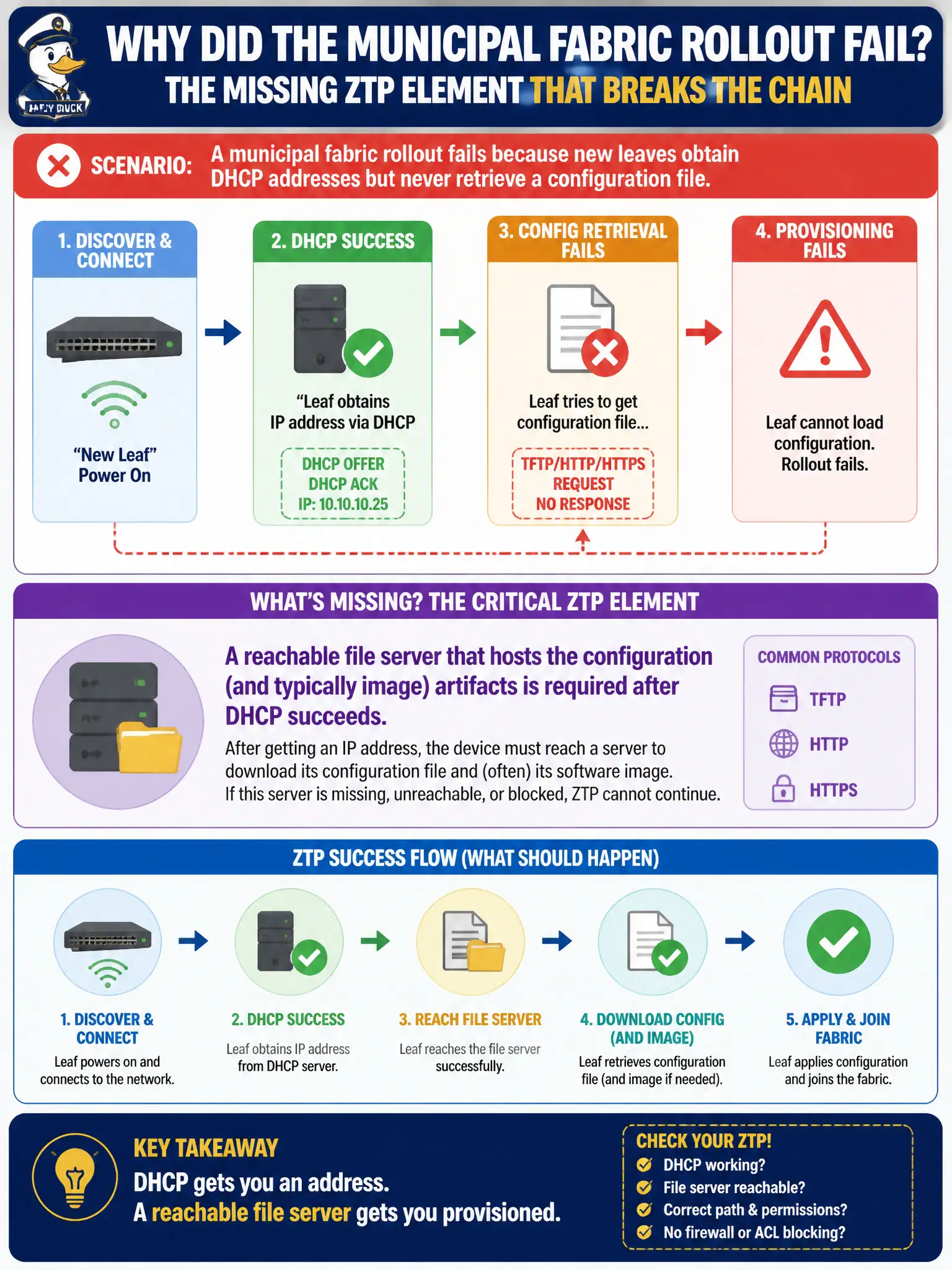
A municipal fabric rollout fails because new leaves obtain DHCP addresses but never retrieve a configuration file. Which missing ZTP element best explains this failure?
Select an answer to reveal the explanation.
Short Explanation
DHCP handing out an address is like giving a courier a street address but no warehouse location. Without a reachable file server pointing to the config (and often the Junos image), ZTP stalls after the lease. The municipal rollout needs that file path, not overlay EVPN magic, to finish day-0.
Full Explanation
If municipal leaves get DHCP addresses but never retrieve configuration, the missing ZTP element is a reachable file server hosting config and typically image artifacts, plus correct DHCP pointers to those objects. An IP lease alone does not finish day-0 bring-up. EVPN Type-5 advertisement is not a prerequisite for first-boot file retrieval; overlay routes are not the ZTP control channel. Reserving VXLAN VNI 0 as a ZTP control plane misattributes overlay constructs to management provisioning. Forcing OSPF instead of BGP on spines does not substitute for file-server reachability after DHCP succeeds. Exam caveat: Failures after a successful lease usually indicate bad options, blocked management routing/ACLs, wrong URLs, or missing artifacts. Operational check: From the leaf management address, test file-server reachability, decode DHCP boot/file options, and confirm referenced objects exist. In civic data-center practice, treat the correct concept as part of a controlled management design rather than an isolated checkbox, and document the expected show-command or log evidence so the next on-call engineer can prove the fabric behavior without re-deriving the theory under pressure. In civic data-center practice, treat the correct concept as part of a controlled management design rather than an isolated checkbox, and document the expected show-command or log evidence so the next on-call engineer can prove the fabric behavior without re-deriving the theory under pressure.