
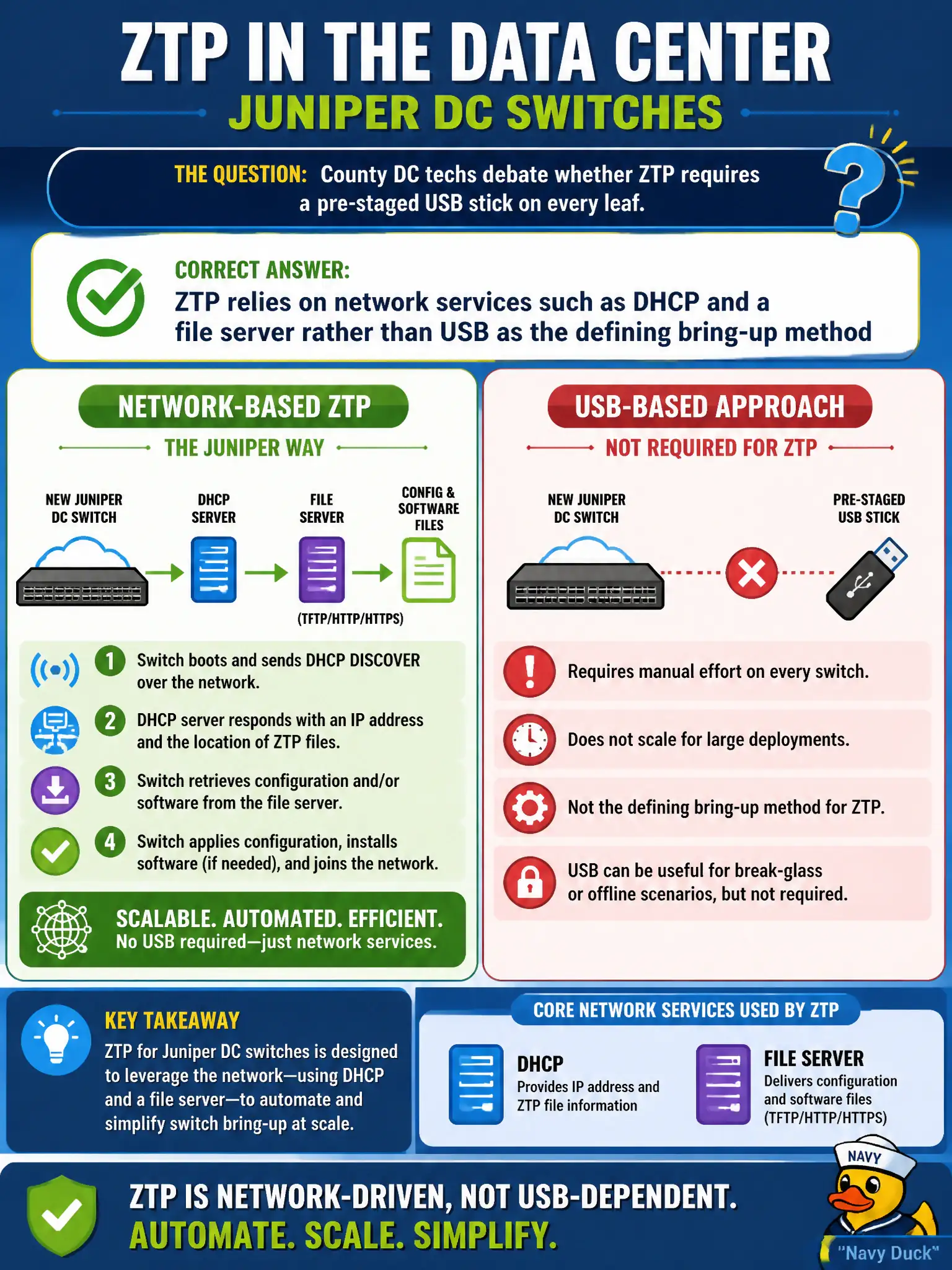
County DC techs debate whether ZTP requires a pre-staged USB stick on every leaf. Which statement correctly describes network-based ZTP for Juniper DC switches?
Select an answer to reveal the explanation.
Short Explanation
Think of USB staging as hand-delivering a paper map to every truck, while network ZTP is the GPS that downloads the route. Juniper DC ZTP is built around DHCP and a reachable file server, not a mandatory thumb drive on every leaf. The county debate should land on network-assisted provisioning as the defining method.
Full Explanation
Network-based Juniper DC ZTP relies on DHCP and a reachable file server rather than USB as the defining bring-up method. County pods scale by pointing factory-default leaves at controlled provisioning services instead of pre-staging media on every device. Requiring USB config on every device inverts the usual model; USB may exist in some workflows but is not the defining dependency of network ZTP. Claiming ZTP always disables DHCP and forces static management IPs from first boot misunderstands day-0 addressing, which typically depends on DHCP. Saying ZTP replaces BGP underlay peering and removes spine connectivity confuses provisioning with fabric routing that still must be established. Exam caveat: Steady-state static management addressing later does not erase DHCP’s role during the ZTP window. Operational check: Boot a leaf without USB, capture DHCP Offer options, and confirm the pulled config matches the intended county role file. In civic data-center practice, treat the correct concept as part of a controlled management design rather than an isolated checkbox, and document the expected show-command or log evidence so the next on-call engineer can prove the fabric behavior without re-deriving the theory under pressure.