
Public-works NOC asks which first-boot behavior starts ZTP on a factory-default Junos data-center switch. Which concept is correct?
Select an answer to reveal the explanation.
Short Explanation
Factory-default is the blank slate where ZTP wakes up—like a new phone activating on first power-on. The public-works NOC should expect ZTP to kick in when the Junos DC switch boots without a saved config, hunting the network for provisioning. You do not need EVPN or a pre-baked hostname for that first-boot dance to start.
Full Explanation
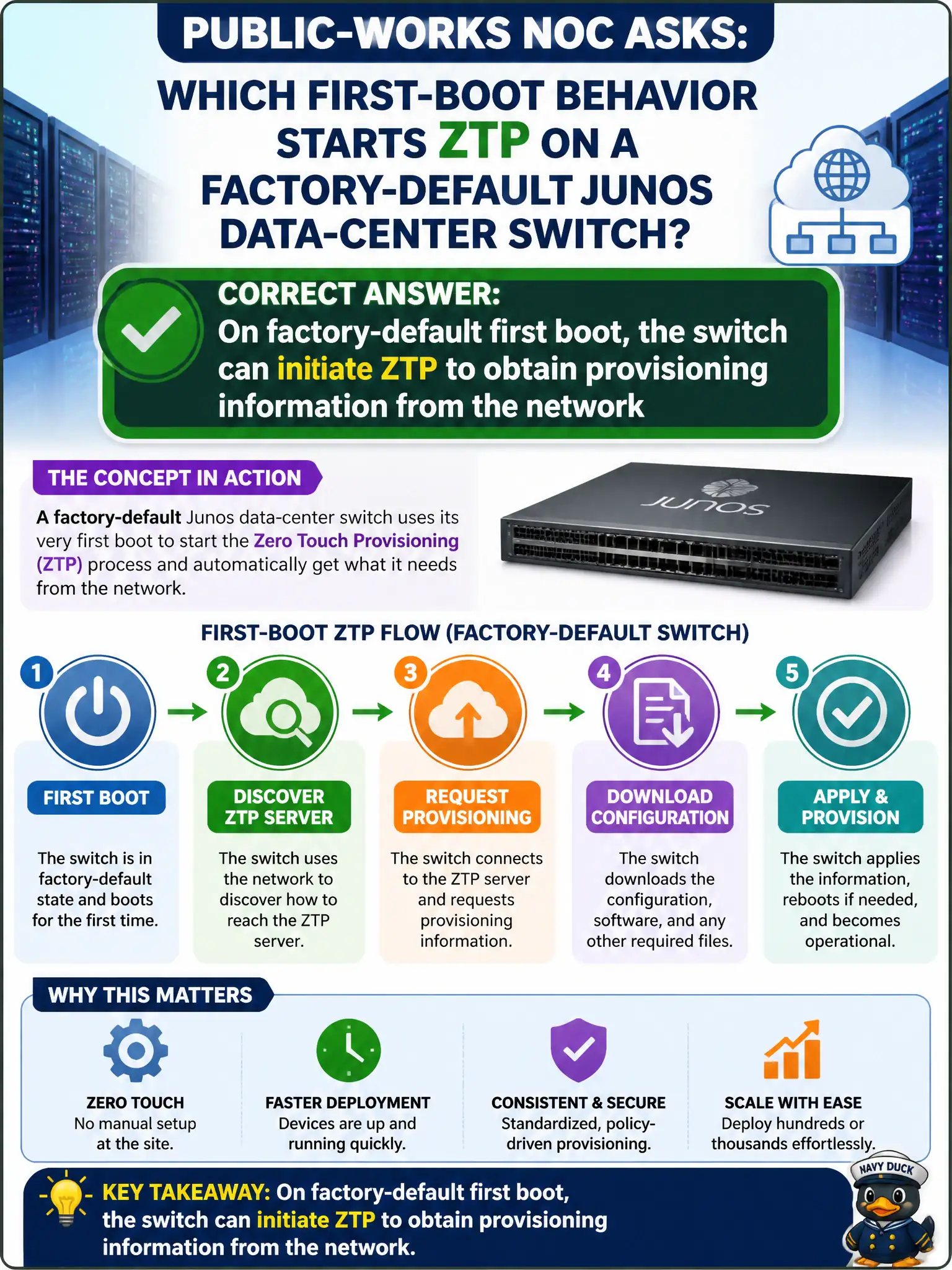
On factory-default first boot, a Junos DC switch can initiate ZTP to obtain provisioning information from the network. Public-works NOC staff should expect blank devices to seek DHCP and then file-based image and configuration delivery. Starting ZTP only after committing full production config and rebooting twice reverses cause and effect: production config is the outcome, not the trigger. Requiring EVPN signaling to all spines before ZTP begins places overlay state ahead of day-0 management provisioning. Requiring a unique hostname already saved in NVRAM misunderstands identity delivery; hostname is commonly applied by the retrieved config. Exam caveat: Devices with a saved configuration generally boot that config and do not re-enter the factory-default ZTP path. Operational check: Confirm factory-default state, capture Discover/Offer on the management VLAN, and verify file retrieval starts without EVPN or a pre-saved hostname. In civic data-center practice, treat the correct concept as part of a controlled management design rather than an isolated checkbox, and document the expected show-command or log evidence so the next on-call engineer can prove the fabric behavior without re-deriving the theory under pressure.