
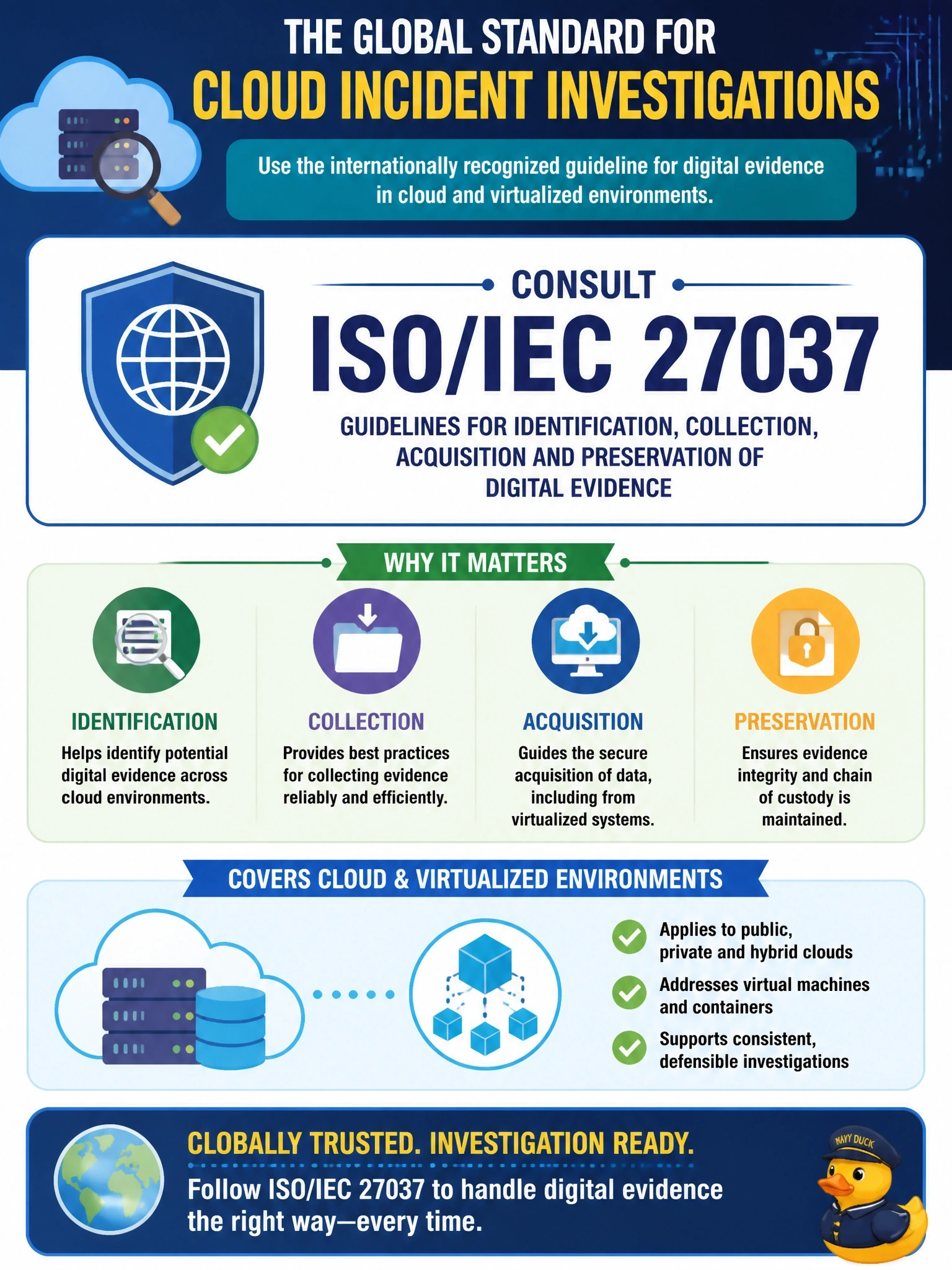
Investigators handling a cloud incident need internationally recognized guidelines for the identification, collection, acquisition and preservation of potential digital evidence, including from virtualized systems. Which standard should they consult?
Select an answer to reveal the explanation.
Short Explanation
Think of the forensic standards as an assembly line: 27037 is the first station, where you find, grab and bag the evidence. Analysis comes later in 27042, and eDiscovery has its own lane in 27050. Match the verbs in the question, identify, collect, acquire, preserve, and you've got your station.
Full Explanation
ISO/IEC 27037 provides guidelines for the identification, collection, acquisition and preservation of digital evidence, the early handling activities that determine whether evidence remains admissible and trustworthy. It addresses roles such as the digital evidence first responder and specialist, the principles of relevance, reliability and sufficiency, and handling considerations that apply to a range of devices and systems; CCSP cites it among the forensics requirements for cloud environments. ISO/IEC 27042 covers the later stages, analysis and interpretation of digital evidence, so it does not describe how to identify or preserve it in the first place. ISO/IEC 27050 addresses electronic discovery, the legal process of identifying, preserving, collecting and producing electronically stored information for litigation, which overlaps conceptually but targets legal production rather than incident evidence handling. ISO/IEC 27018 is a code of practice for protecting personally identifiable information in public clouds acting as PII processors and has nothing to say about evidence handling. Exam caveat: in cloud, investigators often depend on the provider to perform or assist acquisition, so the standard's principles must be supported by contract terms. Operational check: confirm forensic procedures reference ISO/IEC 27037 handling steps, hash acquired images and maintain a chain of custody record.