
Law enforcement investigating one tenant of a public cloud service proposes seizing the physical server that hosts that tenant's virtual machines. The provider objects. Why is physical seizure problematic in this setting, and what approach is generally preferred?
Select an answer to reveal the explanation.
Short Explanation
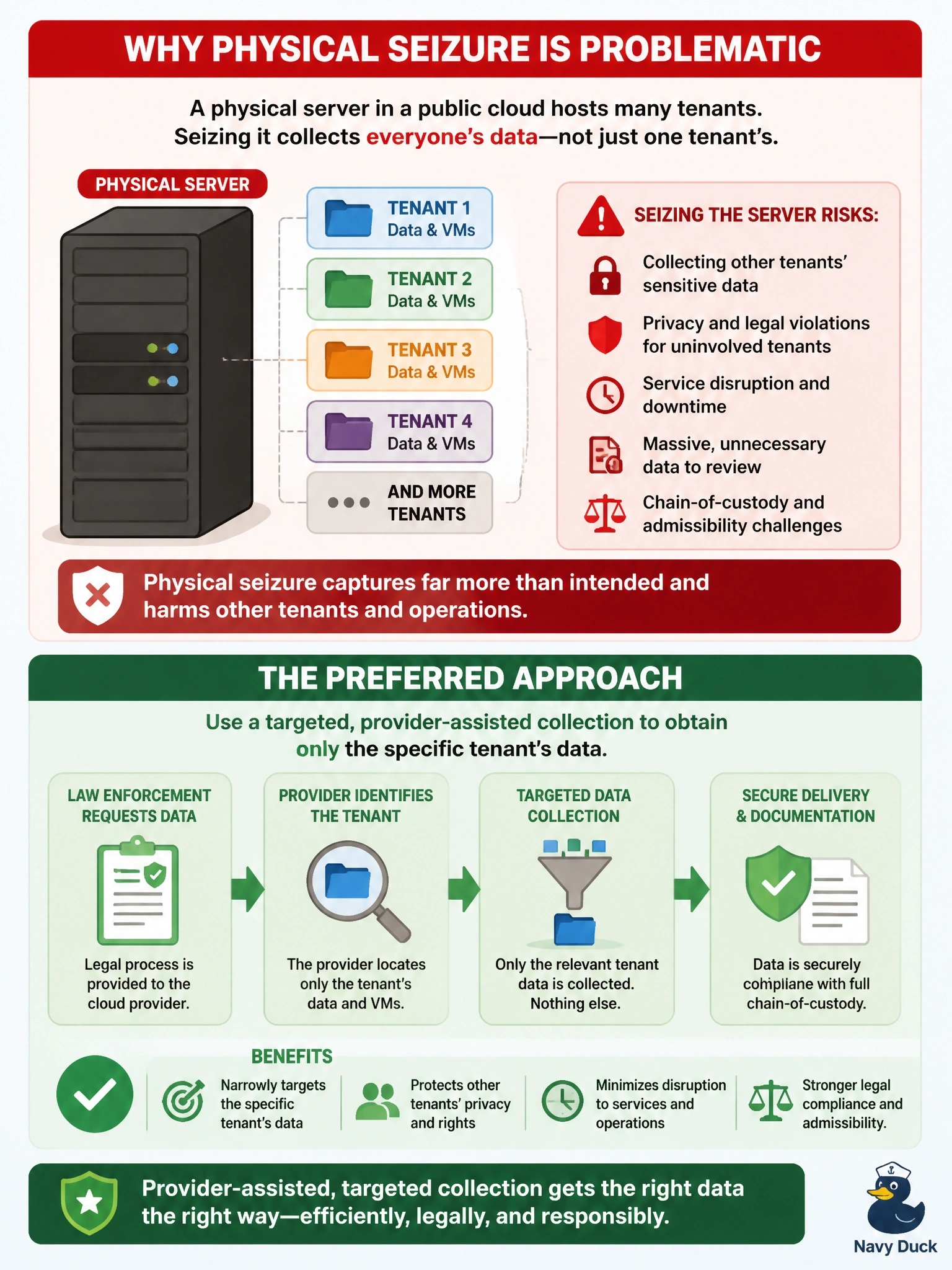
Seizing a cloud server is like towing the whole apartment building to search one flat. Every other tenant's data rides along, and their privacy and availability go out the door. The cleaner answer is a targeted, provider-assisted collection of just the data you're entitled to.
Full Explanation
Multi-tenancy means a single physical host and its storage commonly serve many customers, and a tenant's data may be spread across numerous devices and locations through data dispersion. Seizing hardware would therefore disrupt unrelated customers, expose their confidential data to investigators who have no authority over it and still might not capture all of the target tenant's data. The preferred approach is for the provider, under valid legal process, to identify and export the specific tenant's data, snapshots and logs, documenting the process to preserve chain of custody. Claiming seizure gives the best chain of custody ignores both the over-collection of other tenants' data and the fact that the target's data may reside elsewhere. Saying each physical server hosts only one tenant confuses logical isolation with physical dedication; hypervisors isolate tenants that share the same hardware, which is the essence of multi-tenancy. Asserting that providers must refuse all requests is wrong; providers comply with valid legal process, typically after legal review and within their published policies. Exam caveat: customers should understand provider policies on law enforcement requests, notification and data location before an incident. Operational check: confirm the contract addresses how the provider handles legal requests, customer notification and evidence preservation.