
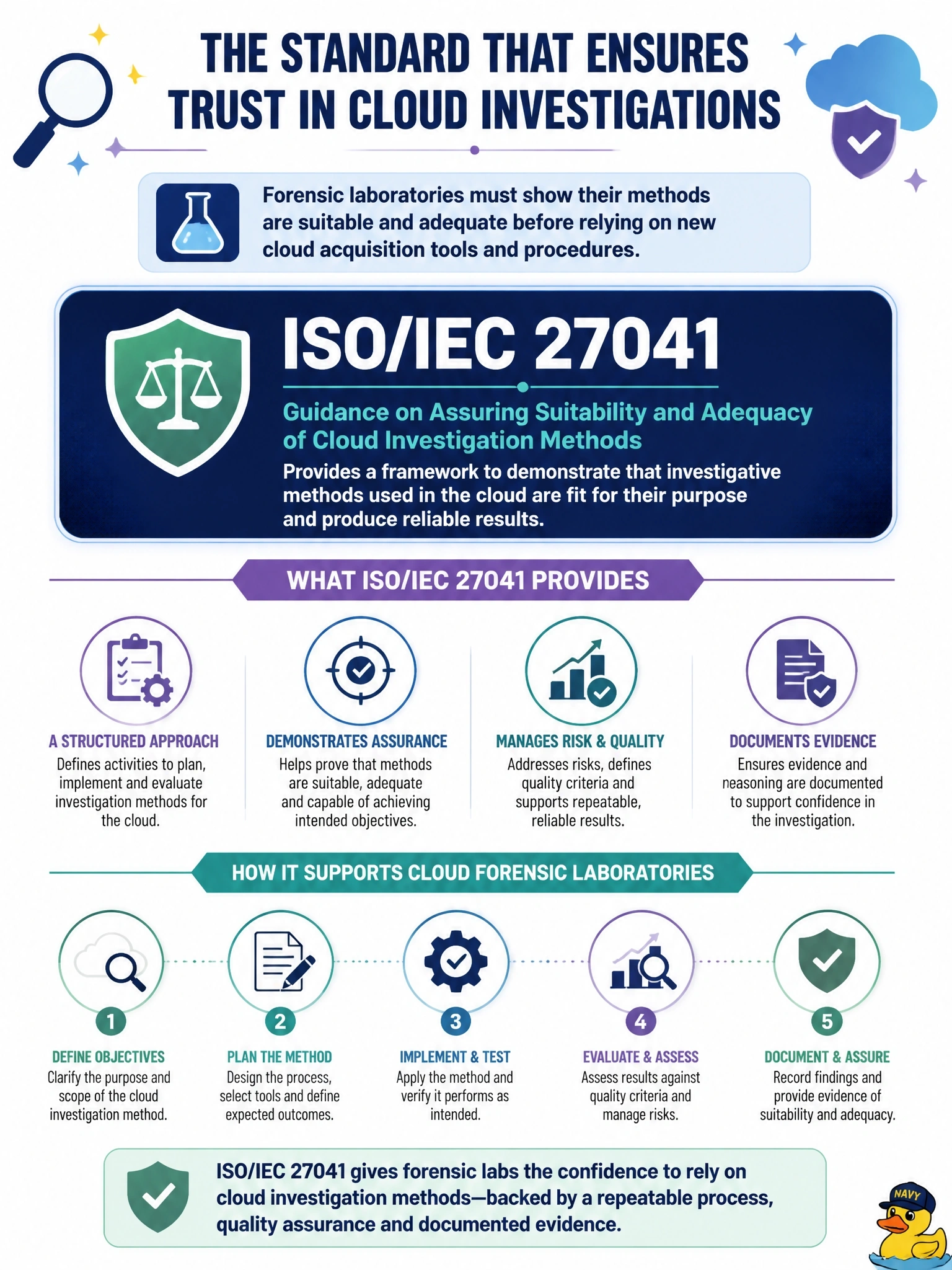
A forensic laboratory supporting cloud investigations must demonstrate, before relying on a new acquisition tool and procedure, that its investigative methods are suitable and adequate for their purpose. Which standard provides guidance specifically on this assurance?
Select an answer to reveal the explanation.
Short Explanation
Before you trust a scale, you calibrate it; 27041 is the calibration standard for investigative methods. It's about proving your tools and procedures are fit for purpose. Don't mix it up with 27042, which is how you analyze the evidence, or 27043, the overall investigation process.
Full Explanation
ISO/IEC 27041 gives guidance on assuring the suitability and adequacy of incident investigative methods, including how to validate and verify tools and processes so that their results can be relied on. It is the standard a laboratory uses to show that a new acquisition tool or procedure produces accurate, repeatable output before applying it to real evidence. ISO/IEC 27037 covers identification, collection, acquisition and preservation of digital evidence; it describes how to handle evidence but not how to prove that a method is fit for purpose. ISO/IEC 27043 sets out incident investigation principles and processes, a framework spanning readiness through closure, and refers to the other standards for detail rather than providing method assurance itself. ISO/IEC 27042 addresses the analysis and interpretation of digital evidence, including competence and how conclusions are reached and reported, which comes after methods have been validated. These standards are designed to work together, so the distinction tested is which one focuses on validating methods. Exam caveat: cloud acquisition often relies on provider interfaces such as snapshots and log exports, which also need validation. Operational check: confirm each tool and procedure has a documented validation record, test data set and known limitations before use in casework.