
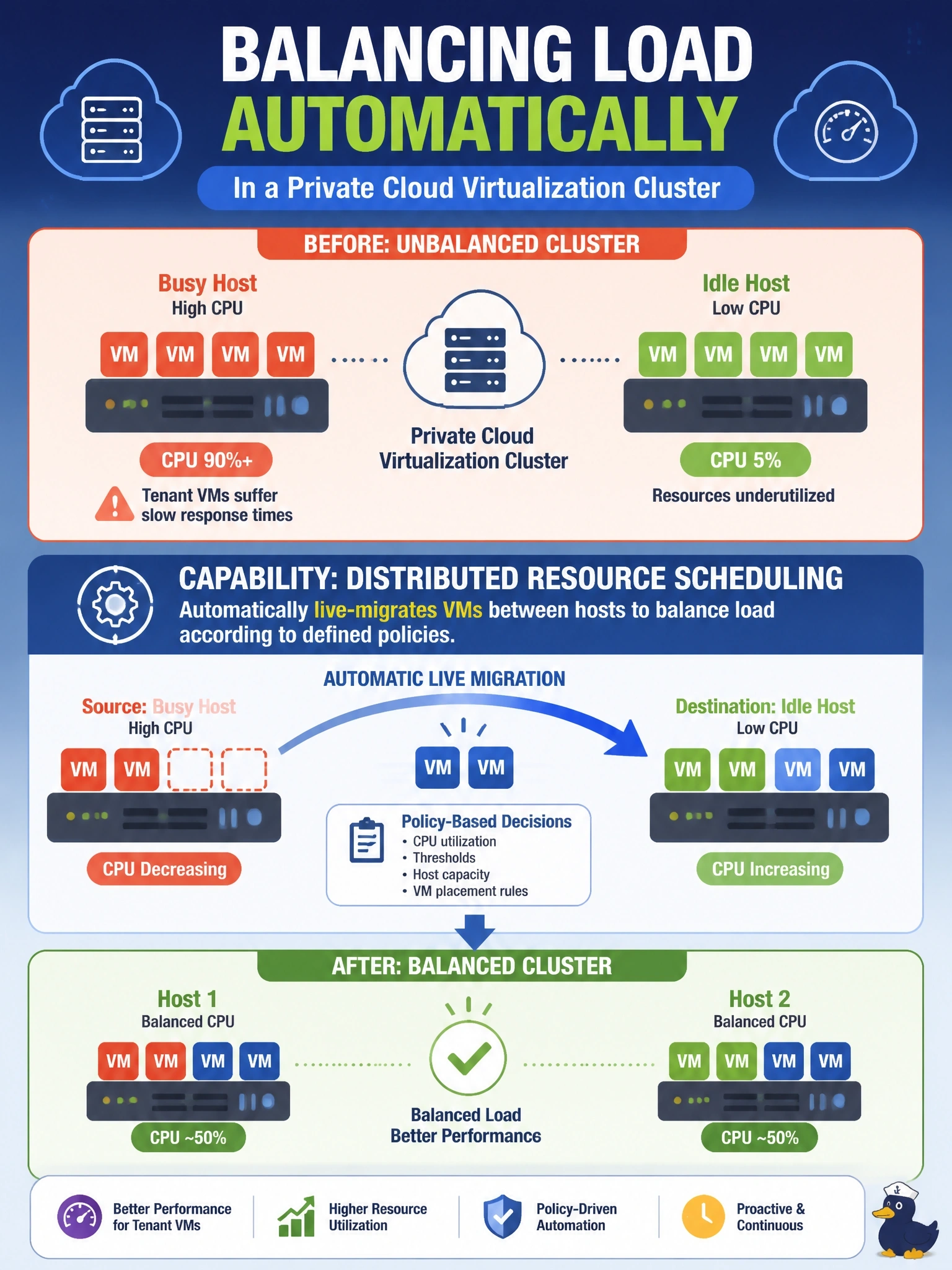
In a private cloud virtualization cluster, some hosts run at sustained high CPU while others sit nearly idle, and tenant VMs on the busy hosts are suffering slow response times. Which capability addresses this automatically?
Select an answer to reveal the explanation.
Short Explanation
Think of distributed resource scheduling as a host at a restaurant who keeps moving diners to free tables so no waiter's swamped. It watches load across your cluster and shifts VMs to quieter hosts automatically. The trap is HA, which only steps in after a host actually dies.
Full Explanation
Distributed resource scheduling, also described as dynamic optimization, continuously monitors CPU and memory utilization across the hosts in a cluster and uses live migration to move virtual machines from overloaded hosts to underused ones according to configured policies, thresholds and placement rules. It also places new VMs on the most suitable host at power-on. The result is balanced performance without manual intervention and better use of pooled resources. High availability responds to host failure: it detects that a host is down and restarts its VMs elsewhere, which addresses outages rather than uneven load on healthy hosts. Storage clustering pools and replicates storage for resilience and capacity; it does not rebalance compute load between hypervisor hosts. Maintenance mode deliberately evacuates one host for planned work; it can be used to drain a host manually, but it is not a continuous, automatic balancing mechanism. Exam caveat: the outline lists distributed resource scheduling, dynamic optimization, storage clusters, maintenance mode and HA together under availability of clustered hosts, so expect questions that require distinguishing their triggers and purposes. Operational check: confirm that the cluster's resource scheduling is enabled in automatic mode with appropriate thresholds, review its migration history during peak periods, and check that affinity rules keep redundant tenant VMs on different hosts.