
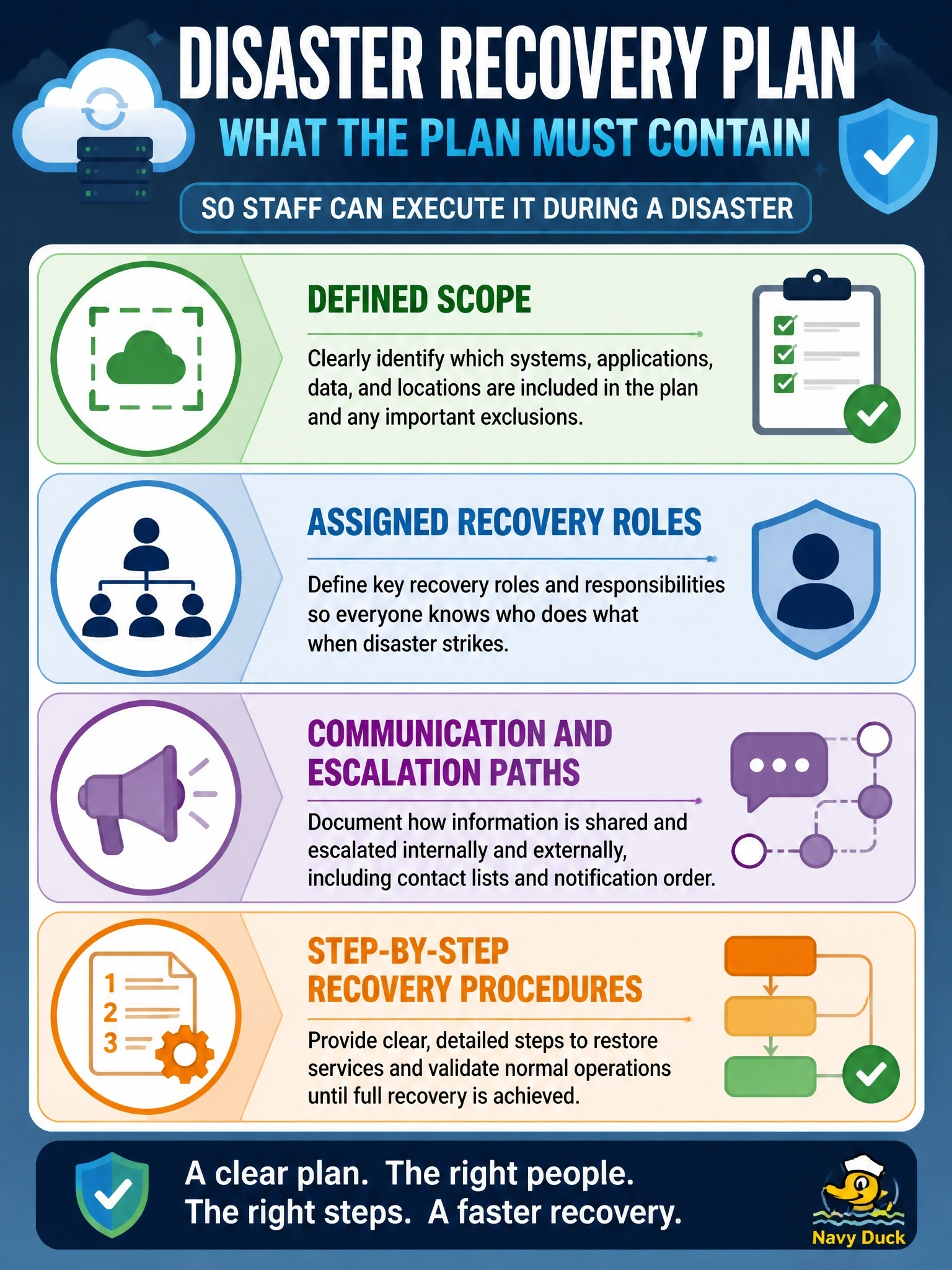
A cloud security professional is drafting a new business continuity and disaster recovery plan for a group of cloud-hosted services. The business impact analysis is complete and recovery strategies have been selected. What must the plan document contain so staff can execute it during a disaster?
Select an answer to reveal the explanation.
Short Explanation
A DR plan is a recipe you'll follow while the kitchen's on fire, so it has to say what's covered, who does what, who you call, and the steps in order. If it reads like a risk report or leaves the steps to whoever's on call, it fails exactly when you need it. And no, the provider isn't going to cook your dinner for you.
Full Explanation
Once the business impact analysis has set priorities and recovery strategies have been chosen, the plan turns those decisions into something executable under pressure. It defines its scope, meaning which services, locations and scenarios it covers; it assigns roles and responsibilities, including who can declare a disaster and who performs each task, with alternates; it sets out communication and escalation paths to staff, customers, the cloud service provider and regulators; and it provides step-by-step recovery and failback procedures with the dependencies and order of restoration. An asset inventory and risk register are planning inputs; requiring responders to reassess every risk during an event delays recovery and replaces documented decisions with improvisation. A BIA summary explains why priorities exist, but leaving the procedures to individual judgment defeats the purpose of the plan and makes outcomes depend on who happens to be on call. Under shared responsibility the provider restores its own infrastructure, not the customer's workloads, data or configurations, so a contact list alone is not a plan. Exam caveat: the plan is a living document; testing and change management keep it accurate. Operational check: confirm each procedure names an owner and an alternate, contact details are current, and the plan is stored somewhere reachable when primary systems are down.