
A company wants to verify that its cloud disaster recovery site can actually process real workloads, but management prohibits any test that would interrupt or shift production traffic. Which type of test meets both goals?
Select an answer to reveal the explanation.
Short Explanation
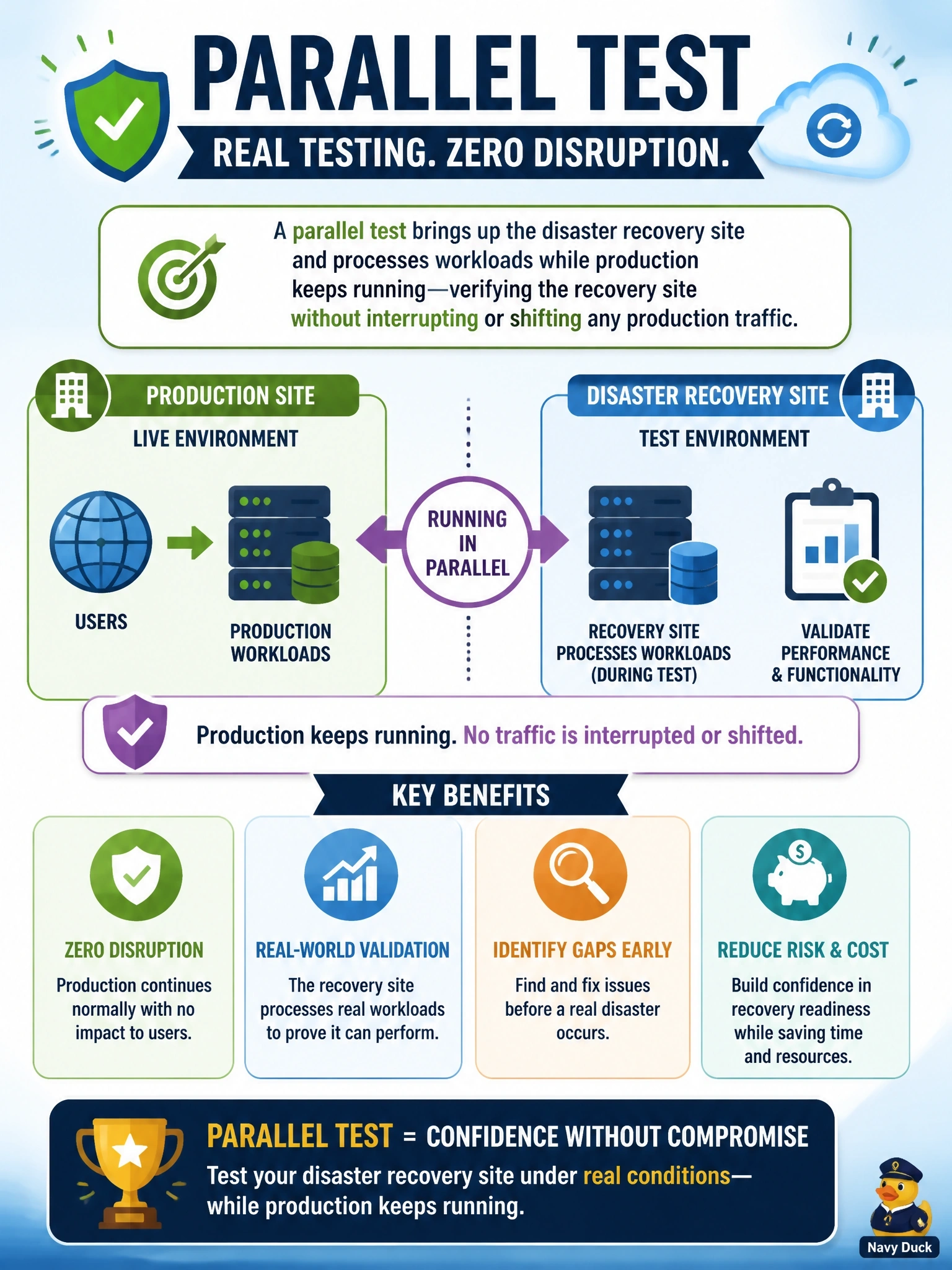
You want proof the backup kitchen can really cook, but you're not allowed to close the main restaurant. So you fire up both and cook the same orders side by side; that's a parallel test. A tabletop or checklist never proves the site works, and a full interruption test is exactly what management just banned.
Full Explanation
DR tests form a ladder from discussion to disruption. A parallel test activates the recovery environment and runs real or replicated workloads on it while the primary environment continues to serve production, so the organization learns whether the recovery site can actually process transactions without taking any production risk. Results are compared with production to confirm correctness and performance. A full interruption test shuts down or isolates production and forces operations onto the recovery site; it gives the highest assurance but carries real risk of an outage, which management has explicitly prohibited. A tabletop exercise is a discussion-based walkthrough of a scenario; it validates understanding of roles and the logic of the plan but never demonstrates that systems at the recovery site function. A checklist review confirms that plan sections are complete and current, which is useful hygiene and still proves nothing about technical capability. Exam caveat: in the cloud, parallel tests are easier because recovery environments can be provisioned on demand, but they must be isolated so test transactions do not reach real customers or payment processors. Operational check: define success criteria before the test, run the parallel workload against a copy of production data, and record measured recovery times against the RTO for the post-test report.