
A regulator requires a financial services firm to show that its critical cloud-hosted workloads could be recovered even if its only cloud service provider suffered a prolonged provider-wide outage or ceased operations. Which disaster recovery design best satisfies this requirement?
Select an answer to reveal the explanation.
Short Explanation
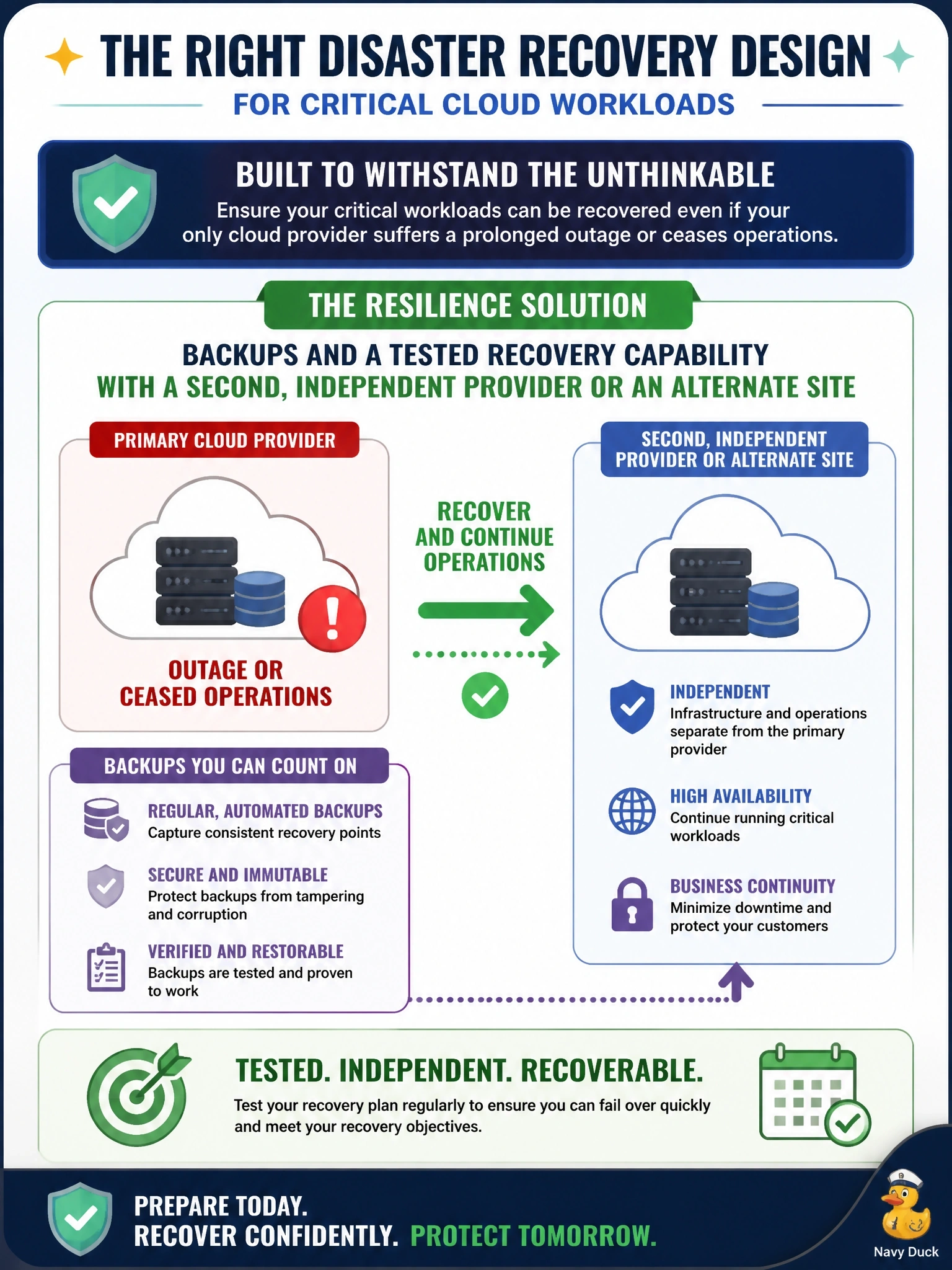
If the whole landlord goes away, it doesn't matter how many apartments you rented in their building. Surviving the loss of the provider means your backups and a way to run them live somewhere that provider doesn't control. Multi-region looks resilient, but it's still one company's eggs in one company's basket.
Full Explanation
Regional and zonal redundancy protects against failures inside a provider's infrastructure, but every region still shares the provider's control plane, identity system, business continuity and corporate existence. When the threat is a provider-wide outage, account lockout or the provider ceasing operations, the only effective design keeps current copies of data, plus the configurations and procedures needed to run the workloads, with an independent second provider or a customer-controlled site, and proves the capability through testing. Replicating across three regions of the same provider improves availability against regional events but fails completely in the stated scenario. Uptime commitments and service credits are financial remedies; they compensate for an outage after the fact and recover nothing. Immutable archive backups defend against deletion and ransomware, which is valuable, yet they remain inside the provider whose loss is the scenario, so they are unreachable when that provider is unavailable. Exam caveat: cross-provider recovery depends on portability; proprietary services and data formats that cannot run elsewhere undermine the plan, so portability and interoperability must be designed in. Operational check: verify that backups are copied to the secondary provider on schedule, that restoration there has been timed in an exercise, and that credentials for the secondary environment do not depend on the primary provider's identity service.