
While planning disaster recovery for a cloud-hosted customer portal, the business agrees that during a disaster the portal may run at half of its normal capacity until the primary environment is restored. Which planning parameter does this agreement define?
Select an answer to reveal the explanation.
Short Explanation
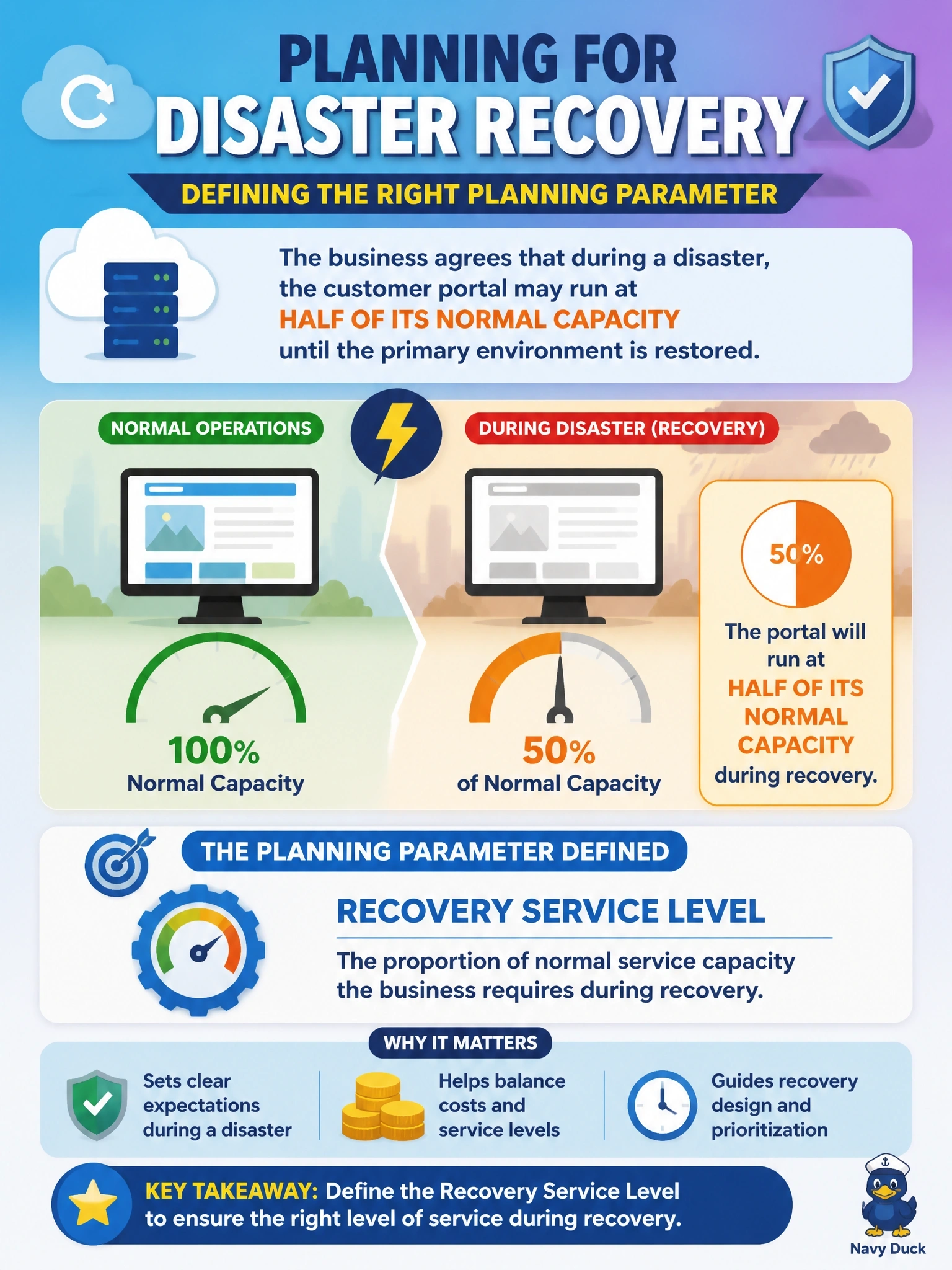
Think of a restaurant after a kitchen fire running a short menu from the food truck out back: open, just not at full strength. That 'half capacity is fine for now' agreement is the recovery service level. It's not about how fast you're back or how much data you lost, so don't let the familiar RTO and RPO labels grab you.
Full Explanation
The recovery service level expresses how much of normal service, usually as a percentage of capacity or performance, must be available while operating from the recovery environment. Agreeing that the portal may run at half capacity until the primary environment returns sets this parameter at fifty percent, and it directly shapes cost: the recovery site can be provisioned or scaled to that level rather than to full production size. The recovery time objective is a time measure, the target for restoring service after the disruption; the agreement here says nothing about how quickly the portal returns, only how much of it must be there once it does. The recovery point objective concerns tolerated data loss and drives backup and replication frequency, which is unrelated to capacity. Maximum tolerable downtime is the business's absolute limit on outage duration, again a time measure rather than a capacity level. Exam caveat: a reduced recovery service level is a deliberate business decision recorded in the BIA and the plan, not something operations may assume on its own; customer-facing SLAs may also constrain how low it can go. Operational check: confirm the recovery environment's configured scaling limits and quotas can deliver at least half of normal capacity, and load-test it at that level during the next DR exercise.