
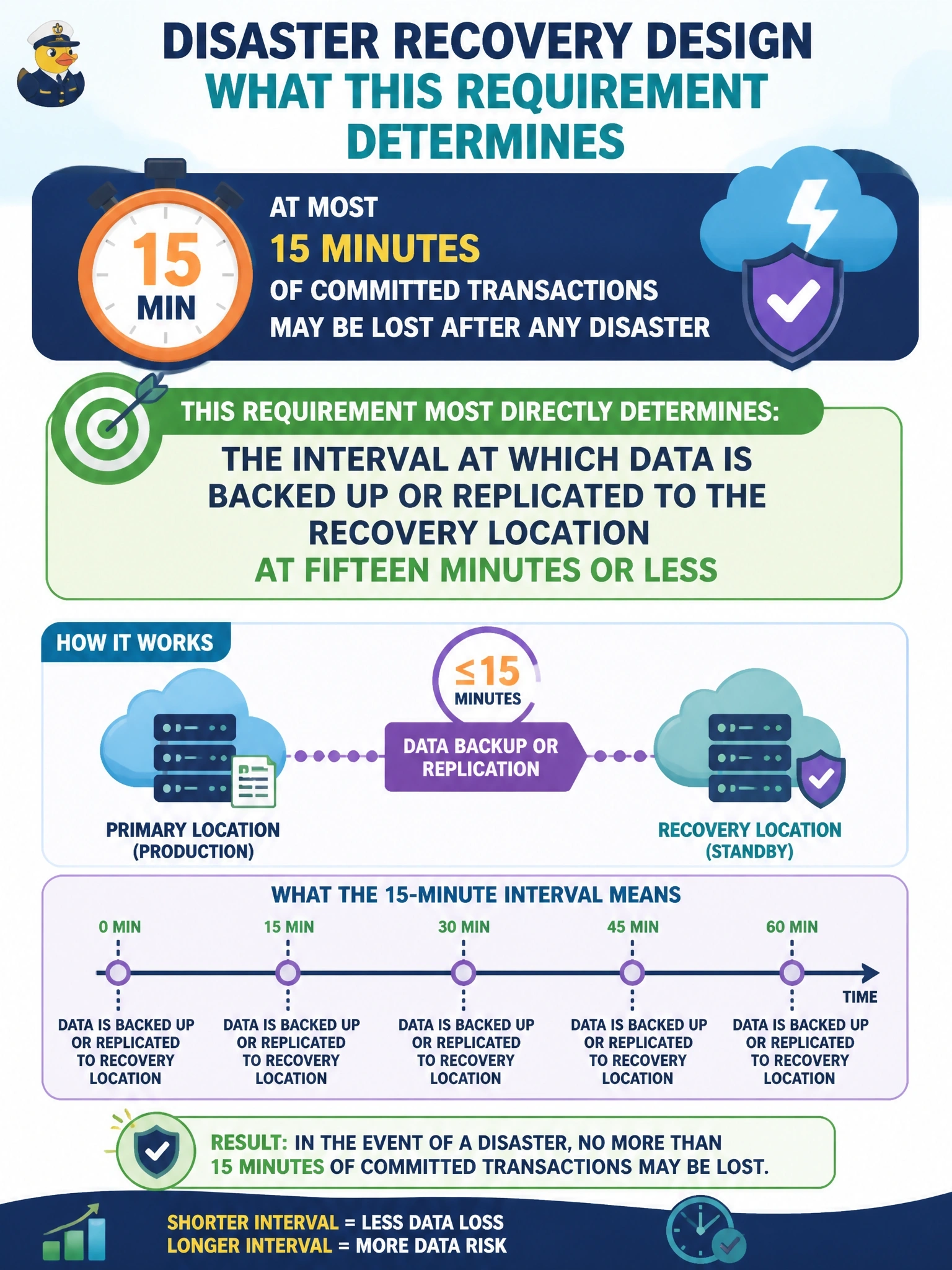
The finance department of a company running its trading ledger in the cloud states that, after any disaster, no more than fifteen minutes of committed transactions may be lost. Which aspect of the disaster recovery design does this requirement most directly determine?
Select an answer to reveal the explanation.
Short Explanation
Ask yourself: if the lights go out right now, how far back does your last good copy go? That gap is your RPO, and fifteen minutes of tolerated loss means you need a copy at least every fifteen minutes. Don't mix it up with RTO, which is about how fast you're back up, not how much you lost.
Full Explanation
A recovery point objective is expressed as an amount of time before the disruption: it is the oldest point to which data may be restored without unacceptable loss. A fifteen-minute RPO therefore sets the maximum gap between protected copies of the data, which in practice means snapshots, log shipping or replication to the recovery location at least every fifteen minutes, or continuous replication. The speed at which the recovery environment comes online is governed by the recovery time objective, a separate requirement that this statement does not address; a system could restore quickly and still lose an hour of data if copies are infrequent. The capacity the recovery site must provide is the recovery service level, which concerns degraded operation, not data loss. Backup retention periods are set by records management, legal and regulatory obligations, and they answer how long copies are kept, not how fresh the newest one is. Exam caveat: asynchronous replication can lag under load, so the achieved RPO may exceed the configured interval; designs for tight RPOs must measure lag, not assume it. Operational check: review backup or replication schedules and monitored replication lag for the ledger, and confirm in a restore test that the recovered data is no more than fifteen minutes older than the simulated failure point.