
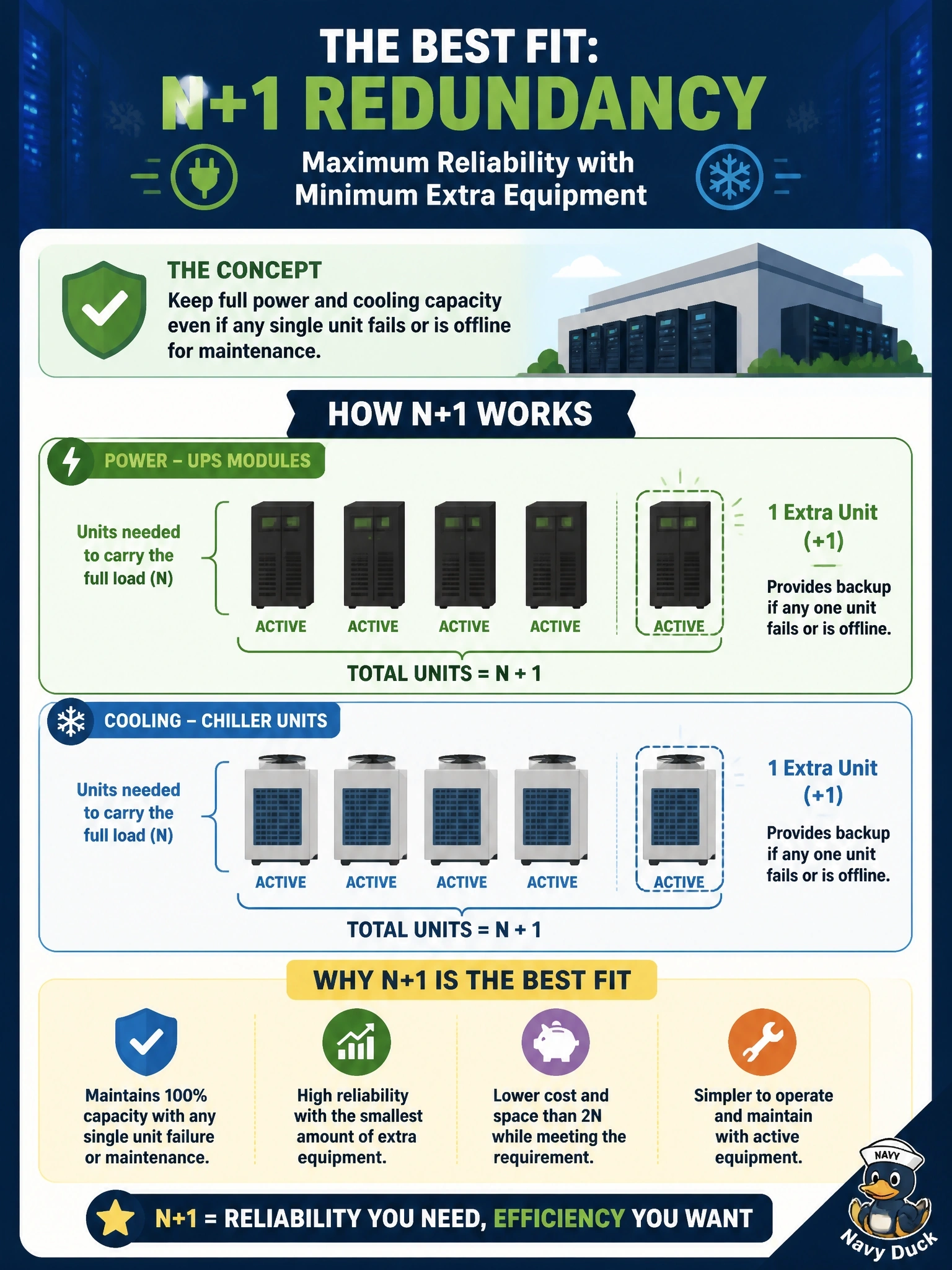
A data center design team must ensure the facility keeps full power and cooling capacity if any single chiller or UPS module fails or is taken offline for maintenance. The budget calls for the smallest amount of extra equipment that meets this requirement. Which redundancy model fits best?
Select an answer to reveal the explanation.
Short Explanation
Think of it like carrying one spare tire: if any single tire goes flat, you're still rolling on a full set. N+1 adds exactly one extra unit, which covers one failure or one maintenance window at the lowest cost. 2N would work too, but you'd be buying a whole second car when the requirement only asked for a spare tire.
Full Explanation
Redundancy models describe how much capacity exists beyond the load requirement, called N. N+1 adds one unit of spare capacity, so the loss of any single component, whether from failure or planned maintenance, still leaves enough units to carry the full load. It meets the requirement with the least additional equipment. An N design has exactly enough capacity; spare parts in a store help with repair time, but while a unit is down the facility runs short of capacity, which violates the requirement. A 2N design duplicates every system on an independent path, tolerating the loss of an entire distribution path and even concurrent maintenance plus failure, but it roughly doubles the infrastructure, so it exceeds the stated budget constraint when a single-component tolerance is all that is required. Load shedding preserves critical services by reducing demand, which means accepting reduced capacity rather than maintaining full capacity, so it fails the requirement by definition. Exam caveat: N+1 tolerates one component outage at a time; if a second unit fails during maintenance, capacity is lost, which is why critical facilities sometimes choose 2N or 2N+1. Operational check: take one chiller or UPS module offline in a maintenance window and confirm the remaining units carry the measured peak load.