
Encrypted archives must remain readable for seven years. During that period the company expects to replace its encryption tooling and adopt new document formats. What must the archiving procedure ensure?
Select an answer to reveal the explanation.
Short Explanation
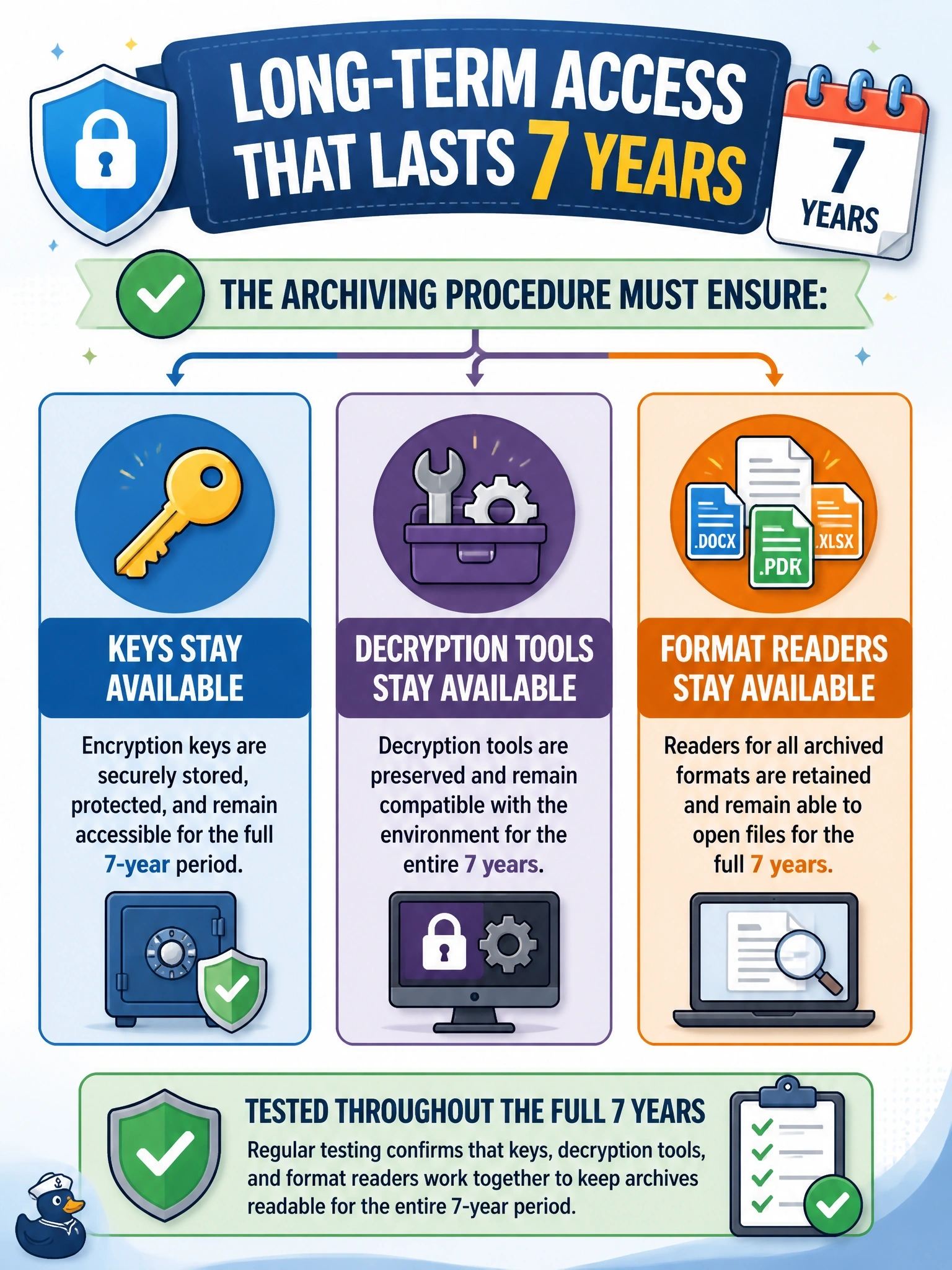
An archive you can't open is just expensive digital landfill. For seven years you need the keys, the software to decrypt and the software to read the format, and you need to prove they still work. Destroying old keys early is the trap, because that's crypto-shredding by accident.
Full Explanation
Archiving preserves data for long periods so it can be retrieved and understood when needed. For encrypted archives, readability depends on three things remaining available for the whole retention period: the keys that decrypt the data, the tools that can perform decryption with those keys and algorithms, and software that can interpret the stored file formats. Archiving procedures should therefore include key retention aligned to the archive period, documented algorithms and tooling, format migration or preservation of readers, and periodic test restores to prove the archive is usable. Destroying old keys when new tooling arrives would make existing archives permanently unreadable, effectively crypto-shredding records the company is obligated to keep. Keeping archives only inside an application that will be retired ties readability to a system that will disappear, so data would be stranded. Storing archives uncompressed in the hottest tier addresses retrieval speed and greatly raises cost, but does nothing about keys, tools or formats, which are the actual risks to readability. Exam caveat: archives also need integrity verification and protection appropriate to their classification. Operational check: schedule periodic test restores that decrypt and open sample archives using the current procedure and record the results.