
At contract termination, a customer needs assurance that its SaaS provider has deleted the customer's data from production systems and backups. What should have been put in place to provide that assurance?
Select an answer to reveal the explanation.
Short Explanation
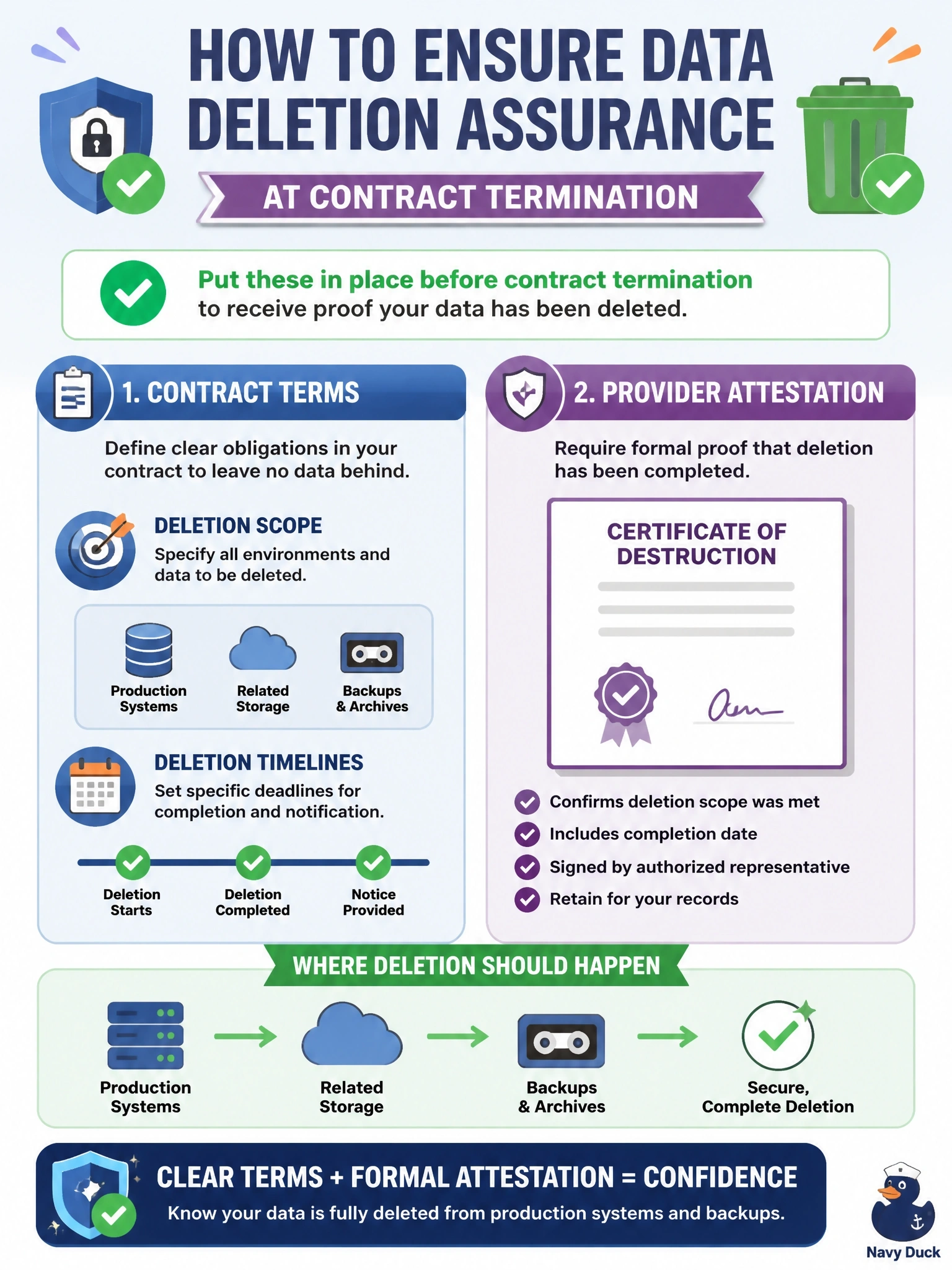
In SaaS you can't go check the provider's disks yourself, so you lock in deletion through the contract. Spell out what gets deleted, by when, and how they'll prove it, like a certificate of destruction. An export just gives you a copy; it doesn't prove theirs is gone.
Full Explanation
In SaaS, the customer has no access to the provider's infrastructure, so assurance of deletion depends on contractual commitments and the provider's attestations. The contract should define what data is in scope, including production copies, replicas, logs and backups, the timeline for deletion after termination, the method used and the evidence the provider will deliver, such as a written attestation or certificate of destruction, possibly supported by independent audit reports. These terms should be negotiated at onboarding, when the customer has leverage, and form part of the exit strategy. A customer-run degaussing of the provider's disks is not feasible; the infrastructure is shared, the customer has no physical access and degaussing does not apply to solid-state media. A final export is important for reversibility and portability, but it only gives the customer a copy; it says nothing about whether the provider's copies were deleted. An SLA uptime credit addresses service availability, not data disposition, and compensation after the fact does not provide assurance. Exam caveat: where the customer controls encryption keys, crypto-shredding can supplement contractual deletion. Operational check: confirm the contract specifies deletion scope, timeline and evidence, and track receipt of the certificate at exit.