
Auditors ask which columns across a company's cloud-hosted relational databases contain national ID numbers. Which data discovery approach is most efficient for this type of data?
Select an answer to reveal the explanation.
Short Explanation
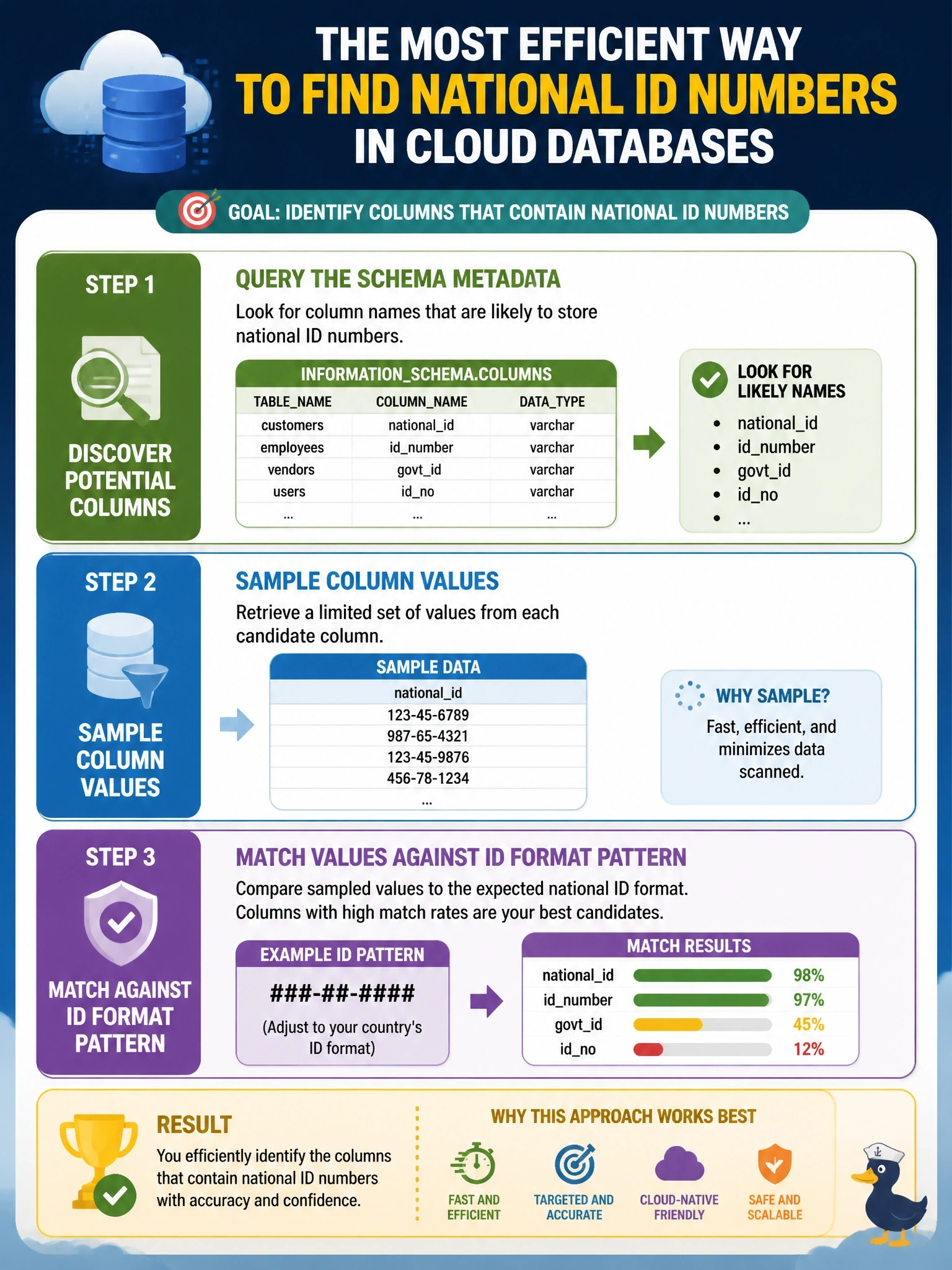
Relational databases hand you a table of contents for free: the schema. You use it to narrow down suspicious columns, then confirm with pattern matching on sample values. OCR and file-share scanning are tools for messy, unstructured data, not neat rows and columns.
Full Explanation
Structured data has a defined schema: tables, columns, data types and constraints are described in metadata that can be queried directly. That makes discovery efficient. The team can search the catalog for column names and comments that suggest identity data, then sample values from candidate columns and test them against the known format of a national ID number with pattern matching and validation such as checksum rules where they exist. Sampling all columns, not only well-named ones, catches cases where a field was named generically. Optical character recognition is a technique for unstructured content such as scanned documents and images; database exports of structured values do not need it. Access logs show who queried which objects, which supports auditing and accountability, but they do not reveal what data a column contains and would miss columns nobody queried. Machine learning content analysis of file shares targets unstructured documents in a different repository, so it does not answer the question about database columns. Exam caveat: column names can be misleading, so metadata search should always be confirmed by content sampling. Operational check: record each confirmed column in the data inventory with its classification and owner, and schedule rescans when schemas change.