
A hospital has thousands of PDFs, scanned forms and text files in cloud object storage that may contain health information. There is no schema, and file names and folders follow no consistent convention. Which data discovery approach fits this situation?
Select an answer to reveal the explanation.
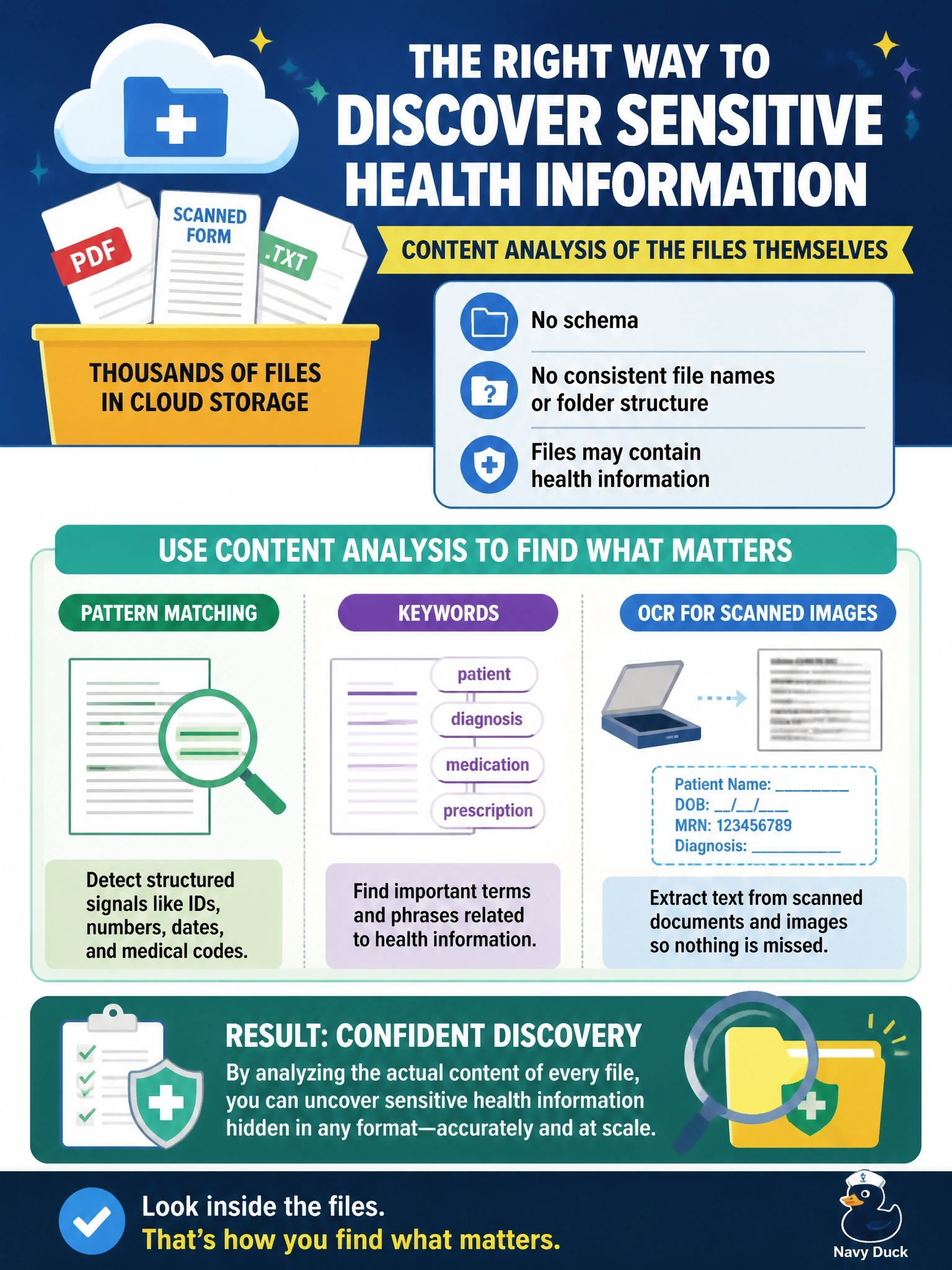
Short Explanation
With unstructured files there's no table of contents, so you've got to read the pages. Content analysis does exactly that, and OCR turns those scanned forms into text it can search. Schemas and row sampling only work when the data actually has rows and columns.
Full Explanation
Unstructured data, such as documents, scanned images, presentations and free text, has no predefined schema that describes its contents. Discovery therefore relies on content analysis: tools open each file, extract text, apply optical character recognition to images and scanned forms, and then match patterns, keywords, dictionaries, document fingerprints or machine learning classifiers that recognize health information. This is slower and more computationally demanding than structured discovery but is the only reliable way to know what such files contain. Schema inspection reads column definitions in databases; object storage holding PDFs and scans has no columns to inspect. Metadata review using file names and folder paths can help prioritize, but the scenario states these follow no consistent convention, so they cannot be trusted to identify health data and would miss sensitive files with innocuous names. Database query sampling selects rows from tables, which presumes structured data that does not exist here. Exam caveat: content analysis produces false positives and false negatives, so tuning and human review of a sample of results are expected. Operational check: run discovery on a known test set first to measure accuracy, then record findings in the data inventory and apply classification labels to the files that contain health information.