
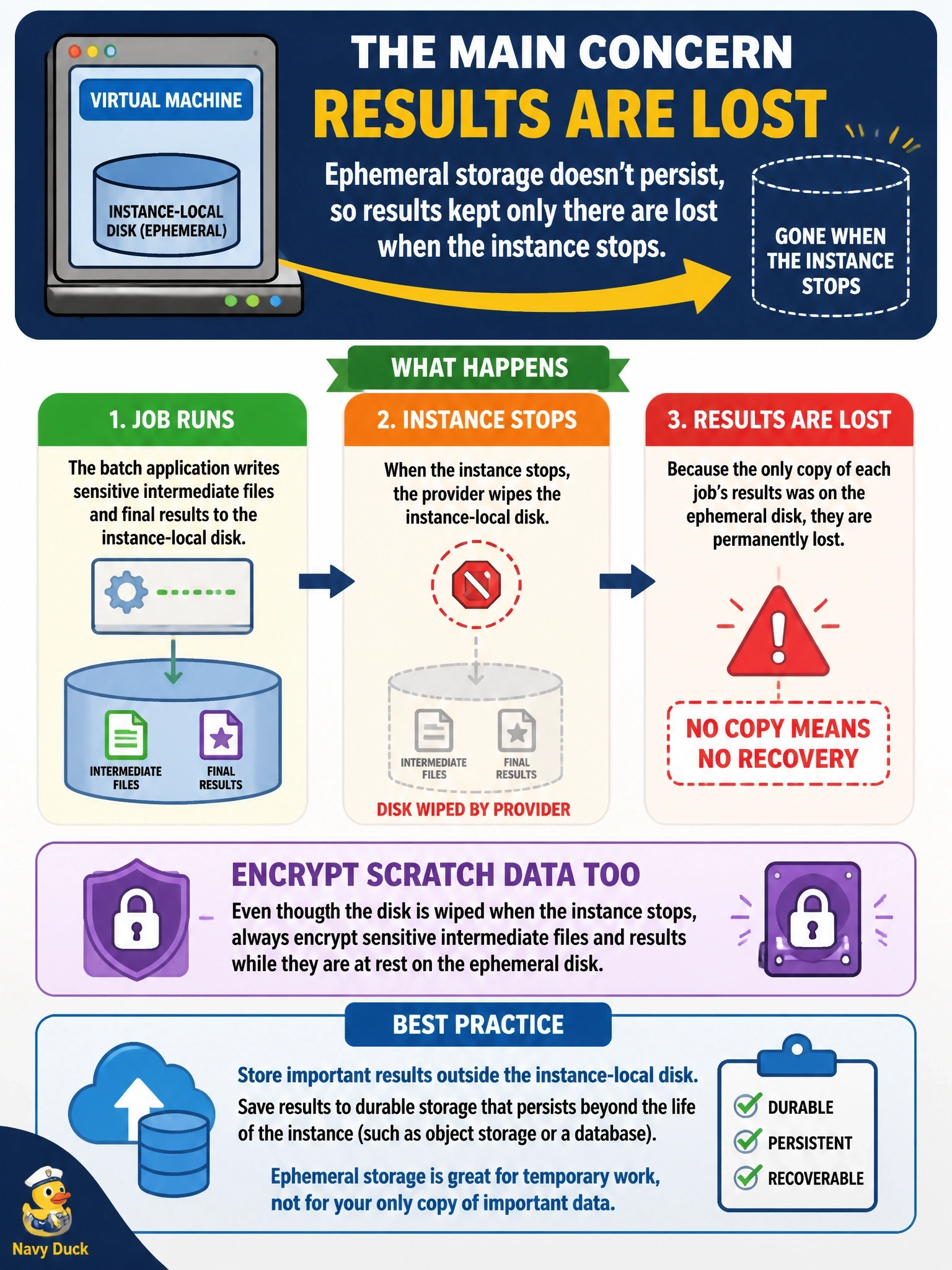
A batch application writes sensitive intermediate files to the instance-local disk of a virtual machine, which the provider wipes when the instance stops. The team now also plans to keep the only copy of each job's results on that same disk. What is the main concern with this design?
Select an answer to reveal the explanation.
Short Explanation
Instance-local disk is a whiteboard that gets wiped the moment you leave the room. It's fine for scratch work, but you'd never leave your only copy of the results on it. And while the data is on there, you still want it encrypted.
Full Explanation
Ephemeral storage is temporary storage tied to the life of a compute instance. Its contents disappear when the instance stops, terminates, is moved or fails, which makes it suitable for caches, buffers and scratch files but unsuitable as the sole location of data that must survive. Keeping the only copy of job results there creates an availability and data-loss risk, so results should be written to persistent volume or object storage. Sensitive scratch files still deserve protection while they exist, such as encryption and restricted access, because the threat to ephemeral data includes exposure during the instance's life and remanence concerns if sanitization is not assured. The claim that ephemeral disks replicate to other tenants' hosts is false; isolation between tenants is a basic provider obligation, and ephemeral storage is not replicated at all. The claim that ephemeral storage cannot be encrypted is also wrong, since guest-level or provider-level encryption can be applied. Billing per object request describes object storage pricing, not instance-local disks, and cost is not the main security concern described. Exam caveat: ephemeral computing is a design strength for immutable workloads, provided state lives elsewhere. Operational check: confirm job output is written to durable storage before the instance is released.