
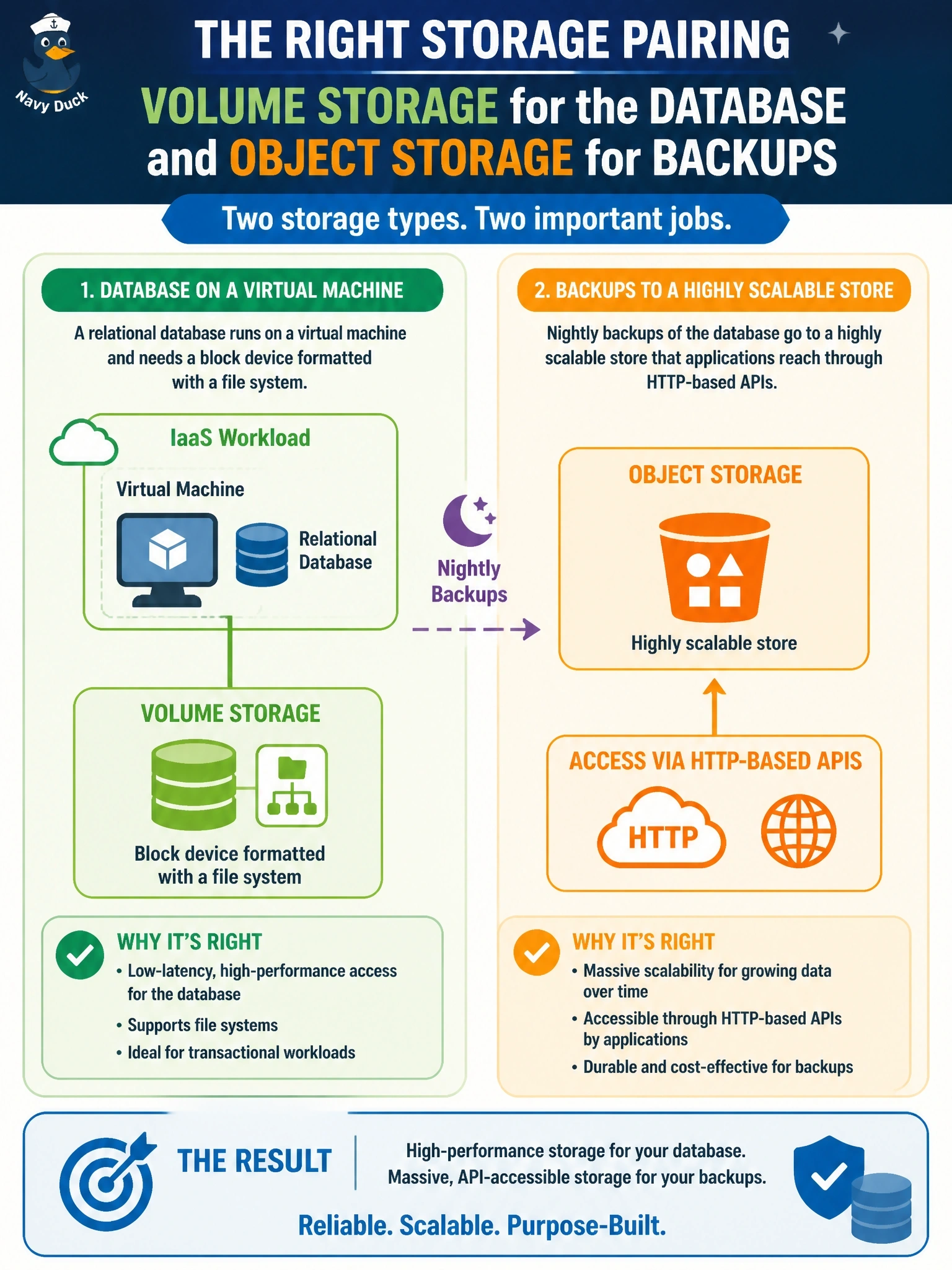
An IaaS workload runs a relational database on a virtual machine that needs a block device formatted with a file system. Nightly backups of that database must go to a highly scalable store that applications reach through HTTP-based APIs. Which storage pairing fits these requirements?
Select an answer to reveal the explanation.
Short Explanation
Think of volume storage as a hard drive you plug into the VM, and object storage as a giant warehouse you talk to over the web. Your database wants the drive; your backups want the warehouse. The trap is swapping them, or parking a database on ephemeral disk that vanishes when the VM stops.
Full Explanation
Cloud storage types in IaaS differ by how they are presented and accessed. Volume storage is block storage attached to a virtual machine, appearing to the guest operating system as a disk that can be formatted with a file system, which is exactly what a relational database engine expects for its data files. Object storage stores data as objects with metadata in a flat namespace and is accessed through HTTP-based APIs; it scales to very large capacities and suits backups, archives and unstructured files. Reversing the pairing fails because databases generally cannot run directly on an API-accessed object store, and an attached volume is not reachable through HTTP APIs. Ephemeral instance storage is non-persistent and is lost when the instance stops or fails, so it cannot hold the primary database, and raw storage refers to direct access to a physical device such as raw device mapping, not a scalable API service. Writing backups to a second attached block device keeps them in the same failure and access domain as the database and misses the API and scale requirement. Exam caveat: some providers offer file storage as a third presentation, but the stated requirements point to volume and object. Operational check: confirm backups land in object storage with access policies and encryption applied.