
A company must keep financial records for ten years in a low-cost archival storage tier, encrypted with keys the company manages itself. Which set of threats should the long-term storage design specifically address?
Select an answer to reveal the explanation.
Short Explanation
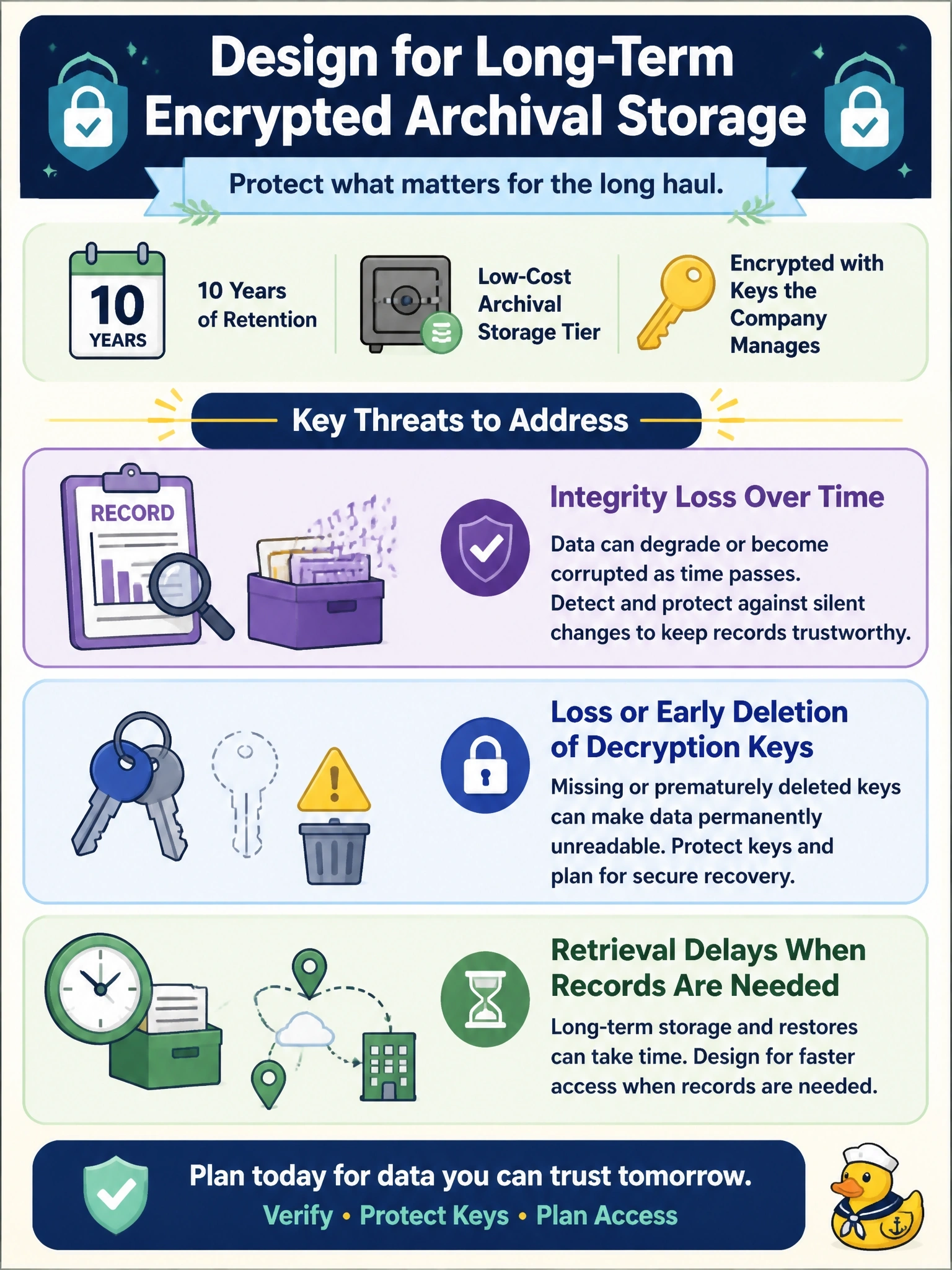
Long-term storage is a time capsule: you need the contents intact, the key to open it, and a realistic idea of how long it takes to dig it up. Lose the key in year six and those records are gone for good. The trap answers describe hot or compute storage, not an archive.
Full Explanation
Long-term storage holds data that is rarely accessed but must be preserved for years, typically in low-cost archival tiers. The threats that matter are those that accumulate with time. Integrity can degrade or be silently altered, so periodic integrity verification with stored hashes is needed. When the customer manages its own encryption keys, losing, rotating away or prematurely destroying a key makes the archive unreadable, which is effectively data destruction, so key retention must match the record retention period. Archival tiers also commonly impose retrieval delays, which matters when records are needed for audits, litigation or regulatory requests, so retrieval time must be planned. Real-time transaction latency is a concern for hot storage serving active databases, not for an archive designed for infrequent access. Data loss on instance stop describes ephemeral storage tied to compute instances, which is the opposite of a durable archival tier. Hypervisor escape is a virtualization threat involving workloads running on shared hosts; an archival storage tier does not run customer code. Exam caveat: format obsolescence is a related long-term risk worth remembering. Operational check: confirm key retention, scheduled integrity checks and a tested retrieval procedure are documented for the full ten years.