
While negotiating a cloud contract, a company insists on a clause stating that when the agreement ends, the provider must return all of the company's data and application artifacts in a usable form and then delete all remaining copies after an agreed period. Which cloud shared consideration does this clause address?
Select an answer to reveal the explanation.
Short Explanation
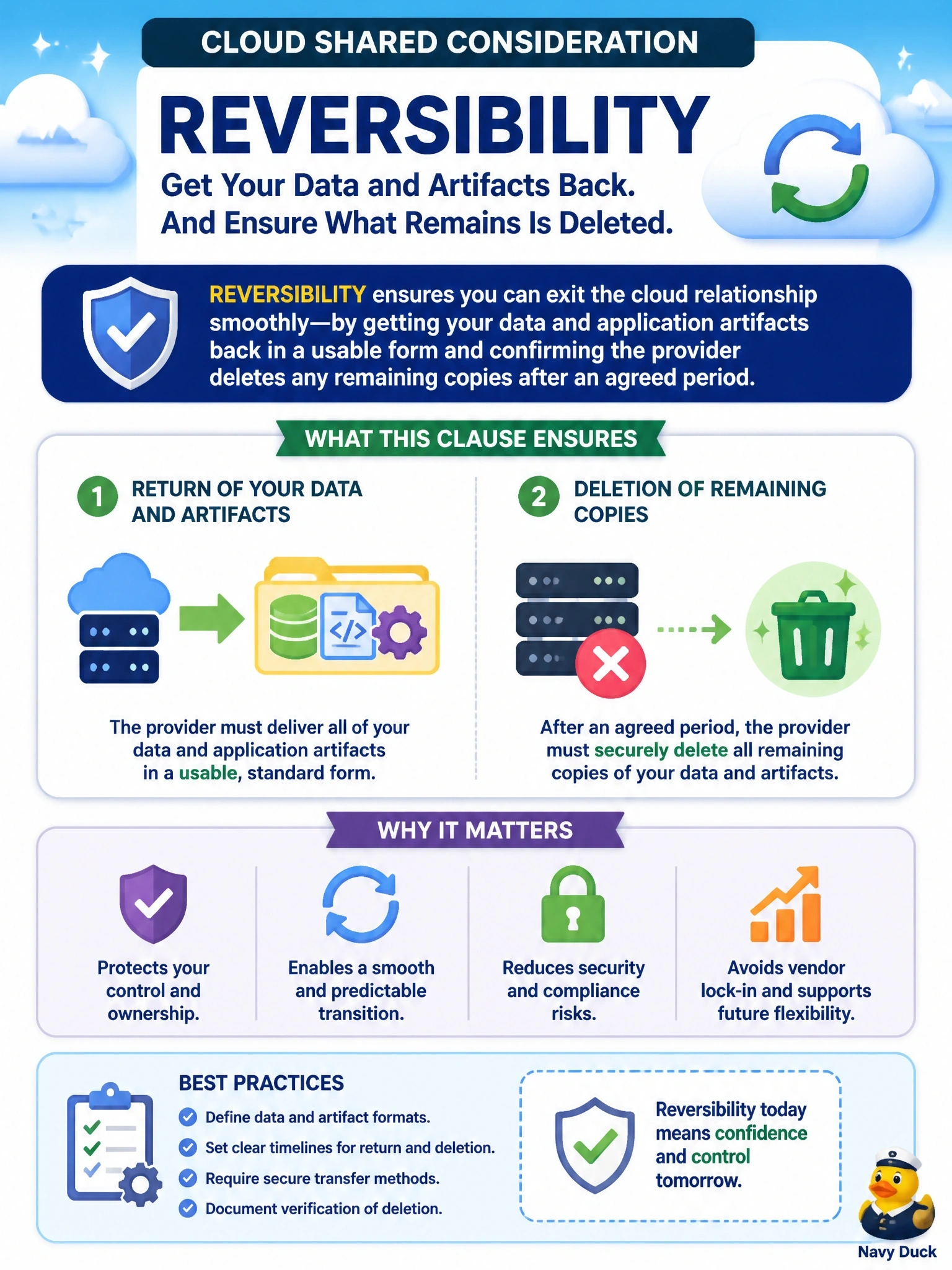
It's the moving-out inspection: you get your stuff back, and the landlord clears out every last box you left. That's reversibility. The trap is portability, which is about whether your stuff fits the next place, not about getting it back and wiped.
Full Explanation
ISO/IEC 17788 defines reversibility as the process for cloud service customers to retrieve their cloud service customer data and application artifacts, and for the provider to delete all customer data, as well as contractually specified cloud service derived data, after an agreed period. The clause covers both halves exactly: return of data and artifacts, then deletion of what remains. Portability is the ability to move data or applications between systems, such as from one provider to another, with low cost, minimal disruption and no need to re-enter or rework them; it concerns usable formats and compatibility at the destination, not the provider's obligation to return and erase. Interoperability is the ability of two or more systems to exchange information and mutually use what has been exchanged, which concerns ongoing integration rather than exit. Auditability concerns collecting and making available evidence about the operation and use of a service, which may help verify deletion but is not the consideration the clause establishes. Exam caveat: reversibility, portability and interoperability are often bundled in contract discussions, so look for the return-then-delete pattern. Operational check: confirm the contract specifies export formats, timelines, the deletion method and a written certificate of deletion at exit.