
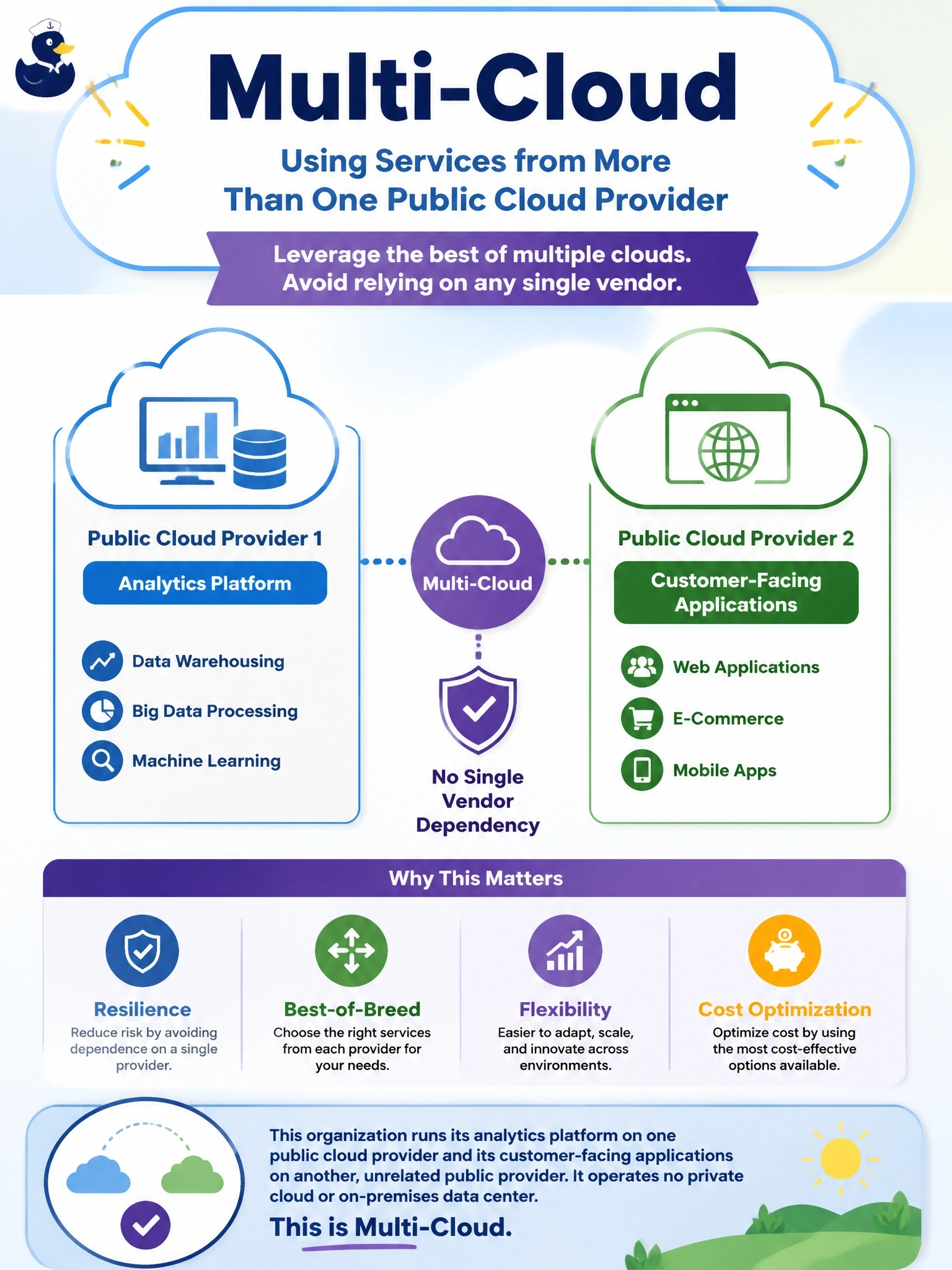
An organization runs its analytics platform on one public cloud provider and its customer-facing applications on a second, unrelated public provider, specifically to avoid depending on any single vendor. It operates no private cloud or on-premises data center. Which deployment model describes this arrangement?
Select an answer to reveal the explanation.
Short Explanation
Shopping at two different grocery stores so one closure doesn't leave you hungry is multi-cloud thinking. Two public providers, no private piece: that's multi-cloud. The trap is hybrid, which needs a private or on-premises side in the mix.
Full Explanation
Multi-cloud describes the use of cloud services from two or more cloud providers, commonly to reduce dependence on a single vendor, use best-of-breed services, or meet resilience goals. Here the organization consumes services from two unrelated public providers and has no private or on-premises component, which is the defining pattern. A hybrid cloud, as commonly tested, combines distinct infrastructures such as a private cloud or on-premises environment with a public cloud, bound together to allow data and application portability; with no private side, the hybrid label does not fit. A community cloud is provisioned for exclusive use by a group of organizations with shared concerns, whereas this is one organization buying public services. A private cloud is provisioned for exclusive use of a single organization, and buying standard public services from two vendors does not make them private. Exam caveat: multi-cloud reduces lock-in but increases operational complexity, because identity, logging, key management and policy must work consistently across different providers. Operational check: confirm the organization has a consistent identity federation, central log collection and a single security policy baseline applied to both providers, so a gap in one is visible.