
During due diligence, a customer asks a public cloud provider to name the physical host and rack that run its virtual machines. The provider replies that workloads are placed dynamically across shared hardware and that the location is not exposed. What does this most directly imply for the customer's security assumptions?
Select an answer to reveal the explanation.
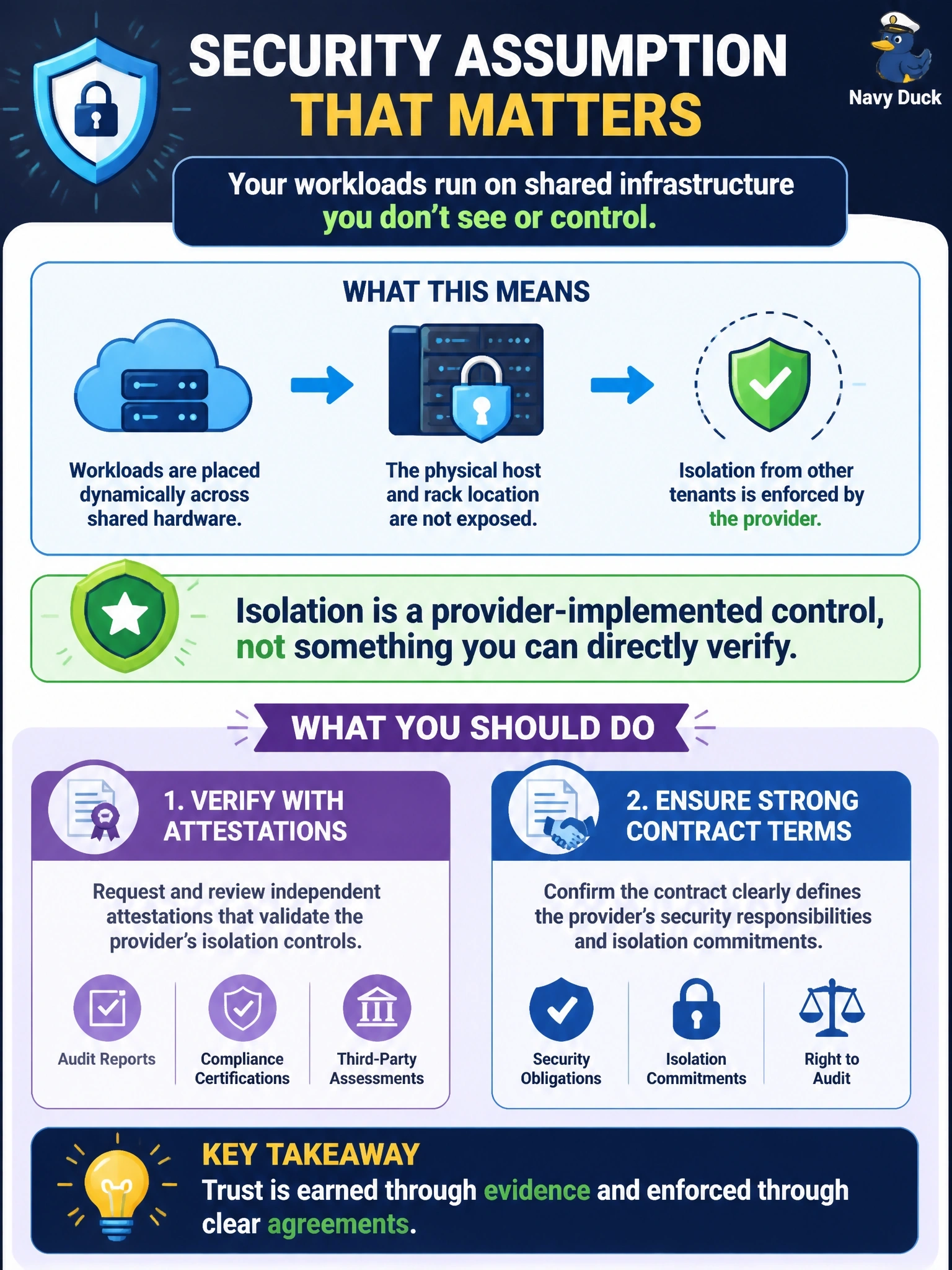
Short Explanation
Living in an apartment block, you can't inspect the walls between your unit and the neighbors yourself; you rely on building codes and inspections. Shared hosts are the same: the provider builds the isolation and you verify it on paper. The trap is thinking you can demand to see the hardware or that sharing makes your duties disappear.
Full Explanation
Resource pooling and multi-tenancy mean the provider serves many consumers from shared physical resources, dynamically assigned according to demand, with a sense of location independence in which the customer generally has no control or knowledge over the exact location of the resources. Tenant isolation therefore depends on controls the provider implements in the hypervisor, network fabric and storage layers. The customer cannot observe those controls directly, so it gains assurance through independent attestations, certifications and contractual commitments. Assuming dedicated hardware contradicts the reply: dynamic placement across shared hardware is the opposite of dedication. Demanding host-level console access is unrealistic in a multi-tenant service, and granting it would itself weaken the isolation of other tenants. Location independence at the host level does not remove legal obligations; customers can usually still select a region, and residency and jurisdiction remain the customer's compliance concern. Exam caveat: dedicated host options exist in some offerings, but they change the cost and tenancy model rather than proving isolation in a shared one. Operational check: review the provider's SOC 2 Type II report for controls covering logical tenant separation and confirm the contract states the regions where data may be processed.