
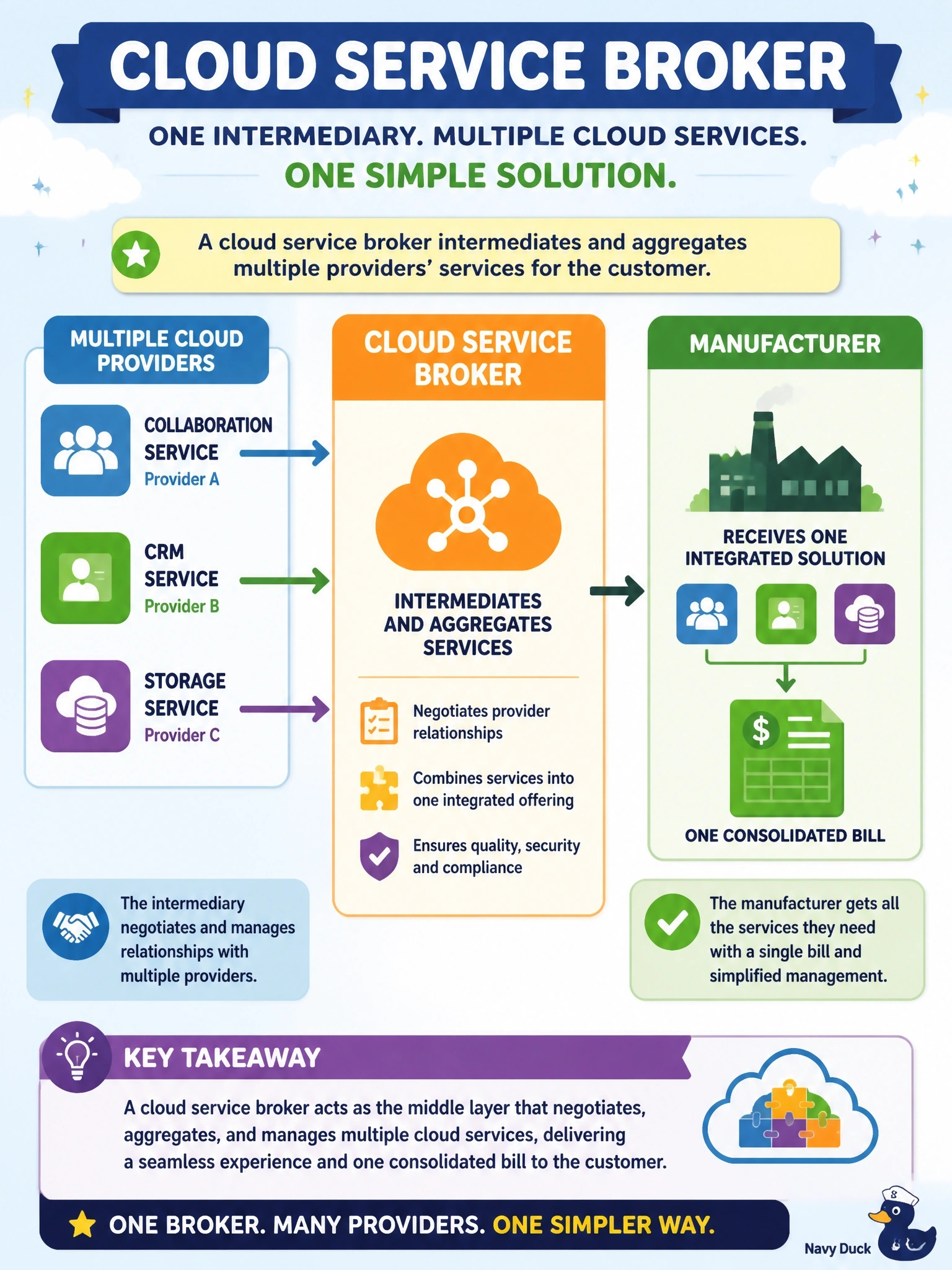
A manufacturer buys collaboration, CRM and storage services from three different cloud providers through a single intermediary. The intermediary negotiates the provider relationships, combines the services into one integrated offering and sends the manufacturer one consolidated bill. Which cloud role does the intermediary fill?
Select an answer to reveal the explanation.
Short Explanation
A travel agent books your flights, hotel and car from different companies and hands you one itinerary and one bill. That's a cloud service broker. Don't be misled by the single invoice: whoever sends the bill isn't automatically the provider running the services.
Full Explanation
A cloud service broker manages the use, performance and delivery of cloud services and negotiates relationships between providers and customers. NIST SP 500-292 describes three broker functions: intermediation (enhancing a service with capabilities such as identity or performance reporting), aggregation (combining multiple services into one), and arbitrage (choosing among providers flexibly). Negotiating with three providers, integrating their services and consolidating billing fits intermediation and aggregation. The provider role belongs to the parties that actually make the collaboration, CRM and storage services available and operate them; issuing an invoice for a bundle does not make the intermediary the operator of those services. A cloud carrier supplies connectivity and transport between consumers and providers, and nothing in the scenario involves network transport. A cloud auditor conducts independent assessment of cloud services, controls and performance; reviewing services is not what this intermediary was hired to do. Exam caveat: in ISO/IEC 17789 the broker is modeled as a sub-role of the cloud service partner, so read whether a question asks for the general role or the specific function. Operational check: confirm the contract states which party answers for incidents and SLAs for each underlying service, because the broker may not.