
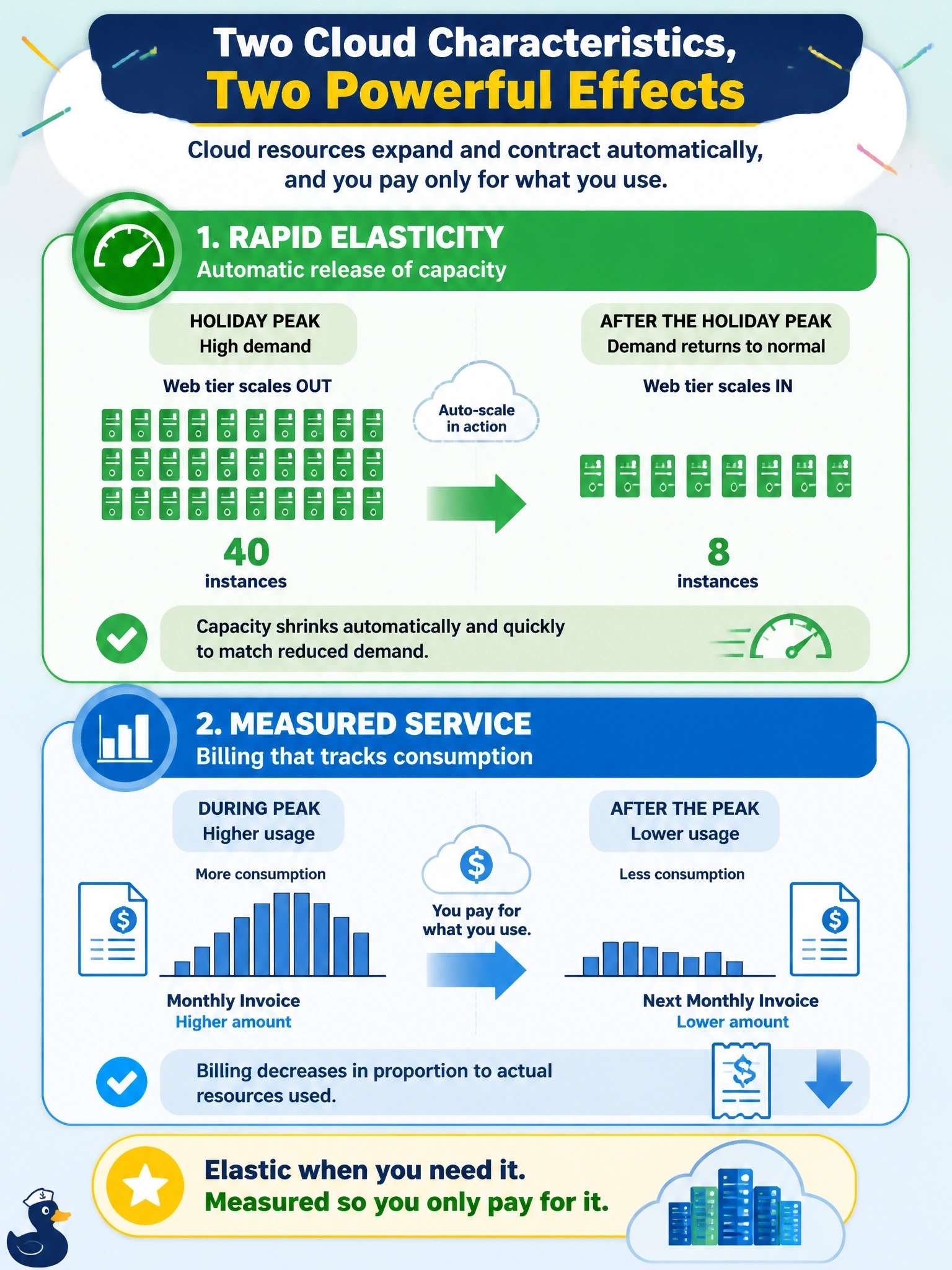
After the holiday peak, an online retailer's web tier shrinks automatically from forty instances to eight, and the next monthly invoice falls in proportion to the reduced usage. Which pair of essential cloud characteristics best explains these two effects?
Select an answer to reveal the explanation.
Short Explanation
Picture a rubber band that stretches for the rush and snaps back afterward, with a meter running the whole time. Elasticity is the stretch and snap, and measured service is the meter that makes your bill shrink too. Don't let resource pooling fool you: it explains how the provider shares hardware, not why your invoice dropped.
Full Explanation
Rapid elasticity, as NIST SP 800-145 describes it, means capabilities can be elastically provisioned and released, in some cases automatically, to scale outward and inward with demand. The web tier contracting from forty to eight instances without human action is exactly that inward release. Measured service means the cloud system automatically controls and optimizes resource use through a metering capability, so usage is monitored, controlled and reported transparently to both provider and consumer; that metering is what lets the invoice follow consumption. Resource pooling explains how released capacity is reassigned to other consumers, but it does not explain the customer's bill, and multi-tenancy does not divide one tenant's invoice among others. On-demand self-service concerns unilateral provisioning without provider interaction, not automatic scaling, and pooling does not change the unit price. Broad network access concerns reachability from heterogeneous clients and plays no role in scaling or billing. Exam caveat: the outline lists rapid elasticity and scalability together; scalability alone can be planned and manual, while elasticity implies responsiveness to demand. Operational check: compare autoscaling activity logs against the provider's usage report for the same period and confirm the billed instance-hours match the scaling events.