
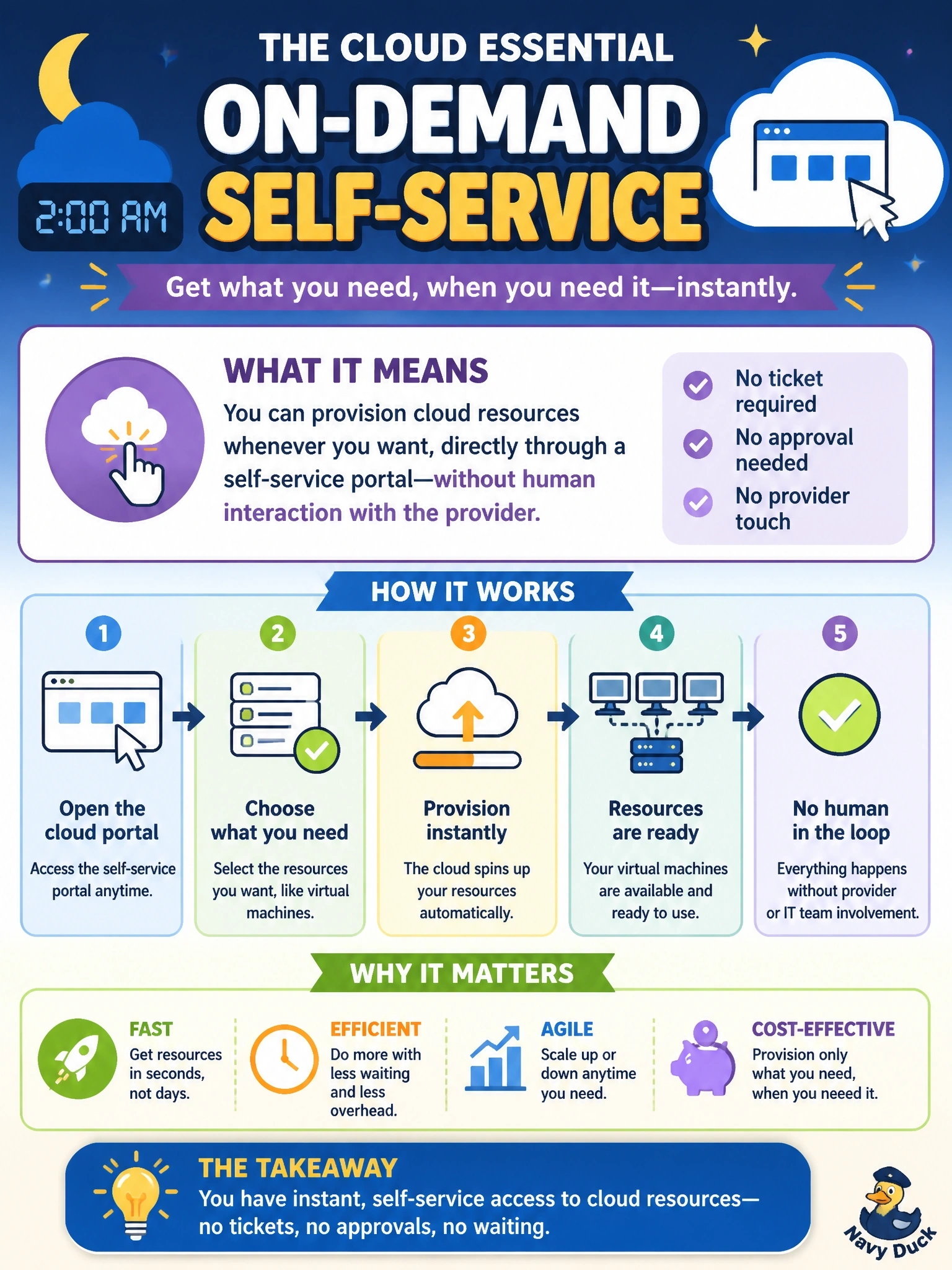
A developer at a retailer provisions three virtual machines through the cloud provider's web portal at 2 a.m. No ticket is raised, and nobody at the provider or in the retailer's IT team reviews, approves or performs any part of the request. Which essential cloud characteristic does this scenario demonstrate most directly?
Select an answer to reveal the explanation.
Short Explanation
Think of a vending machine: you walk up, pick what you want and nobody behind a counter has to help. That's on-demand self-service. The trap is rapid elasticity, which is about capacity growing and shrinking with load, not about who clicks the button.
Full Explanation
NIST SP 800-145 defines on-demand self-service as the ability of a consumer to provision computing capabilities, such as server time and network storage, unilaterally and automatically, without requiring human interaction with each service provider. The defining evidence in this scenario is the absence of any person in the loop: no ticket, no approval and no provider staff, yet machines appear on request. Rapid elasticity describes capabilities being provisioned and released elastically, often automatically, to scale with demand; a single developer creating three machines is not a workload expanding and contracting with load. Resource pooling is real in almost every public cloud, but it describes how the provider serves many consumers from shared physical resources, and nothing in the scenario turns on that sharing. Broad network access concerns availability over the network through standard mechanisms and heterogeneous clients; the portal being reachable is incidental, not the point being illustrated. Exam caveat: several characteristics are usually present at once, so pick the one the scenario's details single out. Operational check: confirm that self-service provisioning is governed by IAM permissions, quotas and tagging policy, because removing the human approver also removes a control point.