
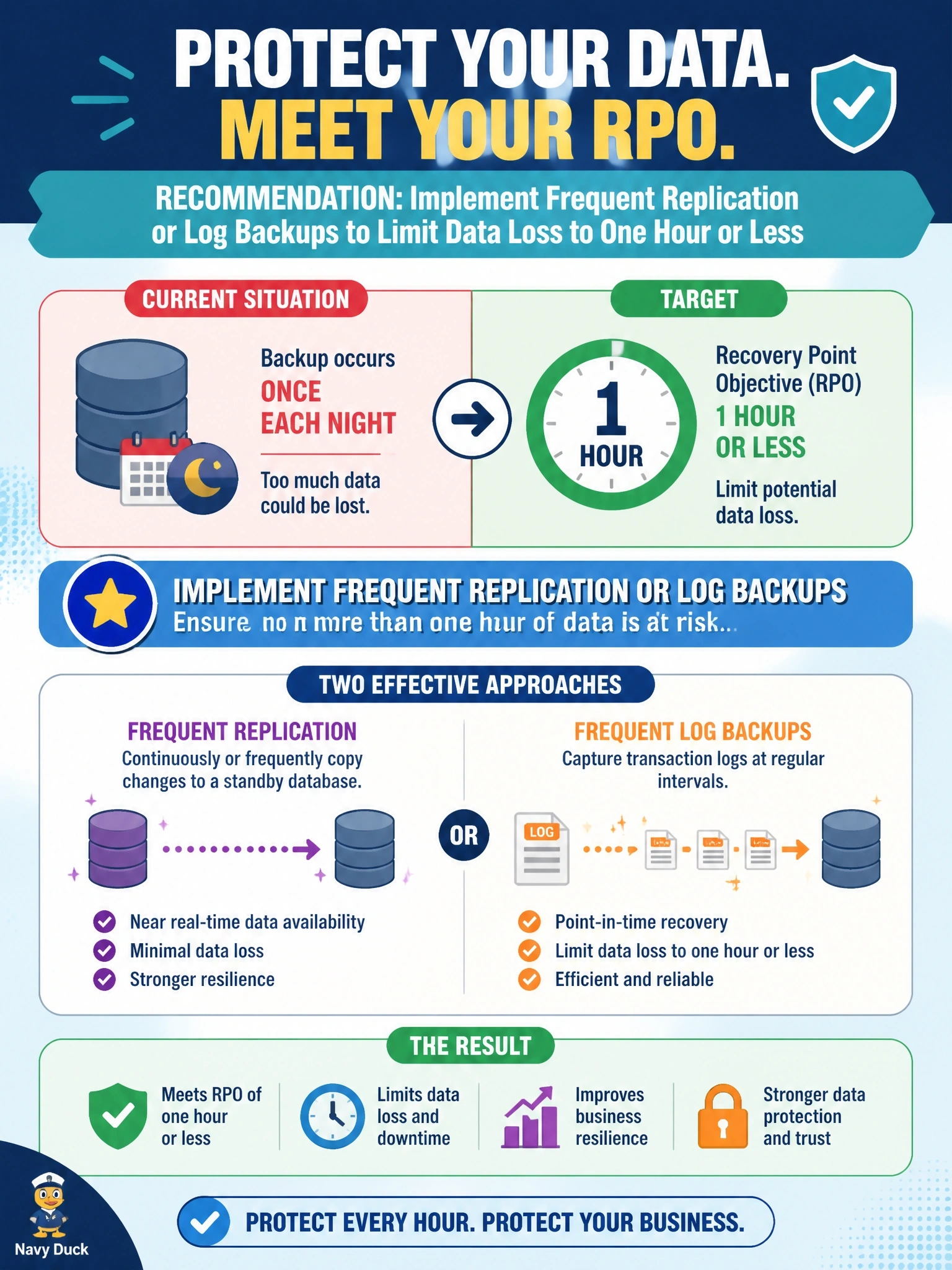
A business impact analysis sets a recovery point objective of one hour for the order database, but the database is backed up only once each night. What should the information security manager recommend?
Select an answer to reveal the explanation.
Short Explanation
RPO is the rearview mirror: how much data you can afford to lose. With nightly backups you could lose almost a full day of orders, so you need protection that captures changes at least hourly. Faster restores and longer RTOs are the trap; they're about time to recover, not data lost.
Full Explanation
The recovery point objective defines the maximum acceptable data loss, measured backward from the disruption. To meet a one-hour RPO, the organization must capture changes at least that often, for example through frequent incremental or transaction log backups or replication to another location. A nightly backup means up to roughly a day of orders could be lost, so the current arrangement does not meet the requirement the business set. Moving the backup to faster storage shortens restoration time, which relates to the recovery time objective; the restored data would still be up to a day old. Raising the recovery time objective to 24 hours confuses the two measures, since RTO concerns how long recovery takes, not how much data is lost, and changing a business-set objective to fit current technology reverses the proper relationship. Storing backups further away improves resilience against a regional event but leaves the backup interval, and therefore the potential data loss, unchanged. Exam caveat: if the cost of meeting the RPO is prohibitive, the business owner may decide to revise it, but that is a documented business decision, not a technical adjustment. Operational check: confirm the backup or replication interval is no longer than one hour and that a recent restore recovered data to within the RPO.