
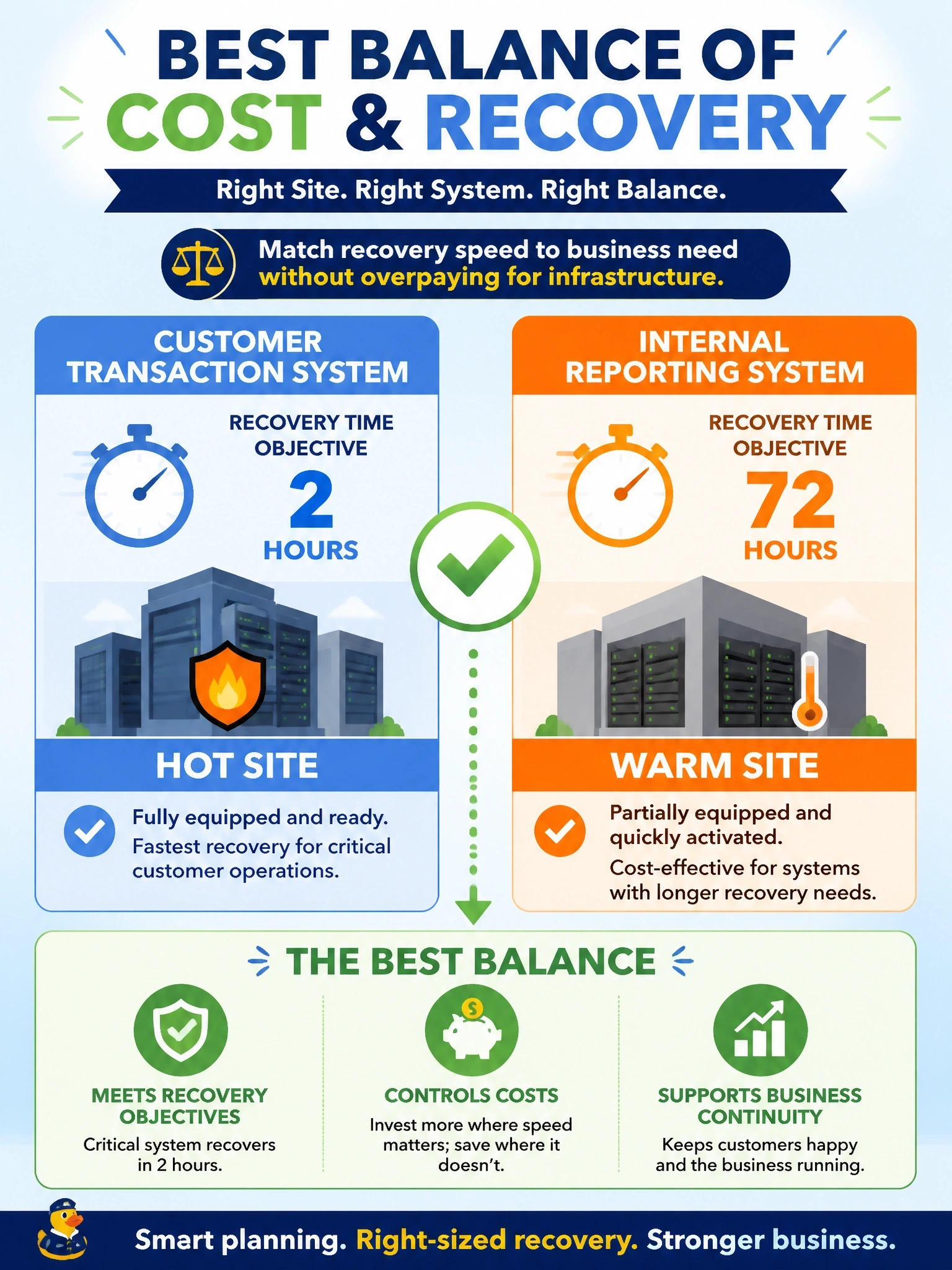
A BIA sets a recovery time objective of 72 hours for an internal reporting system and 2 hours for the customer transaction system. Which recovery site arrangement BEST balances cost and recovery needs?
Select an answer to reveal the explanation.
Short Explanation
Match the site to the clock. A 2-hour RTO needs a hot site that's ready to go; a 72-hour RTO can live with a cheaper warm site you bring up over a day or two. Paying hot-site prices for everything is the trap; it's secure, sure, but it's not cost-effective.
Full Explanation
Recovery site choices trade recovery speed against cost. A hot site is fully equipped and kept close to current, so it can take over within hours, which suits the transaction system's 2-hour recovery time objective. A warm site has infrastructure and some equipment in place but needs configuration and data restoration, typically taking longer, which fits the reporting system's 72-hour objective at lower cost. Matching each system to the least expensive option that meets its objective is the cost-effective approach the BIA is meant to support. A hot site for both meets the objectives but spends heavily to recover a system far faster than the business requires, which is not a balanced use of resources. A cold site for both provides space and utilities only and needs equipment installed and configured, which cannot meet a 2-hour objective; the savings would leave the transaction system unprotected. A reciprocal agreement with a partner organization depends on spare capacity that may not exist when needed, is hard to test and gives no assurance of a 2-hour recovery. Exam caveat: cloud-based recovery options can provide similar tiers, and the same matching principle applies. Operational check: confirm tested failover times for each site arrangement are within the corresponding system's recovery time objective.