
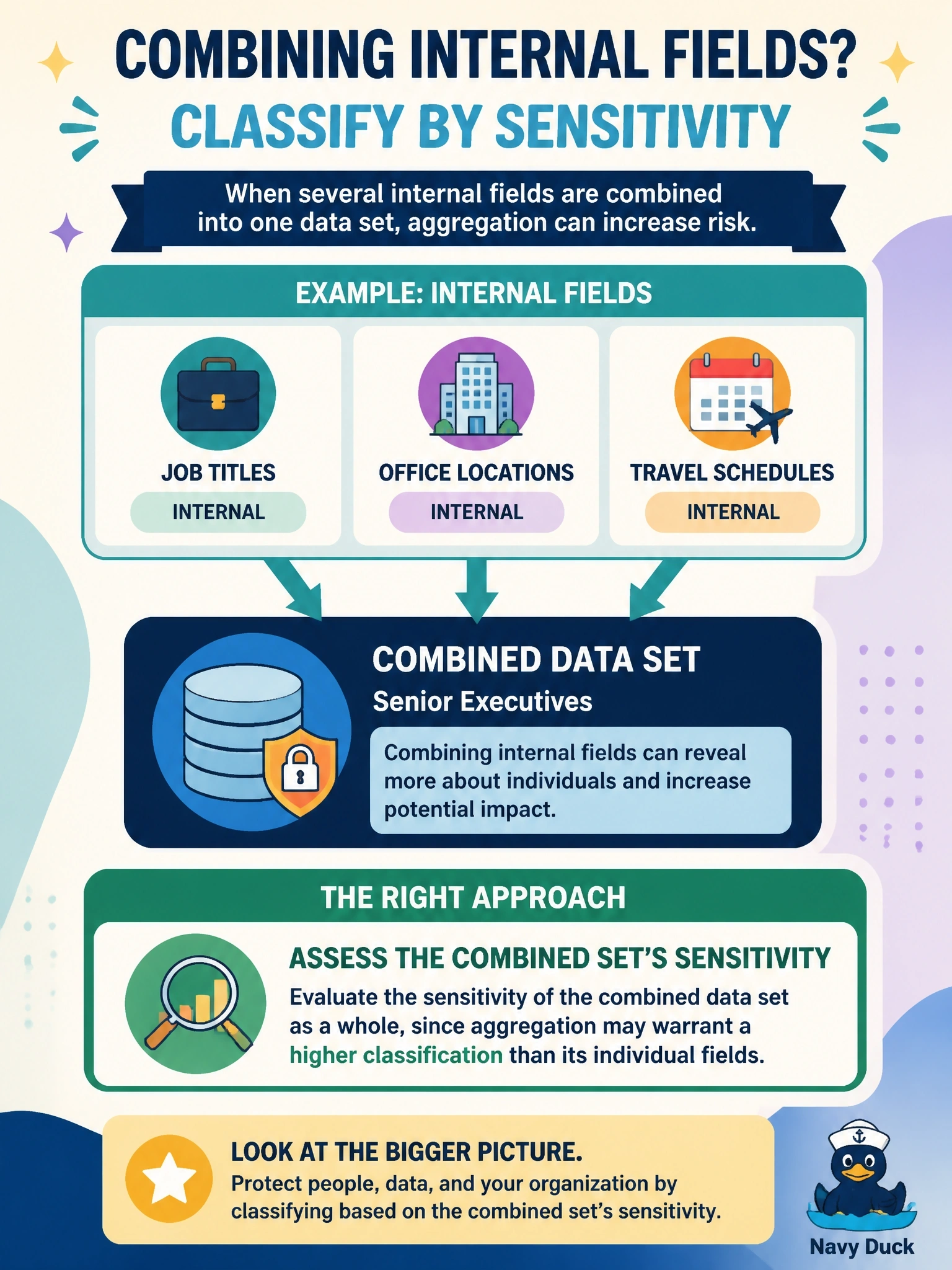
Analysts propose combining several fields that are each classified as internal, such as job titles, office locations and travel schedules, into one data set describing senior executives. How should the combined data set be classified?
Select an answer to reveal the explanation.
Short Explanation
One puzzle piece tells you nothing, but put them together and you've got the picture. Combining harmless fields can create something sensitive, like where your executives will be and when, so you assess the whole, not just the pieces.
Full Explanation
Aggregation occurs when individually low-sensitivity data elements, once combined, reveal information that is more sensitive than any element alone. A data set showing which senior executives will be at which locations and when could support physical threats, social engineering or targeted fraud, even though job titles, office locations and travel schedules are each only internal. The combined data set must therefore be assessed in its own right and may require a higher classification and stronger handling controls than its components. Using the least sensitive field's classification assumes combination adds nothing, which is precisely the error aggregation risk describes. Keeping each field's individual classification ignores that the risk arises from the relationships among fields, not from any single value. Automatically adopting the most sensitive source system's classification sounds conservative but still relies on component ratings; here all sources are internal, so the rule would understate the risk and skip the owner's assessment. Exam caveat: aggregation also applies to large volumes of the same data type, where quantity alone can raise sensitivity. Operational check: confirm the data set's owner has assessed and recorded its classification before it is shared, and that access is limited accordingly.