
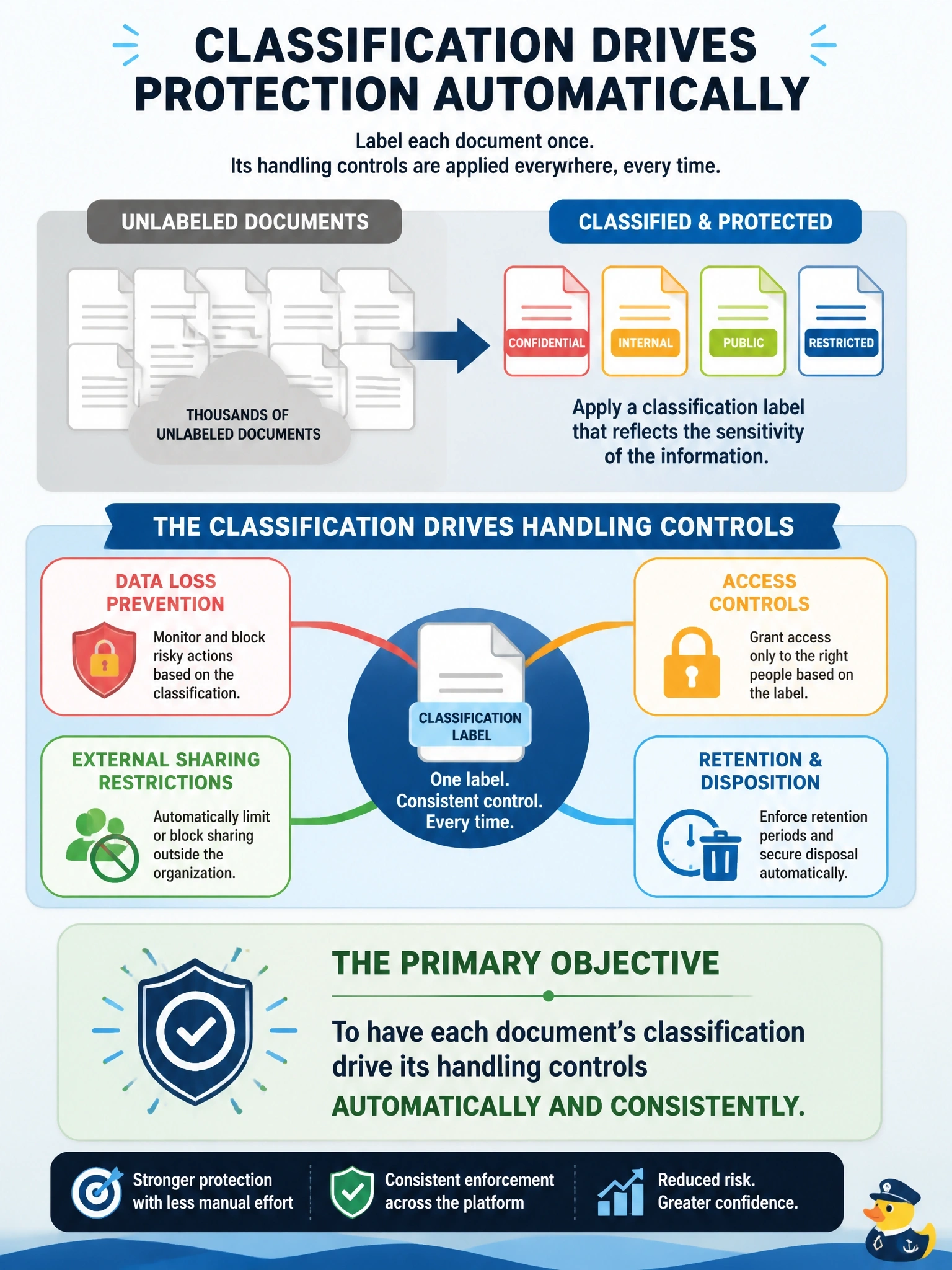
A collaboration platform holds thousands of unlabeled documents. The information security manager proposes requiring classification labels so that data loss prevention and external sharing restrictions are applied automatically according to each label. What is the PRIMARY objective of this approach?
Select an answer to reveal the explanation.
Short Explanation
It's like a luggage tag that tells the conveyor belt which plane the bag goes on. The label is there so your controls can handle each document the right way automatically, and it doesn't take the owner out of the loop.
Full Explanation
Label-based enforcement connects classification to technical controls. When documents carry classification labels, tools such as data loss prevention and sharing restrictions can read the label and apply the handling rules defined for that level, so protection is consistent, scalable and less dependent on each user remembering the rules at the moment of sharing. On a platform with thousands of documents, that consistency is the main benefit and the reason classification is worth applying to unstructured content. Identifying which employees create the most sensitive documents is not the purpose; labeling is about protecting information, and treating it as a way to profile staff misstates its objective. Labels do not remove data owners from classification decisions; owners remain accountable for how their information is classified, although tooling can suggest or default labels for them to confirm. Detecting duplicates to reduce storage is a records management or cost objective unrelated to classification labels. Exam caveat: automated enforcement is only as good as the accuracy of labels, so quality checks on labeling matter. Operational check: confirm that each label maps to a defined set of enforced handling rules and sample labeled documents to verify the rules actually apply.