
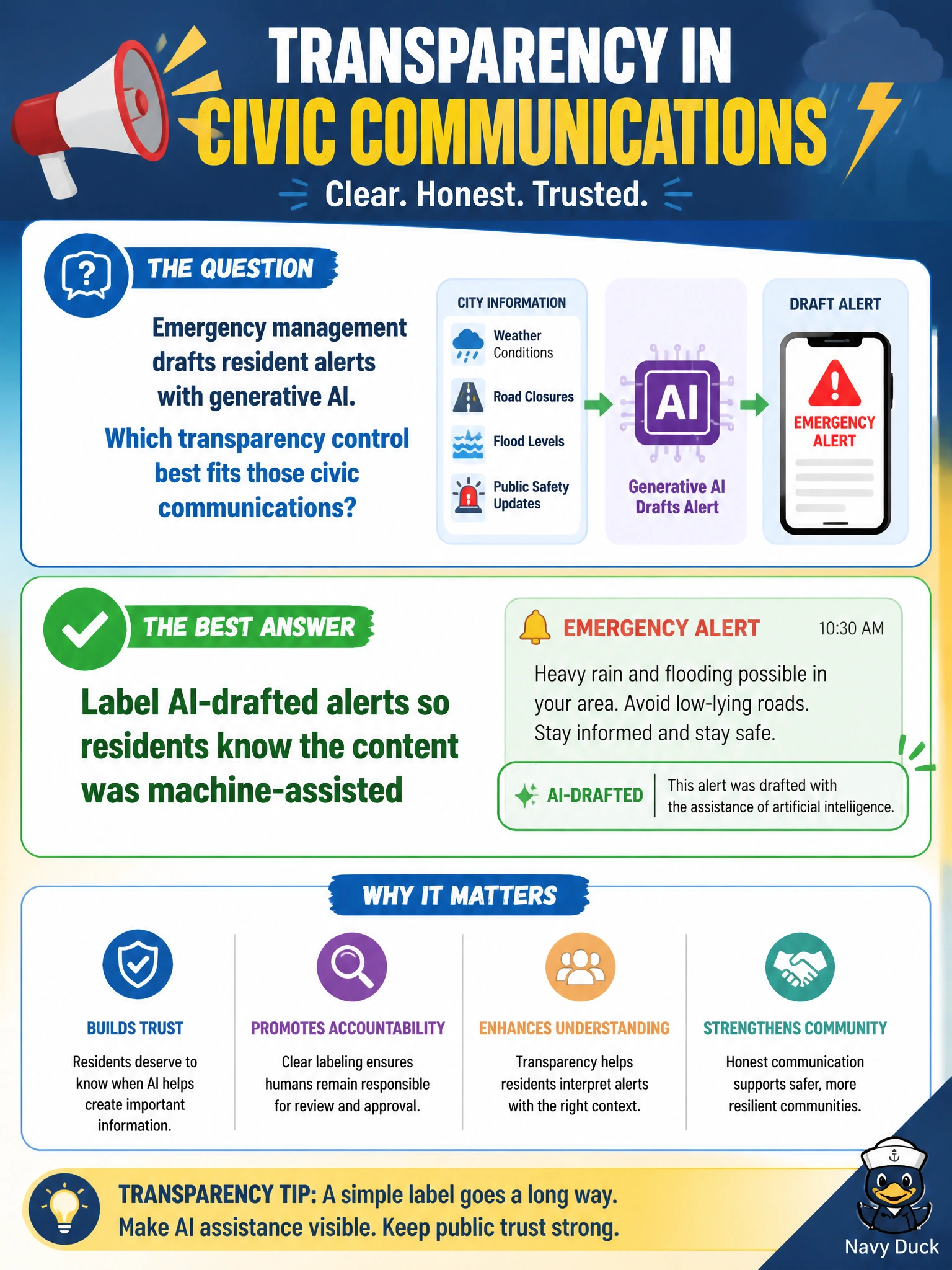
Emergency management drafts resident alerts with generative AI. Which transparency control best fits those civic communications?
Select an answer to reveal the explanation.
Short Explanation
If the city’s alert had a machine assist, say so. A clear label on AI-drafted emergency notices keeps residents in the loop without watering down the message.
Full Explanation
Labeling AI-drafted resident emergency alerts is the transparency control that fits civic mass communications: residents deserve to know when machine assistance shaped notice text that may drive evacuation, shelter, or hazard actions. The correct practice works because disclosure preserves informed trust without blocking rapid drafting—humans still approve content, and the label documents machine assistance as a fact about authorship, not a claim that the message is optional or less urgent. Disclosing AI drafting in post-event summaries for resident transparency review fails as the transparency control here because it delays disclosure until after the emergency; residents receiving alerts need to know about machine-assisted authorship at the moment they decide on evacuation, shelter, or hazard actions, not in a later review document. Embedding hidden provenance metadata in alerts for resident verification systems fails because it keeps the disclosure invisible to ordinary readers; residents receiving emergency alerts never see it without special tools, so it does nothing to plainly inform the public about machine-assisted authorship at the moment it matters. Describing model architecture in alerts so residents assess output trust fails because it dumps engineering detail into a life-safety message instead of telling residents plainly that AI helped draft it; emergency notices need a simple authorship disclosure, not a technical explanation of how the model works. Exam caveat: labeling assistance is not the same as asserting every token was machine-generated, nor does a label replace human review for factual accuracy in life-safety alerts. Operational check: embed a fixed disclosure string in the emergency-alert template, require human sign-off before publish, log which drafts used generative AI, and sample released notices to confirm the label appears whenever the drafting workflow was machine-assisted.
Prefer to study offline? Printable PDF study book + test engine ($7.50, unofficial). These questions stay free here.