
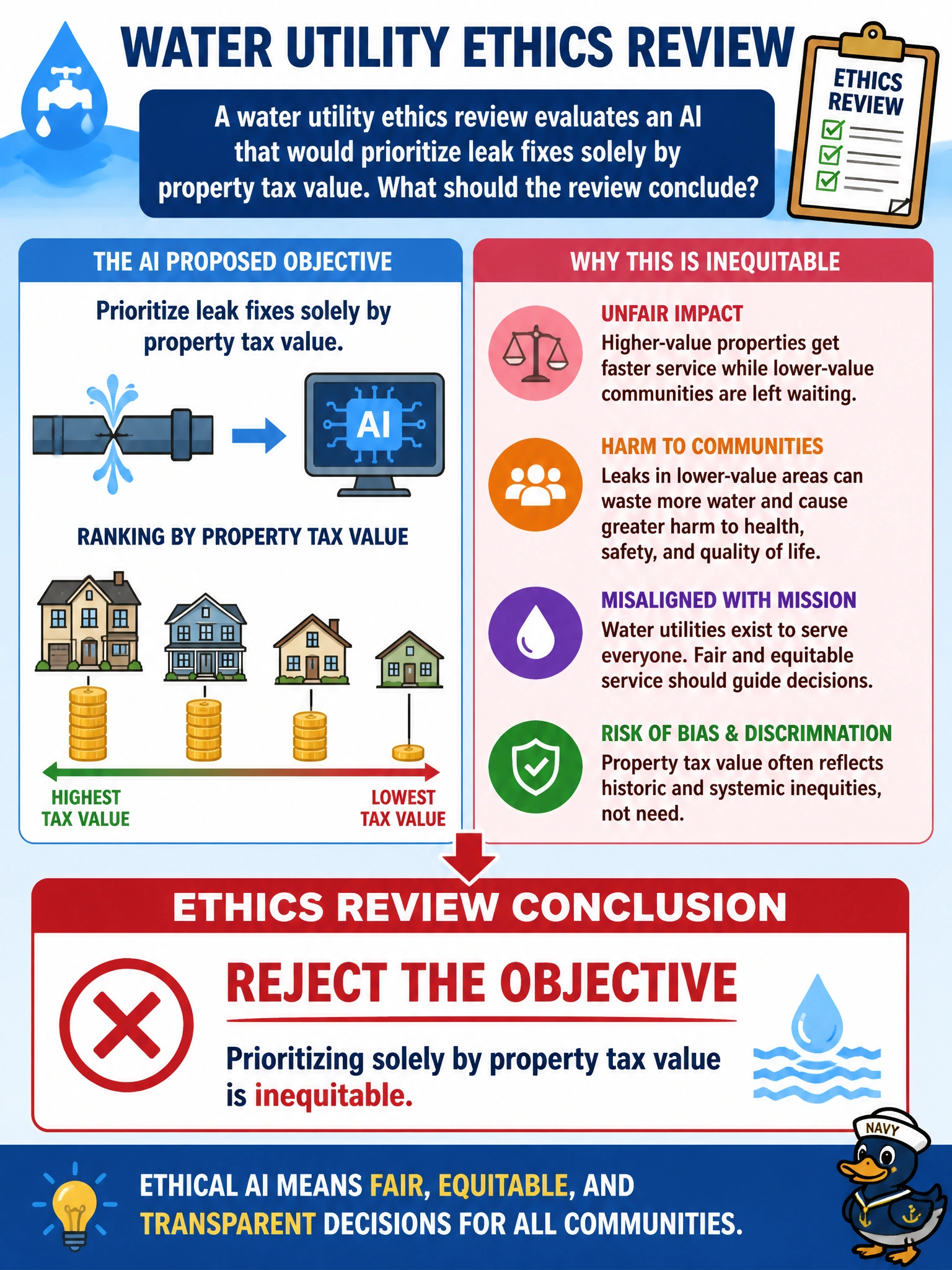
A water utility ethics review evaluates an AI that would prioritize leak fixes solely by property tax value. What should the review conclude?
Select an answer to reveal the explanation.
Short Explanation
Fixing leaks by who pays the most tax is a fairness fail, even when you've got SHAP to explain it. You'll reject that objective before it's wired into work orders, not run a constrained pilot watching demographic parity and leakage recurrence. Counterfactual tests and transparency reports don't fix it when you're still making poorer blocks wait longer.
Full Explanation
An ethics review of a water-utility AI that would prioritize leak fixes solely by property tax value should reject that objective because it encodes wealth as urgency and systematically deprioritizes lower-valued parcels that may still face severe water loss, contamination risk, or service disruption. The correct conclusion works because civic AI objectives are normative choices: a numeric proxy that is easy to optimize remains inequitable if it reallocates scarce repair capacity away from need, vulnerability, or public-health impact. Remediating the objective by adding SHAP explanations for tax-value-based leak prioritization fails conceptually — explaining how tax value influenced the ranking does not change the inequitable rule itself, and interpretability still leaves lower-valued parcels systematically deprioritized for repairs that should be driven by need and infrastructure data. Advancing to a constrained pilot while monitoring demographic parity and leakage recurrence rates fails for the same reason: residents in the pilot area are still exposed to a known tax-value-driven scorer during the trial, and measuring demographic parity and recurrence after some neighborhoods have already waited longer for repairs does not undo that inequity — fairness needs to be solved before deployment, not monitored during it. Permitting the ranking with counterfactual fairness testing and public transparency reporting fails because testing and reporting do not cure the inequitable objective — documenting disparate delay for lower-valued parcels still leaves those parcels waiting longer for repairs that should be allocated by need, vulnerability, or public-health impact. Exam caveat: rejecting a sole tax-value objective does not forbid using assessed value as one feature among many if need, leak severity, and equity weights dominate; the failure mode is sole or decisive use of tax value as the ranking rule. Operational check: require ethics sign-off on objective functions before training, document rejected proxies, define equity and need metrics for leak prioritization, and audit ranked work orders for disparate delay by neighborhood wealth.
Prefer to study offline? Printable PDF study book + test engine ($7.50, unofficial). These questions stay free here.