
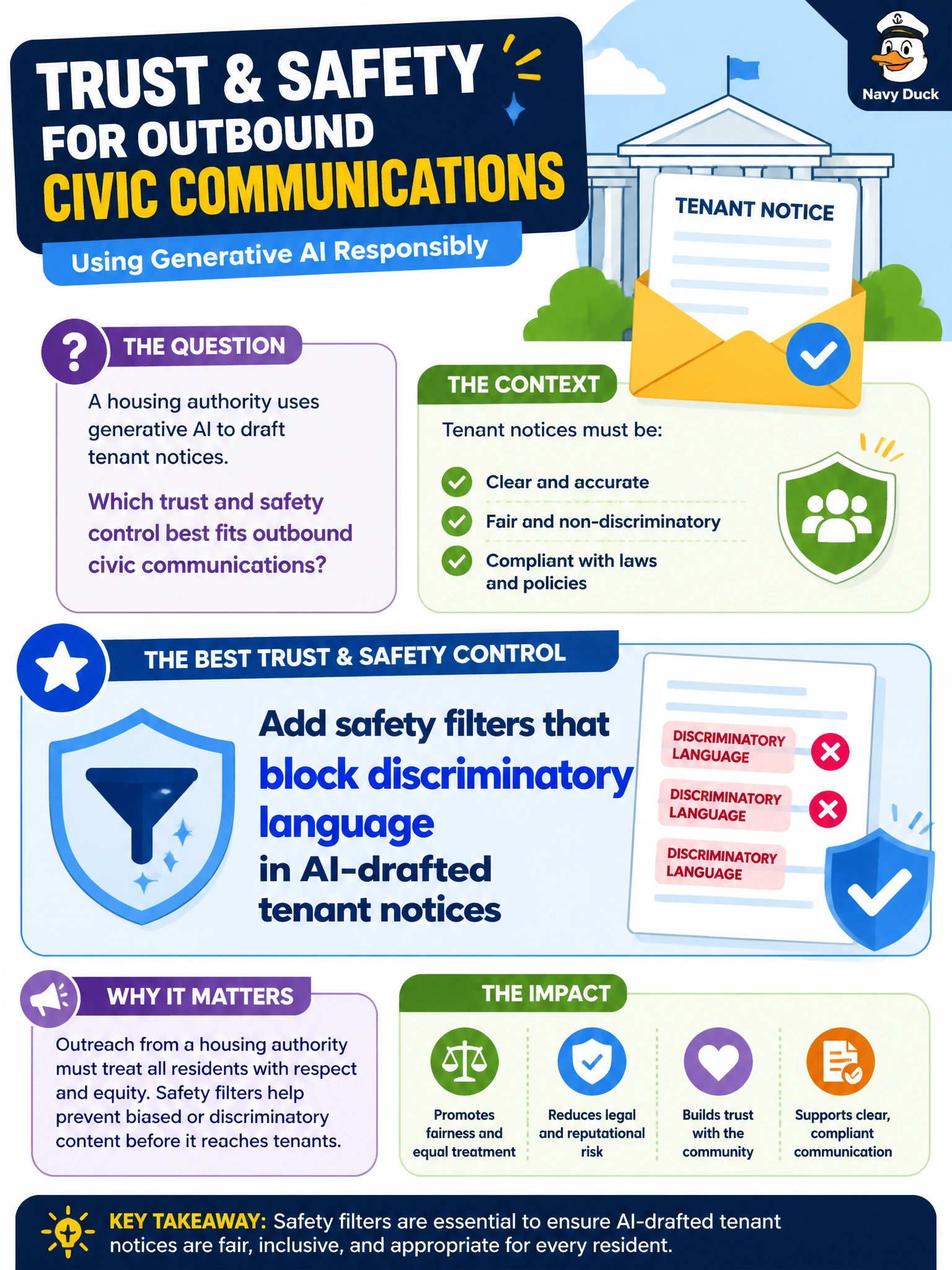
A housing authority uses generative AI to draft tenant notices. Which trust and safety control best fits outbound civic communications?
Select an answer to reveal the explanation.
Short Explanation
Tenant notices go out with the city’s name on them. Put safety filters on the drafts so discriminatory language never makes it past the gate—probing training datasets for pretraining bias won't screen that outbound notice before you send it.
Full Explanation
Housing-authority generative AI that drafts tenant notices produces outbound civic communications carrying the organization’s authority and legal exposure. Safety filters that block discriminatory language prevent harmful phrasing from reaching tenants and reduce legal, reputational, and ethical damage before any notice is released. Applying input injection defenses tuned for resident-facing tenant chatbot queries protects an inbound chatbot interface, but it does nothing to screen outbound tenant notices for discriminatory language before release. Routing AI-drafted tenant notices for plain-language review for improved reading clarity may help readability, but it is not a safety control and will not block discriminatory content from reaching tenants. Running red-team evaluations that probe training datasets for pretraining bias risks addresses upstream pretraining bias, not a pre-release control that prevents harmful phrasing in outbound tenant notices. Exam caveat: trust-and-safety controls for generative municipal communications include content safety filtering before outbound release, especially where discrimination risk is foreseeable. Operational check: place pre-send safety filters on AI-drafted tenant notices, require human review for flagged drafts, log filter hits for continuous improvement, and prohibit unattended auto-send of generative housing notices to resident mailboxes.
Prefer to study offline? Printable PDF study book + test engine ($7.50, unofficial). These questions stay free here.