
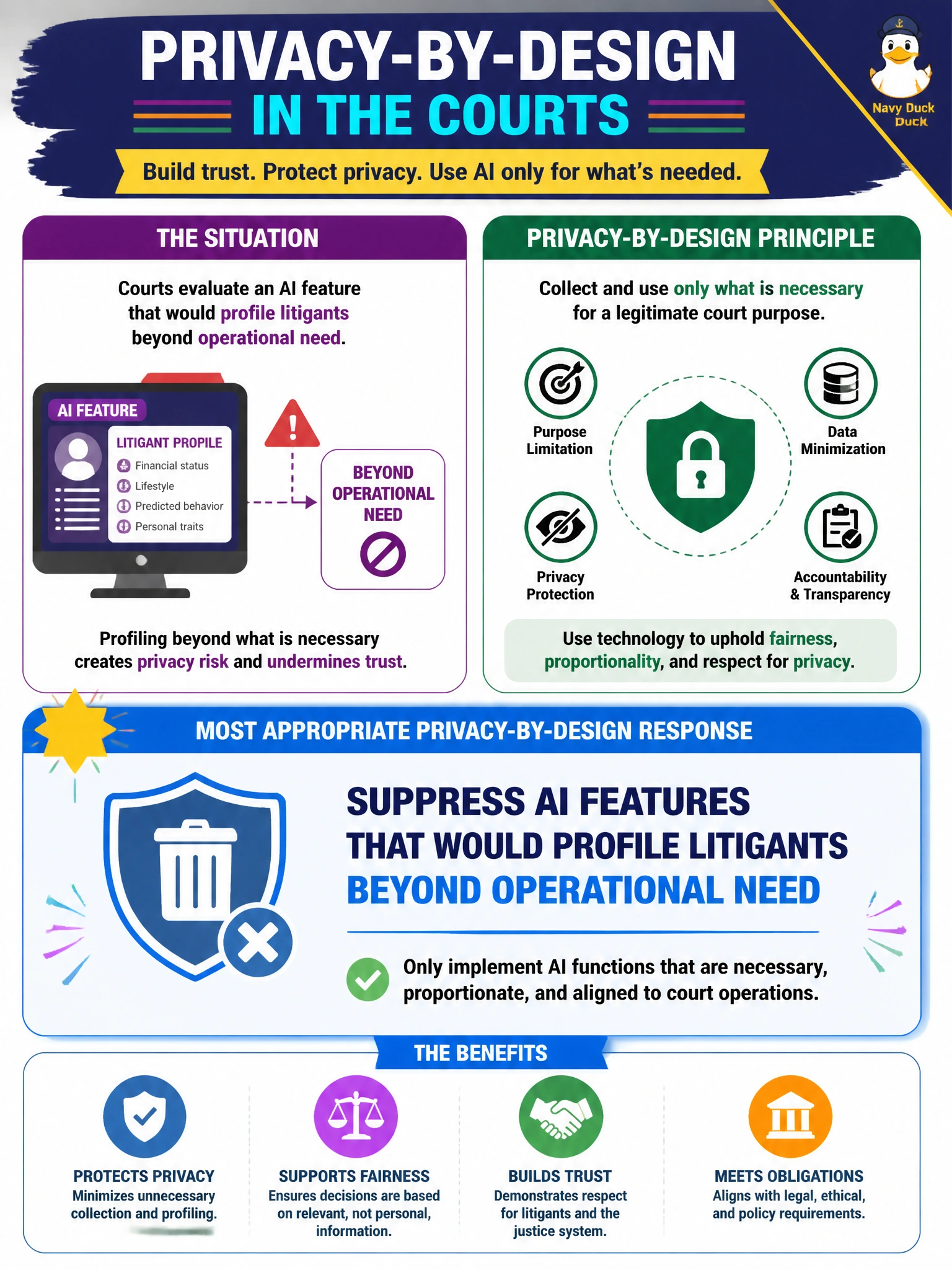
Courts evaluate an AI feature that would profile litigants beyond operational need. What privacy-by-design response is most appropriate?
Select an answer to reveal the explanation.
Short Explanation
Just because you can profile litigants doesn’t mean the courthouse should. Kill features that go past operational need—privacy-by-design means drawing the line before the data pile grows legs.
Full Explanation
Courts evaluating AI features that would profile litigants beyond operational need face a privacy-by-design decision: suppress the feature. Limiting profiling to what adjudication and case management actually require reduces unnecessary surveillance, discrimination risk, and data-retention burden. Retaining litigant profiling behind role-based access controls for staff still profiles beyond operational need and does not eliminate unnecessary surveillance merely because access is restricted. Pseudonymizing litigant identifiers while retaining behavioral profiles for review keeps the prohibited profiling in place and only masks identifiers, so it does not suppress the out-of-scope feature. Publishing profiling logic in transparency notices for litigant review discloses the method but does not stop the profiling itself, so transparency cannot substitute for suppressing a feature that exceeds operational necessity. Exam caveat: privacy-by-design for civic AI means refusing features that exceed operational necessity, not merely securing over-collected attributes after the fact. Operational check: challenge each proposed litigant attribute against a documented operational purpose, reject or suppress out-of-scope profiling features, minimize retention of approved attributes, and prohibit secondary commercial reuse of court AI profiling outputs.
Prefer to study offline? Printable PDF study book + test engine ($7.50, unofficial). These questions stay free here.