
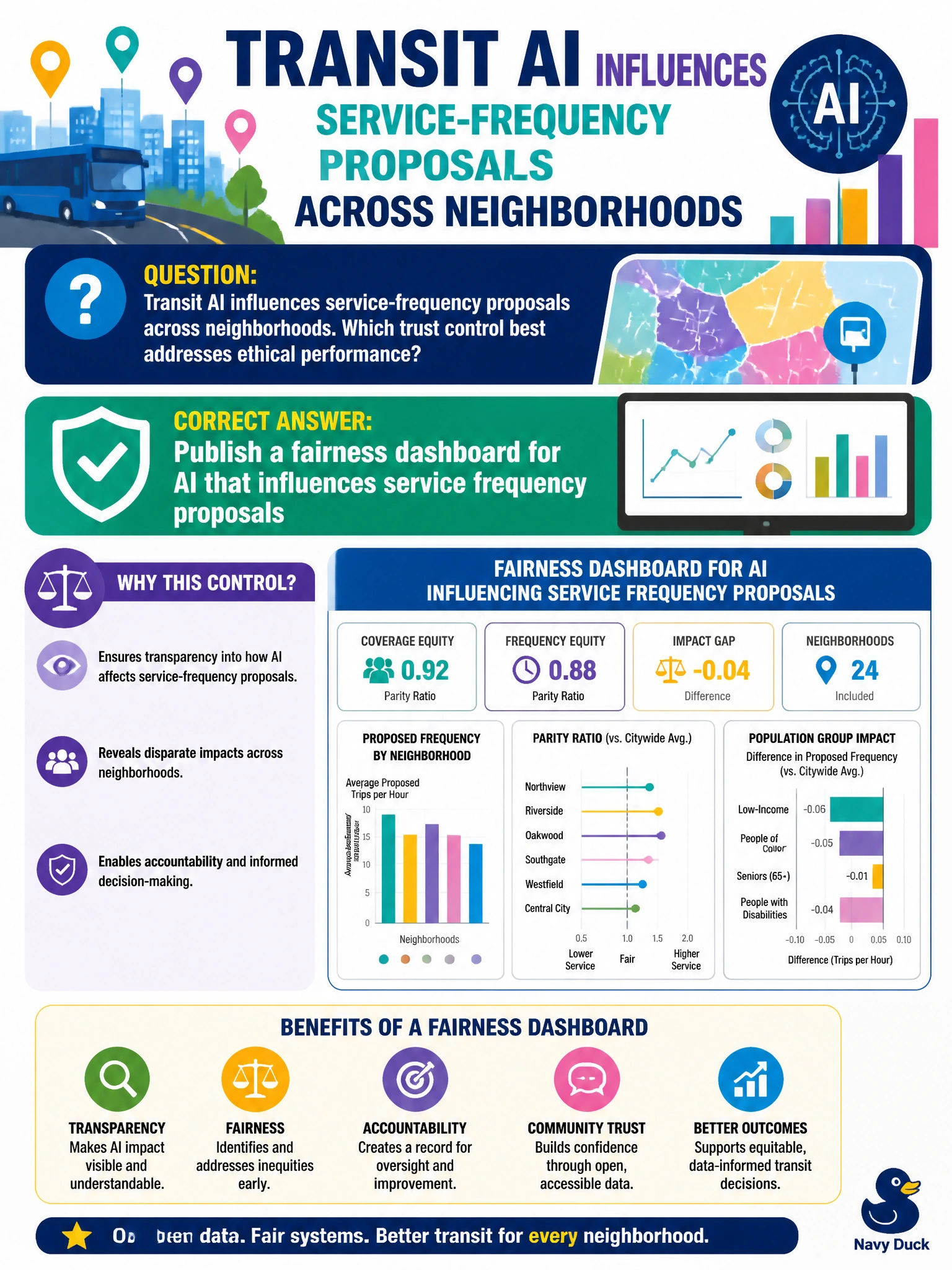
Transit AI influences service-frequency proposals across neighborhoods. Which trust control best addresses ethical performance?
Select an answer to reveal the explanation.
Short Explanation
A privacy dashboard for AI that influences service frequency proposals shows you how data is protected, but it won’t show you whether frequency proposals are fair across neighborhoods. A robustness dashboard tells you it’ll stay stable under stress, but it won’t show you whether service changes treat neighborhoods equitably. An accuracy dashboard shows you overall prediction hits, but it won’t reveal whether wait times and access are fairly distributed.
Full Explanation
Transit AI that influences service-frequency proposals can redistribute wait times and access across neighborhoods. Publishing a fairness dashboard makes disparate impacts visible to planners, boards, and the public so ethical performance is monitored continuously rather than asserted once in a briefing deck. Publishing a privacy dashboard for AI that influences service frequency proposals shows how rider data is protected, but it does not surface neighborhood-level fairness gaps in service-frequency proposals, so it cannot provide the public ethical accountability this question requires. Publishing an accuracy dashboard for AI that influences service frequency proposals reports overall prediction correctness, but it does not reveal whether AI-driven frequency proposals fairly distribute wait times and access across neighborhoods. Publishing a robustness dashboard for AI that influences service frequency proposals addresses model stability under stress and edge cases, but it does not supply the continuous, visible fairness oversight required for service-frequency proposals. Exam caveat: trust controls for civic AI that shapes public services include transparent, ongoing fairness measurement rather than one-time briefings or static slideware alone. Operational check: define neighborhood fairness metrics for frequency proposals, publish a maintained dashboard with a stated refresh cadence, review gaps in governance forums, and bind material disparity thresholds to redesign or mitigation actions before proposals advance to decision makers.
Prefer to study offline? Printable PDF study book + test engine ($7.50, unofficial). These questions stay free here.