
Public-health AI flags clinics for extra inspection. Which privacy, ethics, and trust control should management demand?
Select an answer to reveal the explanation.
Short Explanation
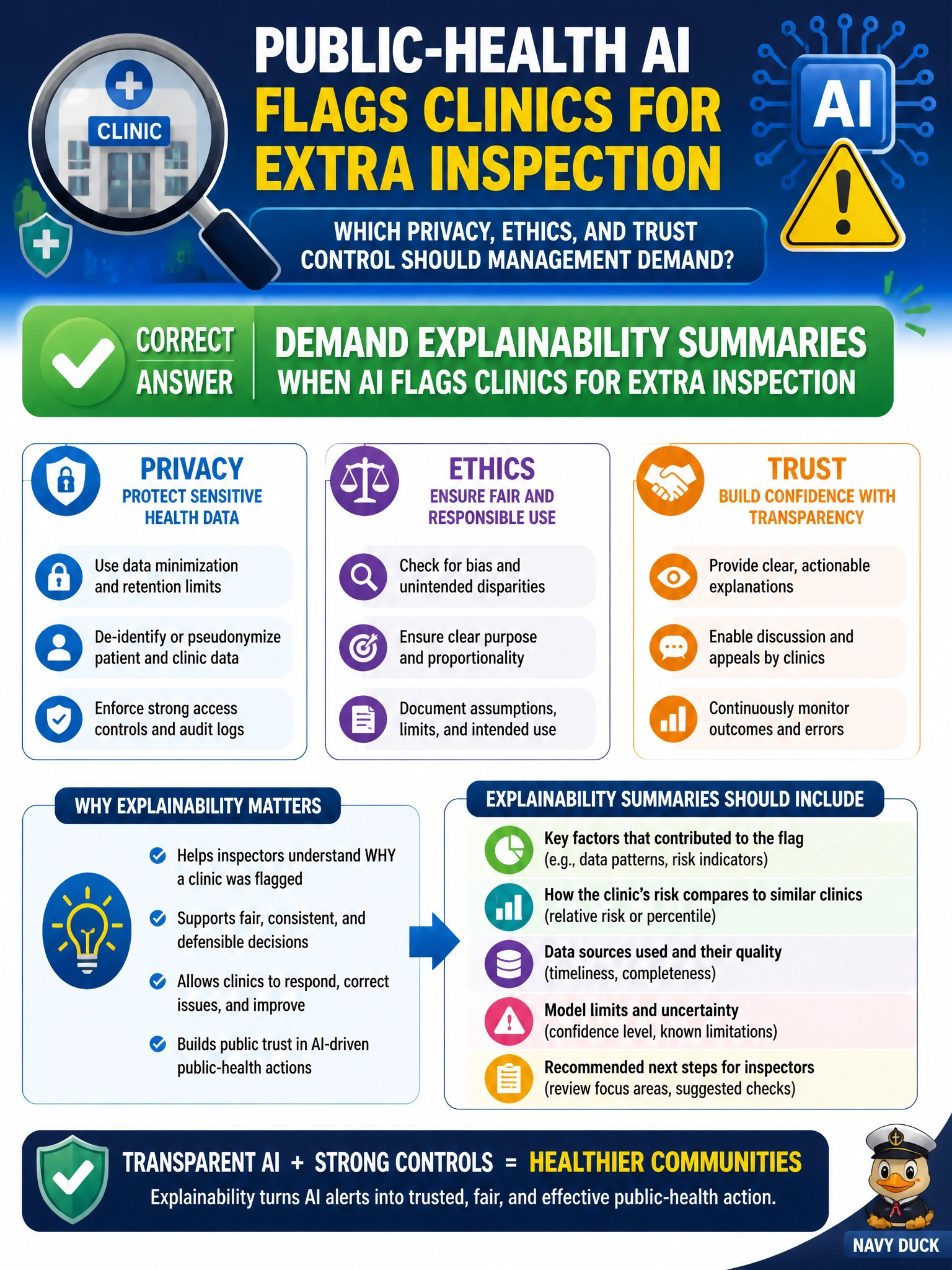
If a clinic gets flagged for extra inspection, model version and training data lineage alone won't tell you why. Ask for explainability summaries so reviewers can see why the model pointed there.
Full Explanation
Public-health AI that flags clinics for extra inspection affects regulated entities’ burden, reputation, and resource allocation. Demanding explainability summaries for those flags enables inspectors and oversight stakeholders to understand driving factors, spot spurious correlations, and defend or challenge the action with reasoned judgment. Publishing aggregated fairness metrics for flagged clinics quarterly supports broad oversight, but it does not give inspectors the case-specific explainability needed to understand, defend, or contest a particular flag. Applying differential privacy noise to published clinic inspection statistics protects published aggregates, but it does not provide the per-flag rationale needed for accountable inspection decisions. Attaching model version and training data lineage to the flagged clinic record documents provenance, but it does not give reviewers the explainability needed to judge why that clinic was flagged. Exam caveat: ethics and trust controls for consequential civic AI include explainability sufficient for human reviewers to understand and contest automated flags. Operational check: require human-readable explainability summaries with each clinic inspection flag, retain them with case records, train inspectors on interpreting limitations, and escalate opaque or unstable explanations for model review before enforcement weight increases.
Prefer to study offline? Printable PDF study book + test engine ($7.50, unofficial). These questions stay free here.