
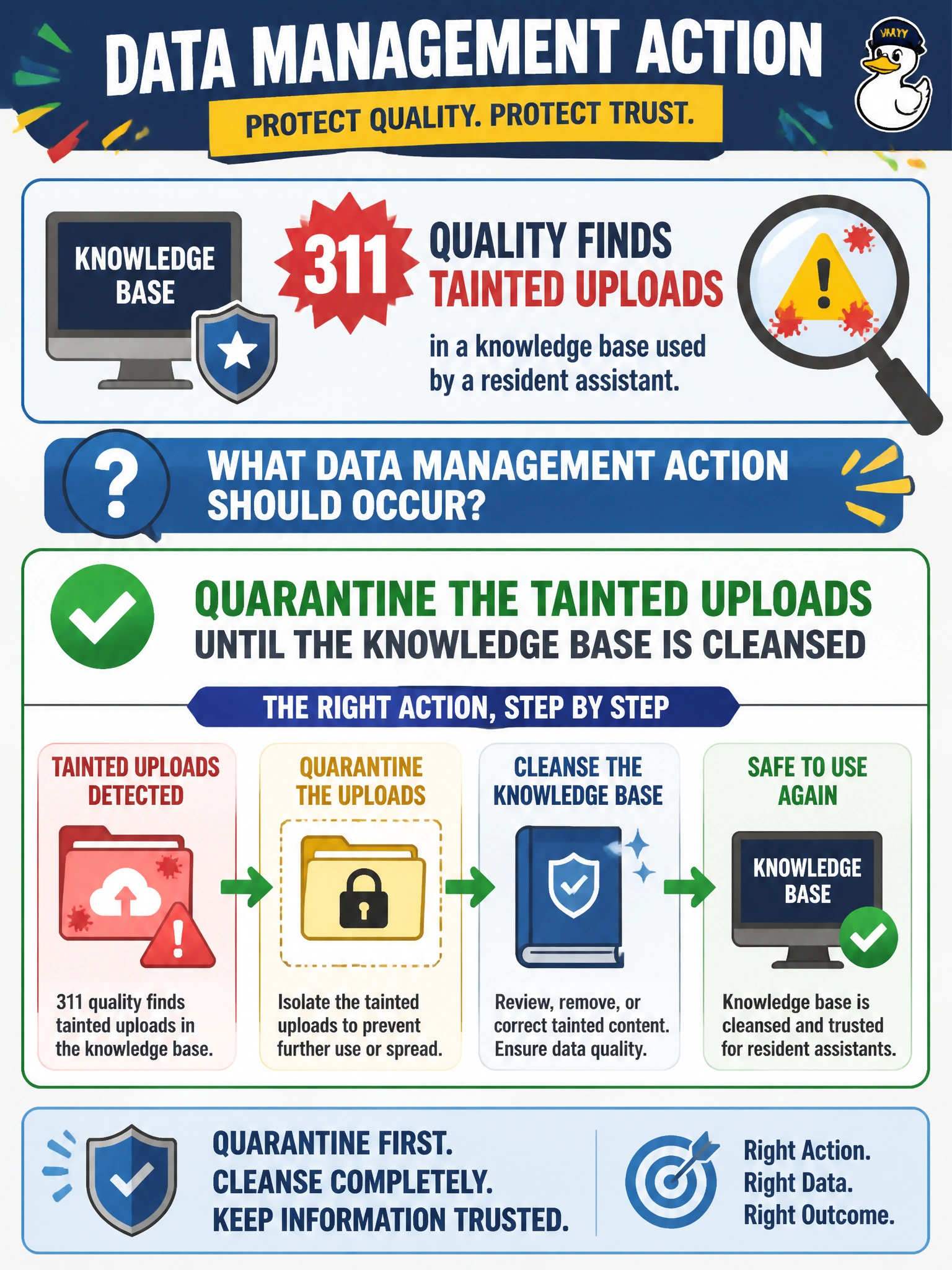
311 quality finds tainted uploads in a knowledge base used by a resident assistant. What data management action should occur?
Select an answer to reveal the explanation.
Short Explanation
Contaminated knowledge is like spoiled milk in the fridge—pull it off the shelf. Quarantine those tainted uploads until the corpus is cleansed so 311 isn’t serving bad guidance.
Full Explanation
When 311 quality finds tainted uploads in a knowledge base used by a resident assistant, integrity of answers is immediately at risk. Quarantining those uploads until the corpus is cleansed stops the assistant from retrieving and amplifying contaminated guidance while investigation and remediation proceed under change control. Versioning the tainted uploads for audit before knowledge base purge fails to contain the risk, since versioning preserves history but leaves the contaminated content retrievable by the assistant until the purge occurs. Annotating the tainted uploads with quality flags to guide retraining fails to isolate the bad content, since flags do not block retrieval and feeding tainted examples into retraining risks baking the contamination into future models. Reindexing the knowledge base to refresh embeddings before the cleanse does not remove the tainted uploads and may simply re-embed contaminated content, since reindexing must follow quarantine and cleansing to be effective. Exam caveat: AI knowledge-base integrity incidents require containment through quarantine and cleansing as data-management actions, analogous to poisoned-content incident response. Operational check: move tainted 311 articles to a quarantine collection that retrieval cannot see, ticket root cause and scope, cleanse or rebuild affected chunks and embeddings, revalidate priority intents, and only then restore content with change records.
Prefer to study offline? Printable PDF study book + test engine ($7.50, unofficial). These questions stay free here.