
Permitting plans to release a plan-check assistant. Which validation practice best fits consequential civic decisions?
Select an answer to reveal the explanation.
Short Explanation
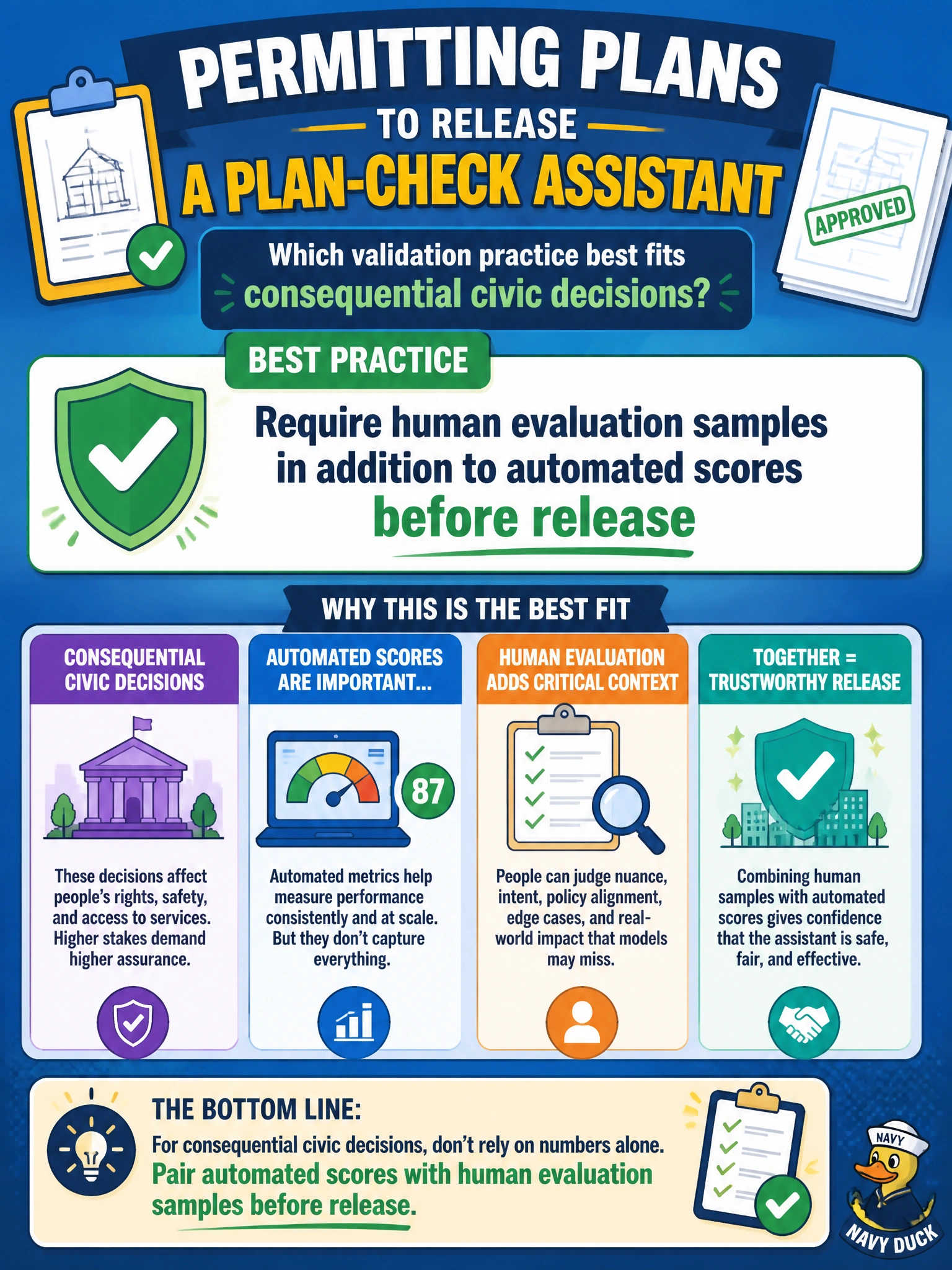
Automated scores are handy, but plan-check drafts still need human eyes. You sample real reviews before release so the assistant isn't graded only by a metric or by accepting the vendor's reports and attestations as validation. You'll find pilot satisfaction doesn't show whether drafts are correct, safe, and fair.
Full Explanation
Permitting plan-check assistants influence consequential civic decisions—what gets approved, delayed, or denied for applicants. Automated scores such as BLEU or accuracy can quantify surface similarity, but they do not reliably catch unsafe guidance, missed code issues, or tone that misleads applicants. Requiring human evaluation samples in addition to automated metrics before release closes that gap by having qualified reviewers judge realistic plan-check drafts against municipal criteria. Running automated regression checks for plan citation accuracy before release creates the same false-precision problem: a check that confirms the assistant cites the right code section says nothing about whether the surrounding guidance is safe or likely to mislead an applicant, and it still skips the human judgment that review of realistic drafts provides. Accepting vendor benchmark reports and security attestations as validation before release fails similarly: it still leans on the vendor's own paperwork rather than the municipality's independent evaluation of how the assistant performs against local permitting criteria, which is what buyer due diligence requires here. Using pilot applicant satisfaction scores as validation evidence before release fails on substance: satisfaction reflects how applicants felt in a pilot, not whether drafts were correct, safe, and fair against code, so it cannot substitute for qualified human evaluation of realistic samples. Exam caveat: for high-impact civic AI, AAISM-aligned validation pairs quantitative metrics with human evaluation of representative, consequential samples. Operational check: define a permitting eval set with human scoring rubrics for correctness, safety, and fairness; gate release on both metric thresholds and human-sample pass rates, and retain the evidence package for audit.
Prefer to study offline? Printable PDF study book + test engine ($7.50, unofficial). These questions stay free here.