
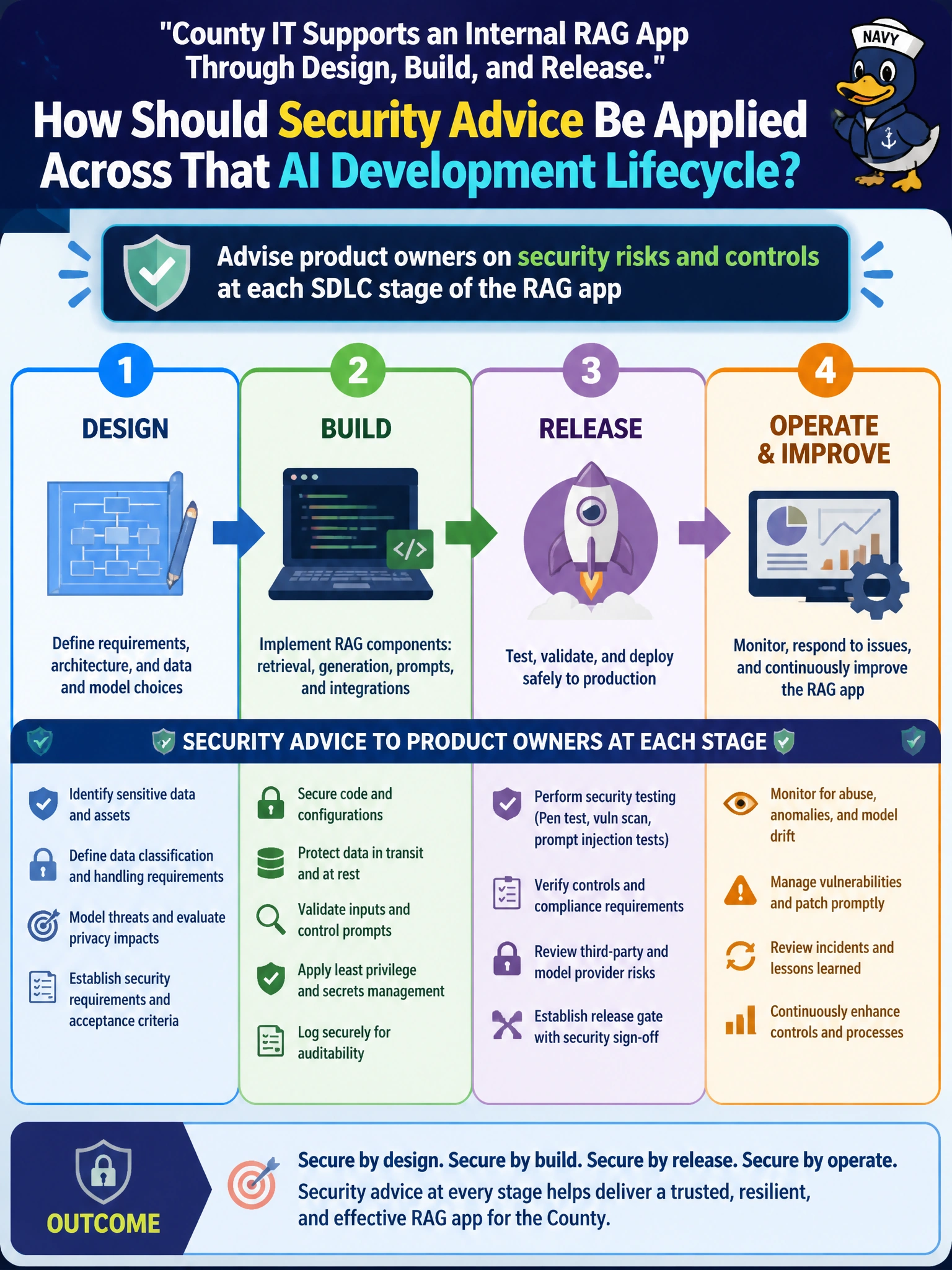
County IT supports an internal RAG app through design, build, and release. How should security advice be applied across that AI development lifecycle?
Select an answer to reveal the explanation.
Short Explanation
You can't swap security for latency benchmarks and still cover the RAG app's risks. You'll miss lifecycle decisions when you advise on each inference cycle, and you'll lose accountability when you brief data vendors who can't accept product risk. Walk the RAG app stage by stage—design, build, test, release—so each risk gets the right control before it hardens into production debt.
Full Explanation
County IT supporting an internal RAG app must apply security advice across design, build, test, and release—not as a single kickoff artifact. Each SDLC stage introduces different AI-specific risks: architecture and data classification in design; retrieval grounding, secret handling, and prompt injection hardening in build; evaluation of hallucination and access control in test; change management and monitoring at release. Advising product owners at each stage keeps controls proportional and timely so defects are cheaper to fix and residual risk is explicit before production. Advising product owners on latency benchmarks and controls at each SDLC stage keeps the right audience and cadence but substitutes performance for security, leaving retrieval poisoning, over-broad permissions, and weak tenancy boundaries ungoverned across design, build, test, and release. Advising product owners on security risks and controls at each inference cycle confuses runtime operations with lifecycle governance; per-inference handling is not stage-appropriate SDLC advice, and it leaves design, build, and release decisions like data classification, grounding controls, and change management without timely direction. Advising data vendors on security risks and controls at each SDLC stage misplaces accountability; external vendors do not own the county RAG app's risk decisions, so without product-owner ownership, stage gates advance without explicit risk acceptance and timely course correction. Exam caveat: AAISM lifecycle management expects continuous, stage-appropriate security counsel for AI solutions, not waterfall-end security theater. Operational check: map each RAG stage to required reviews (data inventory, threat model, eval gates, release checklist) and require signed risk acceptance before the county RAG app advances.
Prefer to study offline? Printable PDF study book + test engine ($7.50, unofficial). These questions stay free here.