
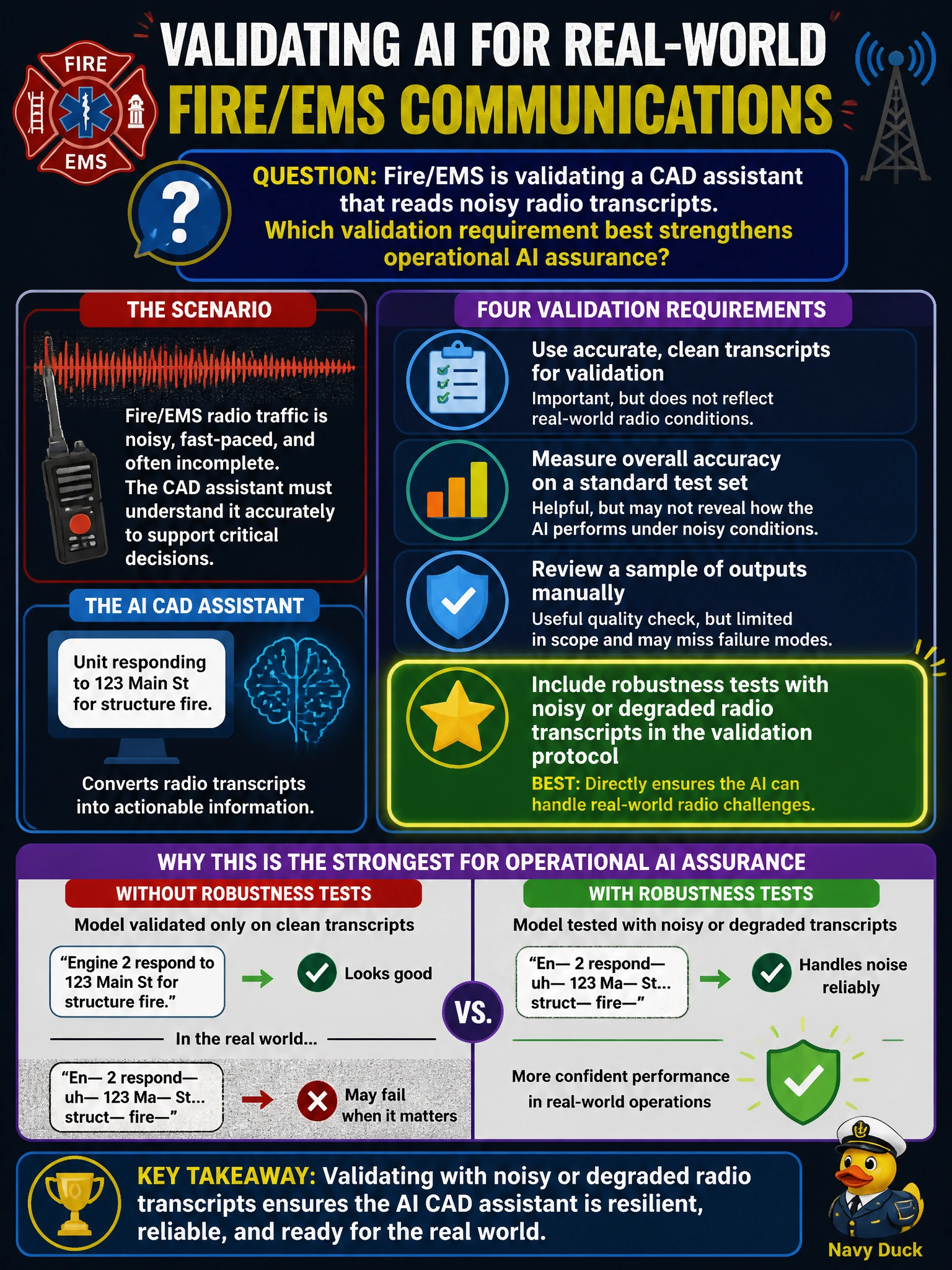
Fire/EMS is validating a CAD assistant that reads noisy radio transcripts. Which validation requirement best strengthens operational AI assurance?
Select an answer to reveal the explanation.
Short Explanation
Field radios are messy—static, overlaps, half-heard calls. You’ve got to build those messy samples into validation so the CAD assistant proves it can handle unseen real noise, since training-data scores don’t prove that.
Full Explanation
Fire/EMS CAD assistants that consume radio transcripts operate in acoustically hostile environments: overlapping talk groups, sirens, clipping, accents, and degraded RF. Operational AI assurance therefore requires the validation protocol to include robustness tests with noisy or degraded transcripts that mirror dispatch reality, not laboratory audio. Passing under those conditions demonstrates that intent extraction and call triage remain reliable when lives depend on comprehension. Scoring transcription accuracy on noisy radio transcripts with training data for acceptance testing creates a false assurance gap—the model may memorize training samples and pass acceptance testing but still fail on unseen noisy, degraded radio transcripts. Rating dispatcher preference for noisy radio transcript outputs in usability scoring is a useful design signal, but it does not test whether the assistant can accurately transcribe noisy or degraded radio traffic under operational conditions. Logging noise profiles from degraded radio transcripts in audit trails for validation documentation supports compliance traceability, but it does not demonstrate that the CAD assistant handles noisy radio transcripts reliably in the field. Exam caveat: for consequential civic AI, validation scope must cover the operating environment’s degraded inputs with held-out data, not just scoring transcription accuracy on training data for acceptance testing. Operational check: build a Fire/EMS validation set with labeled noisy radio samples, define pass/fail robustness thresholds for critical intents, and withhold go-live until those thresholds are met under observed field conditions.
Prefer to study offline? Printable PDF study book + test engine ($7.50, unofficial). These questions stay free here.