
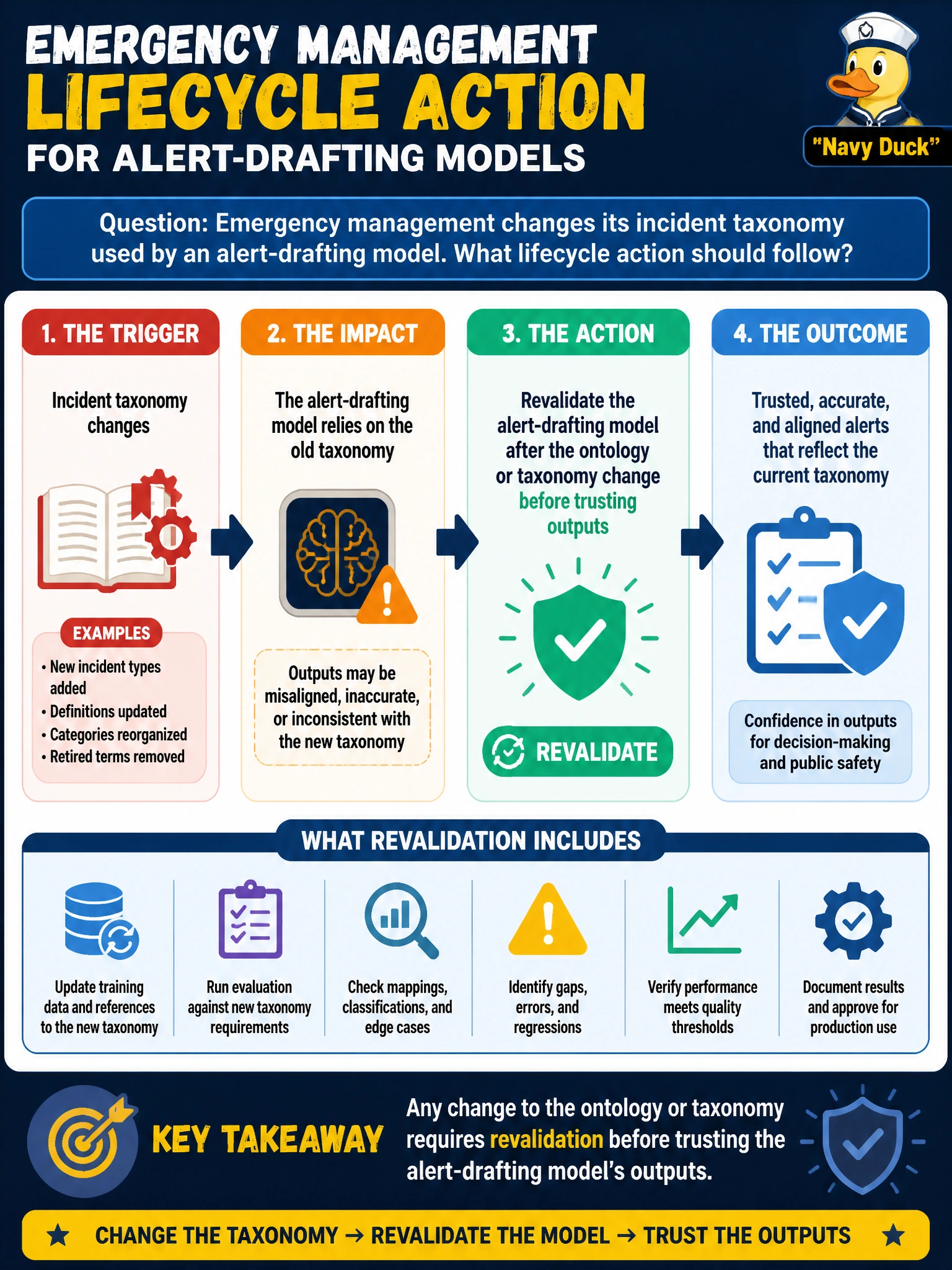
Emergency management changes its incident taxonomy used by an alert-drafting model. What lifecycle action should follow?
Select an answer to reveal the explanation.
Short Explanation
When the label dictionary changes, you’ve got to recheck the model—old habits may not match the new categories. Skip revalidation after a taxonomy shift and you’ll let wrong alerts slip through.
Full Explanation
Emergency-management alert-drafting models depend on the meaning of incident categories. When the incident taxonomy or ontology changes, the lifecycle action that should follow is revalidation of the alert-drafting model before trusting outputs under the new labels. Taxonomy shifts can change input interpretation, training label alignment, and downstream alert wording, so continuing without revalidation risks wrong or inconsistent emergency communications. Reassessing the alert-drafting model on the archived taxonomy benchmark to verify continued accuracy fails because the archived benchmark tests the old categories, not the revised labels; passing old tests does not prove the model handles the new taxonomy correctly. Revalidating the post-processing filter for the revised labels in the staging environment fails because filter-only checks do not verify that the alert-drafting model itself interprets and generates the new incident categories correctly. Piloting the alert-drafting model under the revised labels to gather operational reviewer feedback fails because informal piloting and feedback collection defers systematic revalidation rather than checking the model against the new taxonomy before trusting outputs. Exam caveat: Ontology/taxonomy changes are revalidation triggers in the AI lifecycle; testing on the archived benchmark, checking only the post-processing filter, or piloting for feedback is not a substitute for revalidation before trusting outputs. Operational check: After taxonomy updates, run regression tests on alert drafts across old and new categories, keep human review active until metrics clear, and record revalidation results with the model and taxonomy versions.
Prefer to study offline? Printable PDF study book + test engine ($7.50, unofficial). These questions stay free here.