
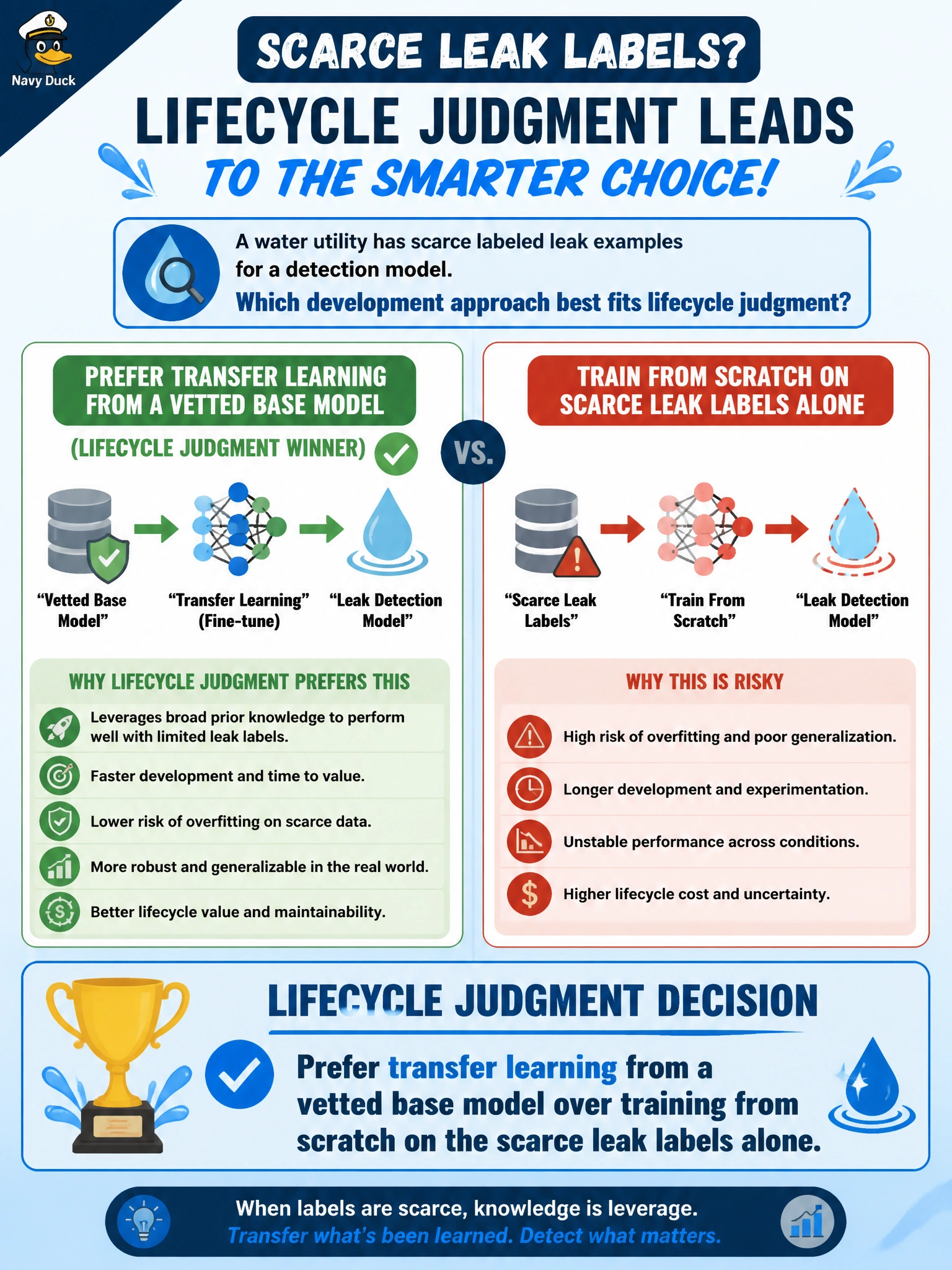
A water utility has scarce labeled leak examples for a detection model. Which development approach best fits lifecycle judgment?
Select an answer to reveal the explanation.
Short Explanation
With few leak labels, stand on a vetted base model’s shoulders instead of inventing everything from scratch. Training a custom detector from scratch on tiny data—even with strong regularization—won't cut it for water ops, and you'll get shakier pretraining from synthetic leaks that may miss real-world acoustics than from a vetted base. Deploying a generic acoustic model on normal-operation checks alone won't give you validated leak scoring until you've adapted it to your leak labels.
Full Explanation
Water utilities often have few labeled leak examples relative to what a large model needs from scratch. Preferring transfer learning from a vetted base model over training from scratch on scarce leak labels alone is the lifecycle judgment that reuses general representations while adapting to limited municipal labels, typically improving sample efficiency and avoiding brittle overfitting on a handful of incidents. Vetting the base model remains part of the security and supply-chain discipline.
Preferring strong regularization while training a custom detector from random initialization on scarce leak labels alone fails because regularization alone cannot create the missing leak signal needed for stable generalization, and it discards the useful general representations a vetted base model would provide. Preferring synthetic leak simulation for pretraining a custom model over transfer from a vetted base model fails because simulated leaks risk fidelity gaps to real municipal acoustics and bypass the proven representations and vetting of an approved base model. Preferring direct deployment of a generic acoustic base model for leak scoring using normal-operation checks alone fails because a generic model without leak-specific adaptation lacks validated detection performance for municipal leaks and skips controlled evaluation on the limited leak set.
Exam caveat: With scarce civic labels, transfer learning from vetted bases beats custom training from scratch on tiny sets—even with strong regularization—and beats synthetic-simulation pretraining or direct deployment of a generic base without leak-specific adaptation.
Operational check: Select a vetted base model from approved sources, fine-tune or adapt with the limited leak set under controlled eval, document provenance of weights, and don't deploy a generic base for leak scoring on normal-operation checks alone without leak-specific adaptation.
Prefer to study offline? Printable PDF study book + test engine ($7.50, unofficial). These questions stay free here.