
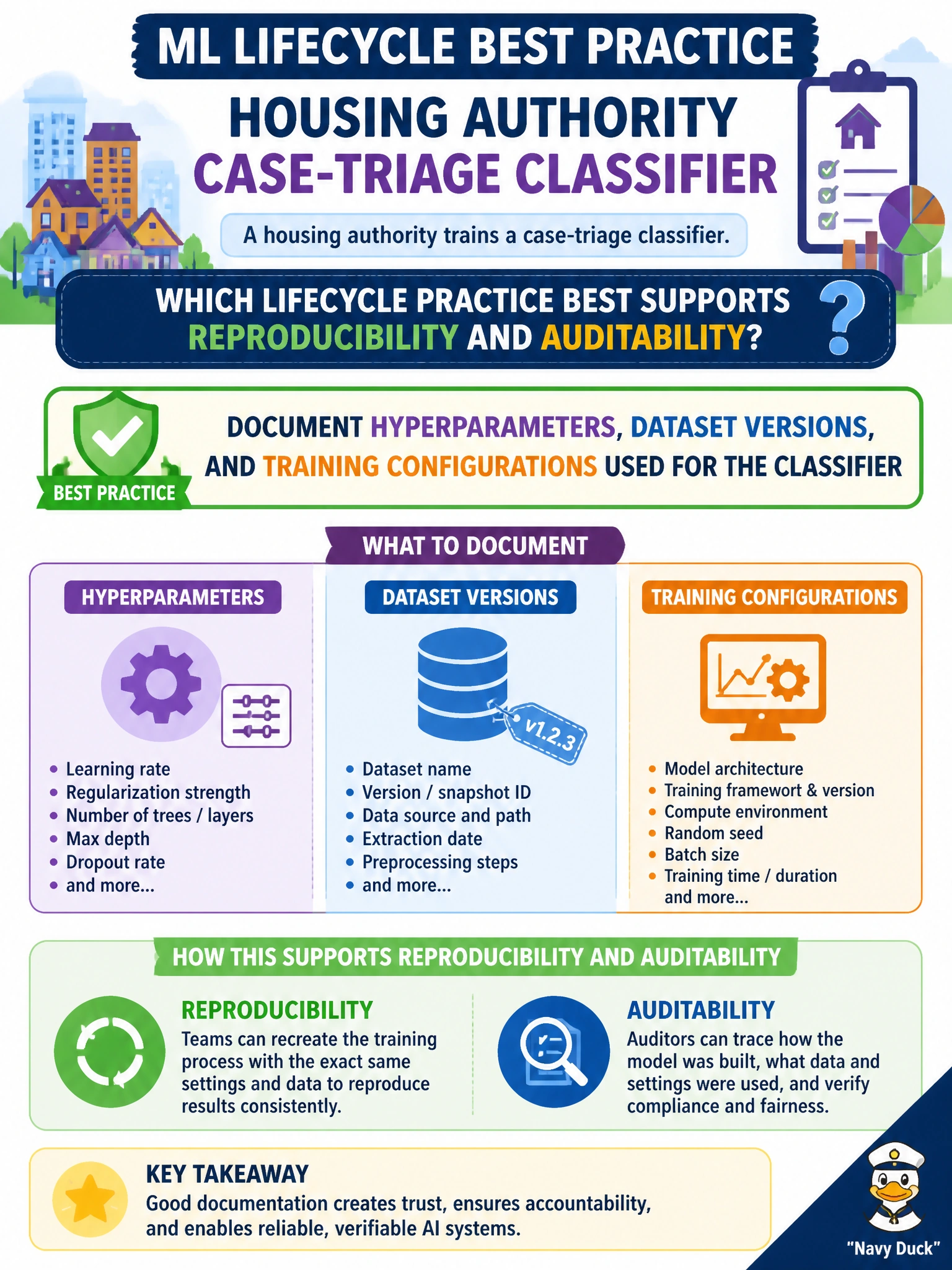
A housing authority trains a case-triage classifier. Which lifecycle practice best supports reproducibility and auditability?
Select an answer to reveal the explanation.
Short Explanation
Write down the recipe—dataset version, settings, the works—so someone can rebuild or audit the classifier later. Versioned dashboards, encryption with access logs, and tuning that only records scores won’t give you that rebuildable record.
Full Explanation
Housing-authority case-triage classifiers must be reproducible and auditable when residents or oversight bodies question outcomes. Documenting hyperparameters, dataset versions, and training configurations used for the classifier is the lifecycle practice that enables rebuilds, forensic comparison after incidents, and credible answers about what data and settings produced a given model. Without that documentation, municipal AI becomes folklore rather than a governed system. Relying on live prediction latency and error-rate monitoring with versioned dashboards for the classifier fails because even versioned dashboards track operational performance, not the dataset versions, hyperparameters, and training configurations needed to reproduce or audit the classifier. Encrypting training datasets and recording storage access with auditable logs for the classifier fails because those protect data and trace who accessed storage; they do not record or preserve the versions, hyperparameters, and configs required to rebuild or audit a specific model. Tuning hyperparameters with automated search and recording validation scores for the classifier fails conceptually because recording scores documents tuning outcomes but does not create the documented recipe of settings, dataset versions, and training configurations needed for reproducibility and audit. Exam caveat: Reproducibility and auditability hinge on documented hyperparameters, dataset versions, and configs—not versioned dashboards, encryption with auditable access logs, or tuning that only records validation scores. Operational check: Store dataset version IDs, hyperparameter files, and training configs in controlled repositories tied to model version tags; do not substitute versioned production monitoring, encryption with auditable logs, or automated tuning with recorded validation scores for those records; and require those artifacts before production promotion of the triage classifier.
Prefer to study offline? Printable PDF study book + test engine ($7.50, unofficial). These questions stay free here.