
An assessor’s office sees model skew after parcel data quality drops post-migration. What should AI vulnerability management recognize?
Select an answer to reveal the explanation.
Short Explanation
When parcel data goes sideways after a migration, the model starts leaning wrong—that’s skew/drift shouting for a fix. You'll misread it if you call those gaps concept drift that just needs retraining or call that skew calibration drift that just needs recalibration, because it's corrupt parcel inputs driving the bias. It's not adversarial drift either, so you'll waste time chasing attackers while your data stays broken.
Full Explanation
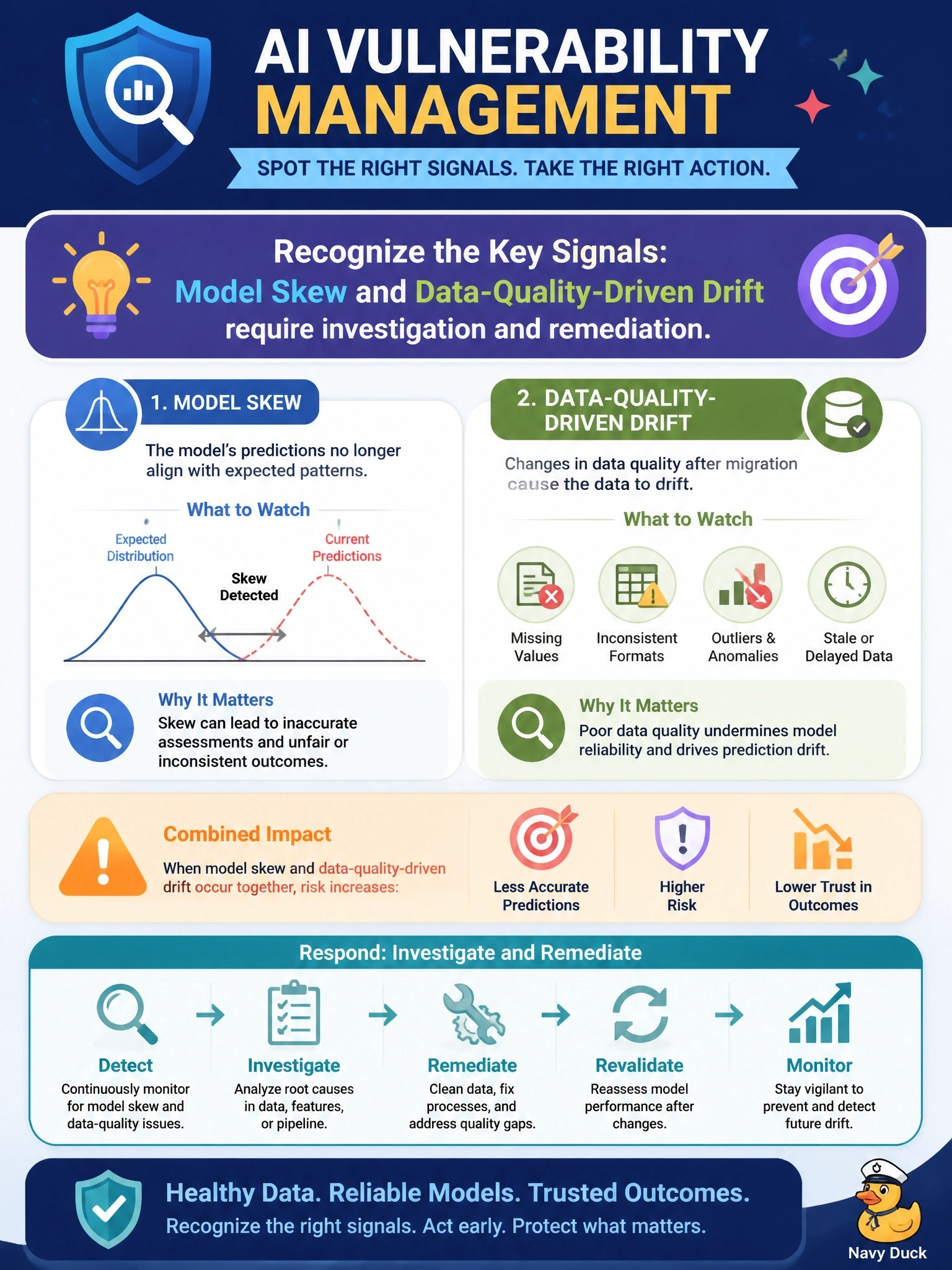
After parcel data quality drops post-migration, model skew and data-quality-driven drift are vulnerability-management signals requiring investigation and remediation. Valuation models inherit the statistical structure of their inputs; corrupted, incomplete, or shifted parcel attributes can systematically bias assessments, undermining fairness and fiscal integrity. Recognizing skew/drift as actionable model vulnerabilities works because treatment—data remediation, recalibration, constrained automation, and enhanced human review—depends on acknowledging the model’s dependence on trustworthy municipal data pipelines.
Treating parcel record gaps as concept drift signals requiring investigation and retraining fails because the gaps are data-quality-driven drift from defective migration inputs, not concept drift where the true input-output relationship has changed, and retraining on corrupted parcel data without remediating the source defects preserves the bias. Treating valuation skew as calibration drift signals requiring investigation and recalibration fails because the skew is driven by corrupted or shifted parcel inputs, not by miscalibrated probabilities, so recalibration alone does not remediate the defective data pipeline. Treating post-migration skew as adversarial drift signals requiring investigation and mitigation fails because the drift stems from accidental migration-related data-quality loss with no adversary, and adversarial mitigations will not remediate biased parcel inputs.
Exam caveat: not every metric move is poison—instrumentation changes can mimic drift—but unexplained skew after a data migration is a mandatory investigate-and-remediate trigger. Operational check: compare pre/post-migration feature distributions and valuation residuals, quarantine automated valuation where skew exceeds thresholds, remediate parcel data defects, retrain or recalibrate as needed, and require assessor sign-off before restoring full automation.
Prefer to study offline? Printable PDF study book + test engine ($7.50, unofficial). These questions stay free here.